
.avif)
.avif)

DevOps Outsourcing Guide 2026: Costs, Models & Best Practices


.svg)

Quick Summary: DevOps outsourcing means hiring an external team or provider to handle CI/CD pipelines, cloud infrastructure, automation, and monitoring instead of building an in-house team from scratch. It typically costs less and moves faster than hiring, but the right outcome depends on picking the right delivery model, vetting the provider's security practices, and keeping clear ownership of your systems. This guide walks through the models, real costs, a step-by-step outsourcing process, and the mistakes that tend to derail these engagements.
Hiring a senior DevOps engineer in 2026 is still brutally competitive. Salaries keep climbing, the skill set keeps expanding, and most companies need DevOps expertise long before they can justify a full in-house team. That gap is exactly why DevOps outsourcing has become such a common move for startups and enterprises alike.
But outsourcing DevOps isn't the same as outsourcing, say, customer support. DevOps teams touch production infrastructure, secrets, deployment pipelines, and sometimes customer data. Get the engagement wrong and it's not just a bad vendor relationship — it's a security incident waiting to happen. Get it right, though, and release cycles shrink, uptime improves, and engineering leaders stop losing sleep over infrastructure fires.
This guide covers what DevOps outsourcing actually involves, the delivery models worth considering, realistic cost ranges, a practical framework for getting started, and the pitfalls that trip up most first-time buyers.
What Is DevOps Outsourcing?
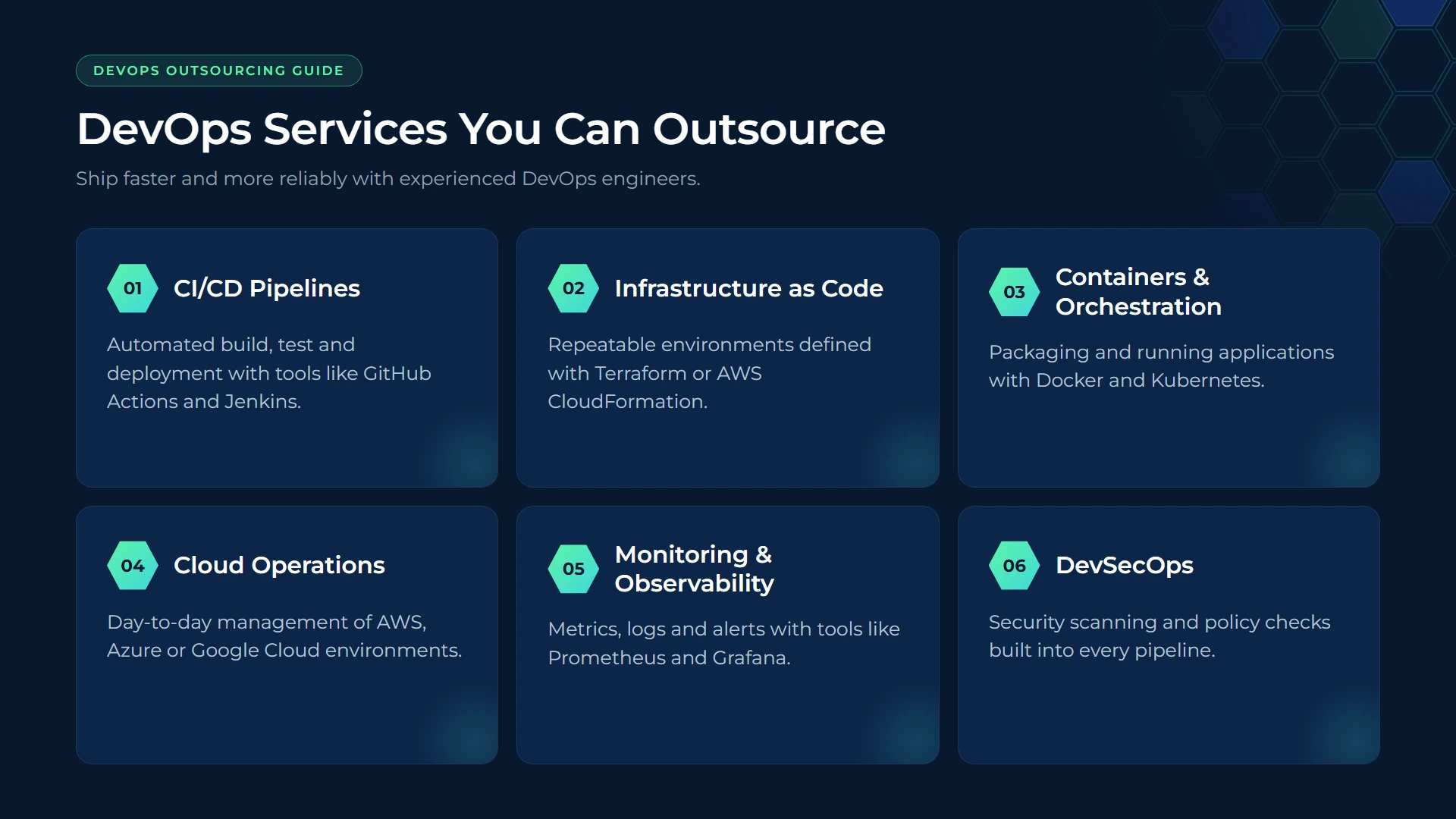
DevOps outsourcing is the practice of contracting an external company or independent specialists to manage some or all of your DevOps function — CI/CD pipeline design, cloud infrastructure management, containerization, monitoring and alerting, security automation, and incident response. Instead of recruiting, onboarding, and retaining a full internal team, companies plug in experienced engineers who already know the tooling.
It's not an all-or-nothing decision. Some teams outsource the entire DevOps function; others bring in outside help for a single project, like migrating to Kubernetes or setting up infrastructure-as-code from scratch, then keep day-to-day operations internal.
Why Companies Outsource DevOps
The reasons tend to cluster around speed, cost, and access to niche expertise. Building a mature DevOps practice in-house can take a year or more; an experienced outsourced team can often get core pipelines running within weeks.
- Faster time-to-value: Pipelines, monitoring, and infrastructure automation can be stood up quickly by engineers who've done it dozens of times before.
- Lower overhead: No recruiting costs, no benefits, no ramp-up time, and no risk of a key hire leaving six months in.
- Broader skill coverage: A single in-house hire rarely covers Kubernetes, Terraform, security compliance, and multi-cloud cost optimization equally well. An outsourced team usually does.
- Scalability: Capacity can flex up during a migration or product launch and scale back down afterward — something that's hard to do with permanent headcount.
- Round-the-clock coverage: Providers with distributed teams can offer on-call support across time zones without anyone pulling 3 a.m. shifts.
DevOps Outsourcing Delivery Models
Not every engagement looks the same. The model chosen affects cost, control, and how deeply the external team integrates with internal processes.
Managed DevOps Services
The provider takes full ownership of infrastructure, pipelines, and monitoring, typically under an SLA. This suits companies that want DevOps handled end-to-end without managing it day to day.
Staff Augmentation
External engineers embed directly into the internal team, following existing processes and reporting lines. This model keeps the most control in-house while filling specific skill gaps.
Project-Based Outsourcing
A defined scope — a cloud migration, a CI/CD overhaul, a security audit — gets delivered on a fixed timeline and budget, then the engagement ends or transitions to internal ownership.

Expand DevOps Capacity with NeoWork
DevOps outsourcing helps companies add support for cloud, deployment, infrastructure, and recurring technical workflows without building every role in-house. At NeoWork, we provide remote teammates who can support DevOps functions within your existing engineering and IT environment. We handle recruitment, benefits, training, and ongoing engagement, while our teammates integrate into your systems, tools, and delivery processes. Our 91% annualized teammate retention rate and 3.2% candidate selectivity rate reflect our focus on selective hiring and longer-term team stability.
Our DevOps outsourcing model offers:
- DevOps and infrastructure support
- integration with your tools and processes
- recruitment and ongoing teammate support
Contact NeoWork to add DevOps capacity that works alongside your existing technical team.
How Much Does DevOps Outsourcing Cost?
Pricing varies a lot depending on the provider's location, seniority of engineers, and scope of work. As a general rule, Eastern European and Latin American providers tend to sit in the middle of the price range, while North American and Western European firms charge more for similar work, and South and Southeast Asian providers often come in lowest. Rates also shift with experience level — a DevOps architect costs meaningfully more than a mid-level engineer running routine pipeline maintenance. For current numbers, it's worth checking a few providers' published rate cards directly, since figures move year to year with demand and currency shifts.
Beyond hourly or monthly rates, total cost of ownership includes onboarding time, any tooling licenses the provider requires, and the cost of knowledge transfer if the engagement ends. A cheap hourly rate that drags out a project timeline isn't actually cheaper.
Step-by-Step: How to Outsource DevOps
A structured process reduces most of the risk in these engagements. Skipping steps — especially the audit and the security review — is where things usually go wrong.
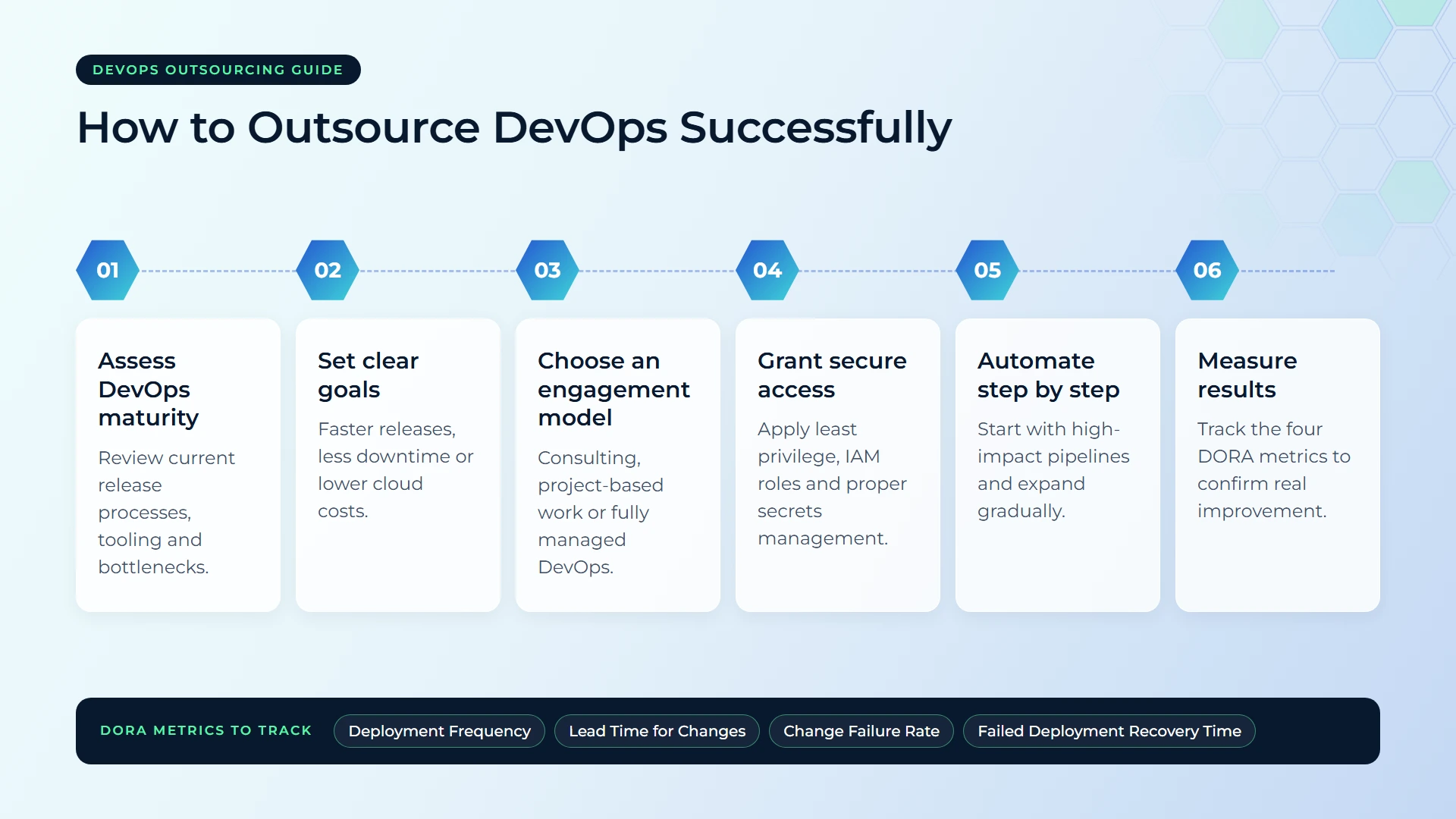
- Audit the current setup. Document existing infrastructure, pipelines, pain points, and compliance requirements before talking to any vendor.
- Define scope and success metrics. Deployment frequency, uptime targets, and incident response times make much better contract terms than vague promises of "better DevOps."
- Shortlist providers. Look at case studies in similar tech stacks, team size, and whether they've worked with companies at a similar scale.
- Vet security and process maturity. Ask how they handle secrets management, access control, and incident escalation. This step gets skipped far too often.
- Run a pilot. A smaller, time-boxed project reveals communication style and technical quality before committing to a long-term contract.
- Scale or renew based on results. If the pilot goes well, expand scope gradually rather than handing over everything at once.
Risks and Challenges — and How to Manage Them
Outsourcing DevOps isn't risk-free, and most of the horror stories trace back to a handful of avoidable mistakes.
- Security exposure: External teams often need access to production systems. Scoped access, audit logs, and a clear offboarding process are non-negotiable.
- Knowledge silos: If documentation lives only in the provider's head, switching providers later becomes painful. Insist on documentation as a contractual deliverable.
- Communication gaps: Time zone differences and unclear escalation paths slow down incident response. Define response-time SLAs upfront.
- Vendor lock-in: Some providers build infrastructure in ways only they fully understand. Favor infrastructure-as-code and standard tooling over proprietary setups.
- Misaligned incentives: Hourly billing can (intentionally or not) reward slow progress. Outcome-based milestones tend to align interests better.
DevOps Outsourcing Best Practices
A few habits consistently separate successful outsourcing relationships from frustrating ones. Start with infrastructure-as-code from day one, so nothing lives only in someone's memory. Keep a shared, living runbook for incidents rather than letting the provider maintain a private one. Set clear, measurable SLAs — deployment frequency, mean time to recovery, uptime — rather than vague quality goals. And review the relationship quarterly, not just when something breaks; that's when scope creep and communication drift usually surface first.
How to Choose the Right DevOps Outsourcing Partner
Technical skill matters, but it's rarely the deciding factor between two reasonably competent providers. What usually separates a good partnership from a bad one is process maturity and communication.
- Ask for references from companies with a similar infrastructure footprint, not just logos on a website.
- Check how they handle incidents — request a real (anonymized) postmortem example.
- Confirm which tools and cloud platforms they specialize in; depth beats breadth here.
- Clarify data residency and compliance handling, especially for regulated industries or EU-based data.
- Evaluate responsiveness during the sales process — it's usually a preview of what support will look like later.
Final Thoughts
DevOps outsourcing isn't a shortcut around good engineering practices — it's a way to access them faster. The companies that get the most value tend to treat it as a genuine partnership: clear scope, measurable goals, and real oversight, not a black box they hand infrastructure to and forget about.
Start small if there's any doubt. A pilot project reveals more about a provider's actual capabilities than any sales call ever will. From there, scaling the relationship — or walking away — becomes a much easier call.
Topics
DevOps Outsourcing Guide 2026: Costs, Models & Best Practices

Quick Summary: DevOps outsourcing means hiring an external team or provider to handle CI/CD pipelines, cloud infrastructure, automation, and monitoring instead of building an in-house team from scratch. It typically costs less and moves faster than hiring, but the right outcome depends on picking the right delivery model, vetting the provider's security practices, and keeping clear ownership of your systems. This guide walks through the models, real costs, a step-by-step outsourcing process, and the mistakes that tend to derail these engagements.
Hiring a senior DevOps engineer in 2026 is still brutally competitive. Salaries keep climbing, the skill set keeps expanding, and most companies need DevOps expertise long before they can justify a full in-house team. That gap is exactly why DevOps outsourcing has become such a common move for startups and enterprises alike.
But outsourcing DevOps isn't the same as outsourcing, say, customer support. DevOps teams touch production infrastructure, secrets, deployment pipelines, and sometimes customer data. Get the engagement wrong and it's not just a bad vendor relationship — it's a security incident waiting to happen. Get it right, though, and release cycles shrink, uptime improves, and engineering leaders stop losing sleep over infrastructure fires.
This guide covers what DevOps outsourcing actually involves, the delivery models worth considering, realistic cost ranges, a practical framework for getting started, and the pitfalls that trip up most first-time buyers.
What Is DevOps Outsourcing?
DevOps outsourcing is the practice of contracting an external company or independent specialists to manage some or all of your DevOps function — CI/CD pipeline design, cloud infrastructure management, containerization, monitoring and alerting, security automation, and incident response. Instead of recruiting, onboarding, and retaining a full internal team, companies plug in experienced engineers who already know the tooling.
It's not an all-or-nothing decision. Some teams outsource the entire DevOps function; others bring in outside help for a single project, like migrating to Kubernetes or setting up infrastructure-as-code from scratch, then keep day-to-day operations internal.
Why Companies Outsource DevOps
The reasons tend to cluster around speed, cost, and access to niche expertise. Building a mature DevOps practice in-house can take a year or more; an experienced outsourced team can often get core pipelines running within weeks.
- Faster time-to-value: Pipelines, monitoring, and infrastructure automation can be stood up quickly by engineers who've done it dozens of times before.
- Lower overhead: No recruiting costs, no benefits, no ramp-up time, and no risk of a key hire leaving six months in.
- Broader skill coverage: A single in-house hire rarely covers Kubernetes, Terraform, security compliance, and multi-cloud cost optimization equally well. An outsourced team usually does.
- Scalability: Capacity can flex up during a migration or product launch and scale back down afterward — something that's hard to do with permanent headcount.
- Round-the-clock coverage: Providers with distributed teams can offer on-call support across time zones without anyone pulling 3 a.m. shifts.
DevOps Outsourcing Delivery Models
Not every engagement looks the same. The model chosen affects cost, control, and how deeply the external team integrates with internal processes.
Managed DevOps Services
The provider takes full ownership of infrastructure, pipelines, and monitoring, typically under an SLA. This suits companies that want DevOps handled end-to-end without managing it day to day.
Staff Augmentation
External engineers embed directly into the internal team, following existing processes and reporting lines. This model keeps the most control in-house while filling specific skill gaps.
Project-Based Outsourcing
A defined scope — a cloud migration, a CI/CD overhaul, a security audit — gets delivered on a fixed timeline and budget, then the engagement ends or transitions to internal ownership.
Expand DevOps Capacity with NeoWork
DevOps outsourcing helps companies add support for cloud, deployment, infrastructure, and recurring technical workflows without building every role in-house. At NeoWork, we provide remote teammates who can support DevOps functions within your existing engineering and IT environment. We handle recruitment, benefits, training, and ongoing engagement, while our teammates integrate into your systems, tools, and delivery processes. Our 91% annualized teammate retention rate and 3.2% candidate selectivity rate reflect our focus on selective hiring and longer-term team stability.
Our DevOps outsourcing model offers:
- DevOps and infrastructure support
- integration with your tools and processes
- recruitment and ongoing teammate support
Contact NeoWork to add DevOps capacity that works alongside your existing technical team.
How Much Does DevOps Outsourcing Cost?
Pricing varies a lot depending on the provider's location, seniority of engineers, and scope of work. As a general rule, Eastern European and Latin American providers tend to sit in the middle of the price range, while North American and Western European firms charge more for similar work, and South and Southeast Asian providers often come in lowest. Rates also shift with experience level — a DevOps architect costs meaningfully more than a mid-level engineer running routine pipeline maintenance. For current numbers, it's worth checking a few providers' published rate cards directly, since figures move year to year with demand and currency shifts.
Beyond hourly or monthly rates, total cost of ownership includes onboarding time, any tooling licenses the provider requires, and the cost of knowledge transfer if the engagement ends. A cheap hourly rate that drags out a project timeline isn't actually cheaper.
Step-by-Step: How to Outsource DevOps
A structured process reduces most of the risk in these engagements. Skipping steps — especially the audit and the security review — is where things usually go wrong.
- Audit the current setup. Document existing infrastructure, pipelines, pain points, and compliance requirements before talking to any vendor.
- Define scope and success metrics. Deployment frequency, uptime targets, and incident response times make much better contract terms than vague promises of "better DevOps."
- Shortlist providers. Look at case studies in similar tech stacks, team size, and whether they've worked with companies at a similar scale.
- Vet security and process maturity. Ask how they handle secrets management, access control, and incident escalation. This step gets skipped far too often.
- Run a pilot. A smaller, time-boxed project reveals communication style and technical quality before committing to a long-term contract.
- Scale or renew based on results. If the pilot goes well, expand scope gradually rather than handing over everything at once.
Risks and Challenges — and How to Manage Them
Outsourcing DevOps isn't risk-free, and most of the horror stories trace back to a handful of avoidable mistakes.
- Security exposure: External teams often need access to production systems. Scoped access, audit logs, and a clear offboarding process are non-negotiable.
- Knowledge silos: If documentation lives only in the provider's head, switching providers later becomes painful. Insist on documentation as a contractual deliverable.
- Communication gaps: Time zone differences and unclear escalation paths slow down incident response. Define response-time SLAs upfront.
- Vendor lock-in: Some providers build infrastructure in ways only they fully understand. Favor infrastructure-as-code and standard tooling over proprietary setups.
- Misaligned incentives: Hourly billing can (intentionally or not) reward slow progress. Outcome-based milestones tend to align interests better.
DevOps Outsourcing Best Practices
A few habits consistently separate successful outsourcing relationships from frustrating ones. Start with infrastructure-as-code from day one, so nothing lives only in someone's memory. Keep a shared, living runbook for incidents rather than letting the provider maintain a private one. Set clear, measurable SLAs — deployment frequency, mean time to recovery, uptime — rather than vague quality goals. And review the relationship quarterly, not just when something breaks; that's when scope creep and communication drift usually surface first.
How to Choose the Right DevOps Outsourcing Partner
Technical skill matters, but it's rarely the deciding factor between two reasonably competent providers. What usually separates a good partnership from a bad one is process maturity and communication.
- Ask for references from companies with a similar infrastructure footprint, not just logos on a website.
- Check how they handle incidents — request a real (anonymized) postmortem example.
- Confirm which tools and cloud platforms they specialize in; depth beats breadth here.
- Clarify data residency and compliance handling, especially for regulated industries or EU-based data.
- Evaluate responsiveness during the sales process — it's usually a preview of what support will look like later.
Final Thoughts
DevOps outsourcing isn't a shortcut around good engineering practices — it's a way to access them faster. The companies that get the most value tend to treat it as a genuine partnership: clear scope, measurable goals, and real oversight, not a black box they hand infrastructure to and forget about.
Start small if there's any doubt. A pilot project reveals more about a provider's actual capabilities than any sales call ever will. From there, scaling the relationship — or walking away — becomes a much easier call.
Topics
Related Blogs
Related Podcasts