

Updated:
Oct 4
2026
.avif)
.avif)


.svg)

Quick Summary: Financial reporting outsourcing means handing specific reporting tasks, like monthly closes, management reports, consolidations, and compliance filings, to an external accounting partner while keeping strategic decision-making in-house. Done well, it cuts overhead costs, speeds up close cycles, and gives finance leaders access to specialized skills without the burden of hiring full-time staff. The key is choosing the right scope, provider, and transition plan so quality and control don't slip.
Finance teams are stretched thin. Month-end close takes too long, reports pile up, and hiring another full-time accountant feels like overkill for the workload. That's usually the moment financial reporting outsourcing starts showing up in budget conversations.
This guide walks through what financial reporting outsourcing actually involves, what it costs, how to pick a provider, and the mistakes that trip up companies trying it for the first time. No fluff, no generic sales pitch — just the practical stuff a finance leader needs before signing a contract.
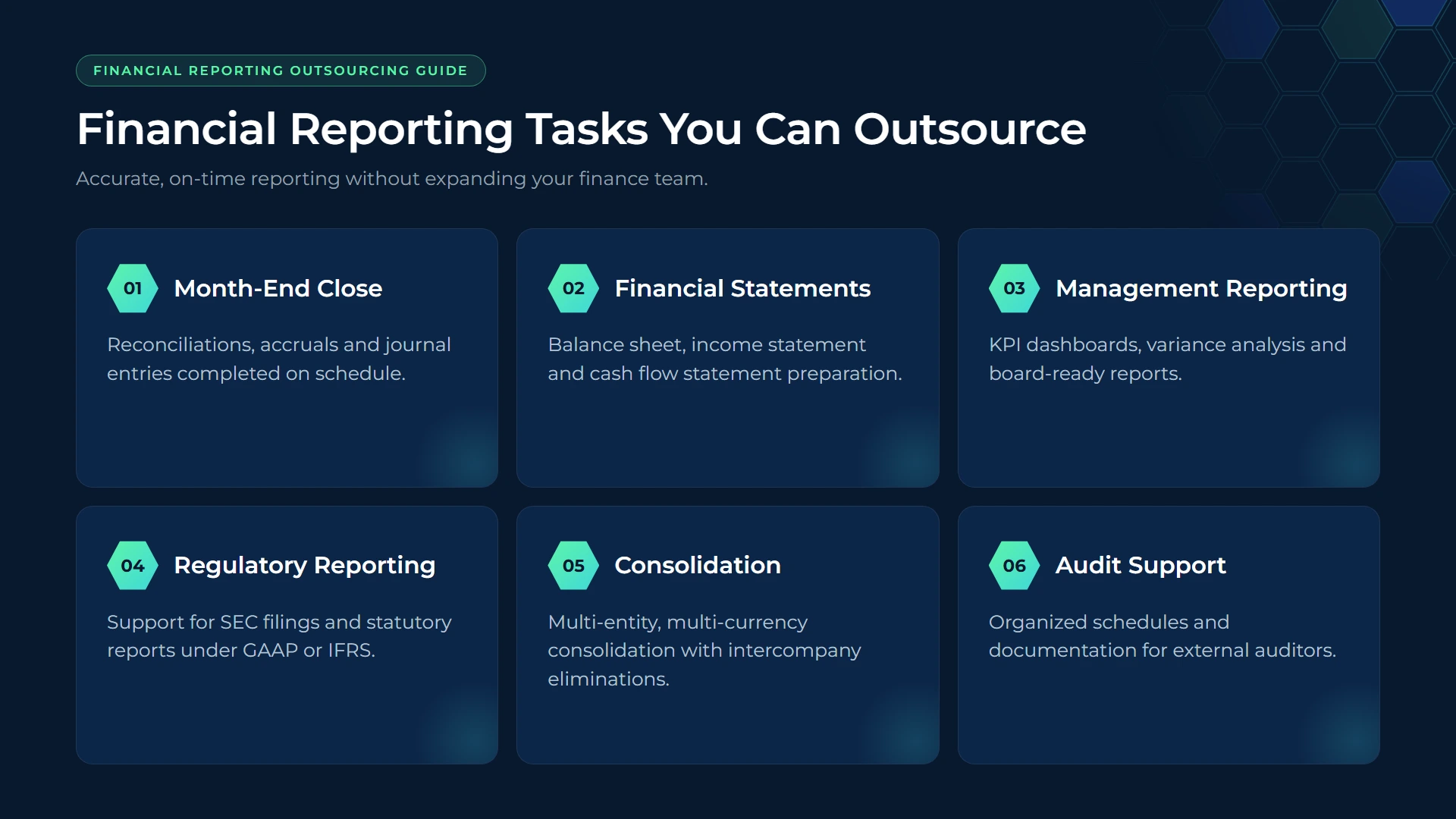
Financial reporting outsourcing is the practice of delegating specific reporting functions, think monthly financial statements, management reports, board decks, consolidations, and regulatory filings, to a third-party firm or offshore team. It's narrower than full finance and accounting outsourcing (FAO), which can include bookkeeping, payroll, and AP/AR as well.
The provider doesn't replace the finance leadership. Instead, it becomes an extension of the team, producing the reports that internal staff review, interpret, and act on. Strategy, forecasting judgment, and investor communication typically stay in-house. The data entry, reconciliation, and report assembly move out.
The reasons tend to cluster around a handful of pressures. Growing companies often can't justify a full reporting department yet, but they've outgrown spreadsheets. Established companies sometimes outsource specific pieces, like consolidations for a multi-entity structure, because the complexity spiked faster than internal capacity.
That said, outsourcing isn't free of trade-offs. Handing off reporting means giving up some day-to-day visibility, and it requires trust in a process that's harder to watch unfold in real time.
A common mistake is treating outsourcing as all-or-nothing. It rarely works that way in practice. Most CFOs keep judgment-heavy, relationship-driven work internal and push the repeatable, rules-based work out.

Financial reporting outsourcing helps companies manage recurring data preparation, records organization, reporting support, and finance workflows without expanding every internal role. At NeoWork, we provide remote teammates who can support financial reporting processes within your existing systems and reporting structure. We handle recruitment, benefits, training, and ongoing engagement, while our teammates follow your tools, processes, and reporting requirements. Our 91% annualized teammate retention rate and 3.2% candidate selectivity rate reflect our focus on selective hiring and longer-term team stability.
Our financial reporting support model offers:
Contact NeoWork to add financial reporting support that fits your existing finance operations.
Pricing varies a lot depending on scope, geography, and whether work is handled onshore, nearshore, or offshore. Three layers usually drive the quote: the complexity of the reporting (basic statements vs. full IFRS consolidations), the volume of transactions feeding into reports, and the service level, meaning how much senior oversight is built into the engagement.
Smaller companies with straightforward monthly reporting often pay a flat monthly retainer, while larger or multi-entity businesses tend to land on hourly or tiered pricing that scales with transaction volume. Rather than quoting a fixed number here, since rates shift year to year and by region, it's worth requesting itemized quotes from at least three providers and comparing what's actually included, not just the headline price.
Not every provider fits every business. A startup running lean needs something very different from a mid-market company managing five subsidiaries across three countries. Here's what actually matters when evaluating candidates.
Ask directly whether the provider has handled businesses of similar size and regulatory exposure. A firm that's never touched multi-state sales tax or IFRS consolidation isn't going to learn it well on someone else's dime.
The provider should work inside existing accounting software, not force a migration. Mismatched systems create duplicate data entry and reconciliation headaches that defeat the purpose of outsourcing in the first place.
Weekly check-ins, a named point of contact, and clear escalation paths matter more than flashy dashboards. Reporting that arrives late or unexplained erodes trust fast.
Financial data is sensitive. Ask about access controls, encryption, and how the provider handles staff turnover on their end, since that's where a lot of risk quietly lives.
Geography shapes both cost and working rhythm. Onshore providers cost more but offer time-zone alignment and easier regulatory familiarity. Nearshore options, often in neighboring regions, balance cost savings with reasonable overlap in working hours. Offshore providers tend to offer the deepest cost savings but require more structured handoffs and documentation to bridge time-zone gaps.
None of these is universally "better." The right choice depends on how much real-time collaboration the reporting work actually needs versus how much can run asynchronously.
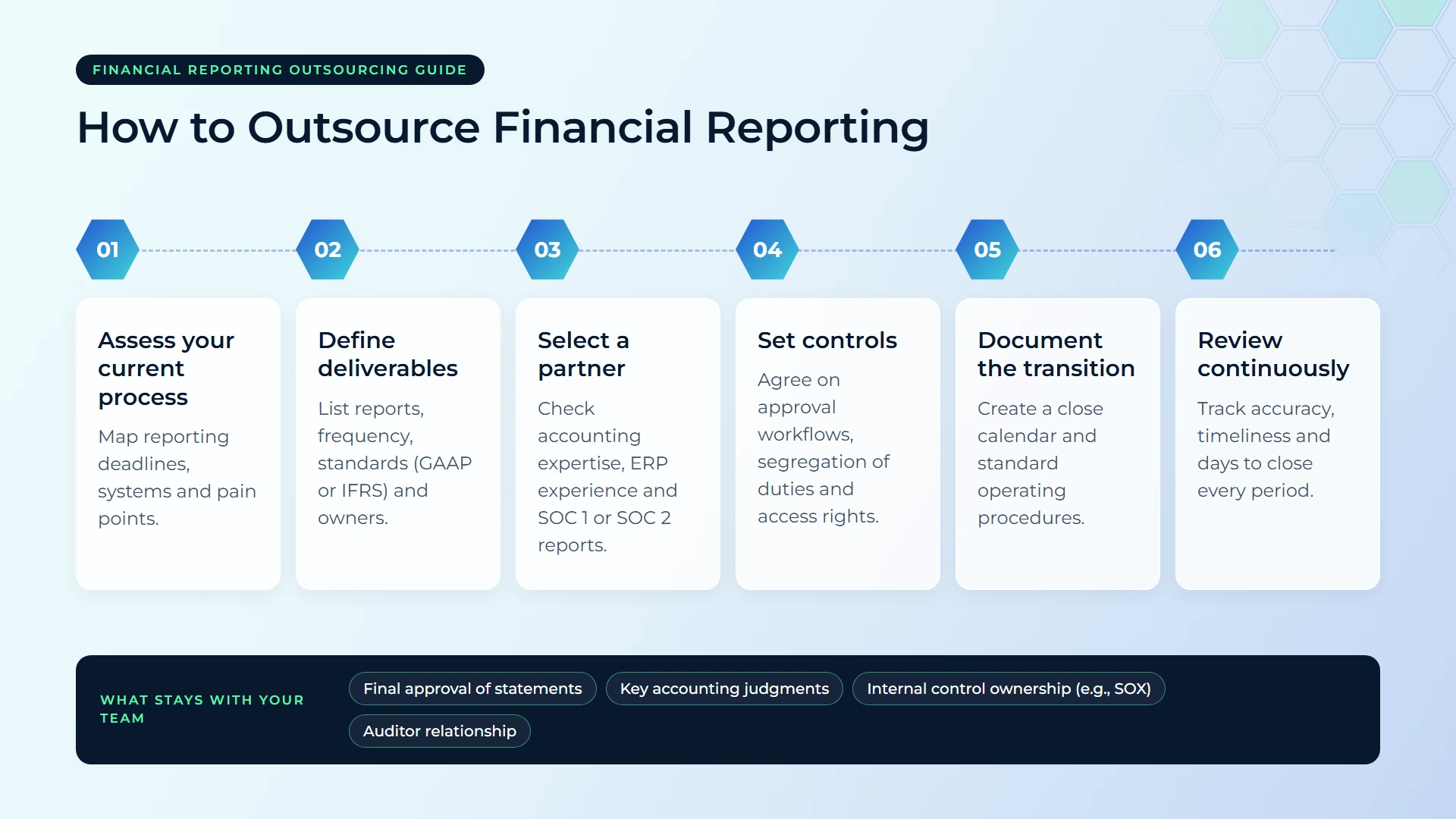
Outsourcing financial reporting rarely fails because of the provider alone. It usually fails because the transition wasn't planned carefully. A few practices consistently separate smooth rollouts from messy ones.
Not every finance team needs to outsource immediately, and rushing into it without a clear trigger often leads to a mismatched engagement. A few patterns tend to show up right before companies make the switch.
If two or more of these sound familiar, that's usually a strong enough signal to start evaluating providers rather than waiting for the problem to get worse.
Outsourcing doesn't mean losing control, though that's a common fear. A well-structured engagement keeps internal staff in the review seat, with the provider handling execution. It's also not just for large enterprises — plenty of small and mid-size companies outsource a single function, like payroll tax reporting, without touching anything else.
The real risks tend to be operational rather than conceptual: poor documentation during handoff, unclear SLAs, or picking a provider based on price alone rather than fit. Each of those is avoidable with a bit of upfront diligence.
Financial reporting outsourcing isn't a shortcut, but it is a legitimate way to free up internal capacity without sacrificing accuracy or compliance. The companies that get the most out of it treat provider selection and onboarding with the same rigor they'd apply to hiring an internal finance leader.
Start small, document everything, set clear expectations, and review the arrangement regularly. That's really the whole playbook. For businesses weighing the decision right now, the smartest next step is requesting detailed quotes from two or three providers and comparing scope, not just price, before committing.

Quick Summary: Financial reporting outsourcing means handing specific reporting tasks, like monthly closes, management reports, consolidations, and compliance filings, to an external accounting partner while keeping strategic decision-making in-house. Done well, it cuts overhead costs, speeds up close cycles, and gives finance leaders access to specialized skills without the burden of hiring full-time staff. The key is choosing the right scope, provider, and transition plan so quality and control don't slip.
Finance teams are stretched thin. Month-end close takes too long, reports pile up, and hiring another full-time accountant feels like overkill for the workload. That's usually the moment financial reporting outsourcing starts showing up in budget conversations.
This guide walks through what financial reporting outsourcing actually involves, what it costs, how to pick a provider, and the mistakes that trip up companies trying it for the first time. No fluff, no generic sales pitch — just the practical stuff a finance leader needs before signing a contract.
Financial reporting outsourcing is the practice of delegating specific reporting functions, think monthly financial statements, management reports, board decks, consolidations, and regulatory filings, to a third-party firm or offshore team. It's narrower than full finance and accounting outsourcing (FAO), which can include bookkeeping, payroll, and AP/AR as well.
The provider doesn't replace the finance leadership. Instead, it becomes an extension of the team, producing the reports that internal staff review, interpret, and act on. Strategy, forecasting judgment, and investor communication typically stay in-house. The data entry, reconciliation, and report assembly move out.
The reasons tend to cluster around a handful of pressures. Growing companies often can't justify a full reporting department yet, but they've outgrown spreadsheets. Established companies sometimes outsource specific pieces, like consolidations for a multi-entity structure, because the complexity spiked faster than internal capacity.
That said, outsourcing isn't free of trade-offs. Handing off reporting means giving up some day-to-day visibility, and it requires trust in a process that's harder to watch unfold in real time.
A common mistake is treating outsourcing as all-or-nothing. It rarely works that way in practice. Most CFOs keep judgment-heavy, relationship-driven work internal and push the repeatable, rules-based work out.
Financial reporting outsourcing helps companies manage recurring data preparation, records organization, reporting support, and finance workflows without expanding every internal role. At NeoWork, we provide remote teammates who can support financial reporting processes within your existing systems and reporting structure. We handle recruitment, benefits, training, and ongoing engagement, while our teammates follow your tools, processes, and reporting requirements. Our 91% annualized teammate retention rate and 3.2% candidate selectivity rate reflect our focus on selective hiring and longer-term team stability.
Our financial reporting support model offers:
Contact NeoWork to add financial reporting support that fits your existing finance operations.
Pricing varies a lot depending on scope, geography, and whether work is handled onshore, nearshore, or offshore. Three layers usually drive the quote: the complexity of the reporting (basic statements vs. full IFRS consolidations), the volume of transactions feeding into reports, and the service level, meaning how much senior oversight is built into the engagement.
Smaller companies with straightforward monthly reporting often pay a flat monthly retainer, while larger or multi-entity businesses tend to land on hourly or tiered pricing that scales with transaction volume. Rather than quoting a fixed number here, since rates shift year to year and by region, it's worth requesting itemized quotes from at least three providers and comparing what's actually included, not just the headline price.
Not every provider fits every business. A startup running lean needs something very different from a mid-market company managing five subsidiaries across three countries. Here's what actually matters when evaluating candidates.
Ask directly whether the provider has handled businesses of similar size and regulatory exposure. A firm that's never touched multi-state sales tax or IFRS consolidation isn't going to learn it well on someone else's dime.
The provider should work inside existing accounting software, not force a migration. Mismatched systems create duplicate data entry and reconciliation headaches that defeat the purpose of outsourcing in the first place.
Weekly check-ins, a named point of contact, and clear escalation paths matter more than flashy dashboards. Reporting that arrives late or unexplained erodes trust fast.
Financial data is sensitive. Ask about access controls, encryption, and how the provider handles staff turnover on their end, since that's where a lot of risk quietly lives.
Geography shapes both cost and working rhythm. Onshore providers cost more but offer time-zone alignment and easier regulatory familiarity. Nearshore options, often in neighboring regions, balance cost savings with reasonable overlap in working hours. Offshore providers tend to offer the deepest cost savings but require more structured handoffs and documentation to bridge time-zone gaps.
None of these is universally "better." The right choice depends on how much real-time collaboration the reporting work actually needs versus how much can run asynchronously.
Outsourcing financial reporting rarely fails because of the provider alone. It usually fails because the transition wasn't planned carefully. A few practices consistently separate smooth rollouts from messy ones.
Not every finance team needs to outsource immediately, and rushing into it without a clear trigger often leads to a mismatched engagement. A few patterns tend to show up right before companies make the switch.
If two or more of these sound familiar, that's usually a strong enough signal to start evaluating providers rather than waiting for the problem to get worse.
Outsourcing doesn't mean losing control, though that's a common fear. A well-structured engagement keeps internal staff in the review seat, with the provider handling execution. It's also not just for large enterprises — plenty of small and mid-size companies outsource a single function, like payroll tax reporting, without touching anything else.
The real risks tend to be operational rather than conceptual: poor documentation during handoff, unclear SLAs, or picking a provider based on price alone rather than fit. Each of those is avoidable with a bit of upfront diligence.
Financial reporting outsourcing isn't a shortcut, but it is a legitimate way to free up internal capacity without sacrificing accuracy or compliance. The companies that get the most out of it treat provider selection and onboarding with the same rigor they'd apply to hiring an internal finance leader.
Start small, document everything, set clear expectations, and review the arrangement regularly. That's really the whole playbook. For businesses weighing the decision right now, the smartest next step is requesting detailed quotes from two or three providers and comparing scope, not just price, before committing.