
.avif)
.avif)

Health Outsourcing Guide 2026: What to Outsource & Why


.svg)

Quick Summary: Health outsourcing means handing specific non-clinical or administrative functions — billing, coding, IT, recruitment, call centers — to a third-party partner so internal teams can focus on patient care. Done well, it cuts overhead, improves compliance, and speeds up hiring; done poorly, it creates data-security gaps and service inconsistencies. The right approach starts small, with one function, a clear contract, and a partner who can prove regulatory compliance before anything else.
Staffing shortages, rising overhead, and tightening compliance rules have pushed more hospitals, clinics, and private practices toward outsourcing in 2026. But the term covers a lot of ground — from offshoring medical coding to hiring a local agency for after-hours scheduling. Figuring out what actually makes sense for a given organization is the hard part.
This guide breaks down what health outsourcing really involves, which functions tend to deliver the best return, what it costs, where the risks hide, and how to vet a partner without getting burned.
What Is Health Outsourcing?
Health outsourcing is the practice of contracting external organizations to handle administrative, technical, or sometimes clinical-support tasks that a healthcare provider would otherwise manage in-house. It's different from staffing agencies filling temporary shifts — outsourcing typically transfers an entire function, along with its processes and performance targets, to a vendor.
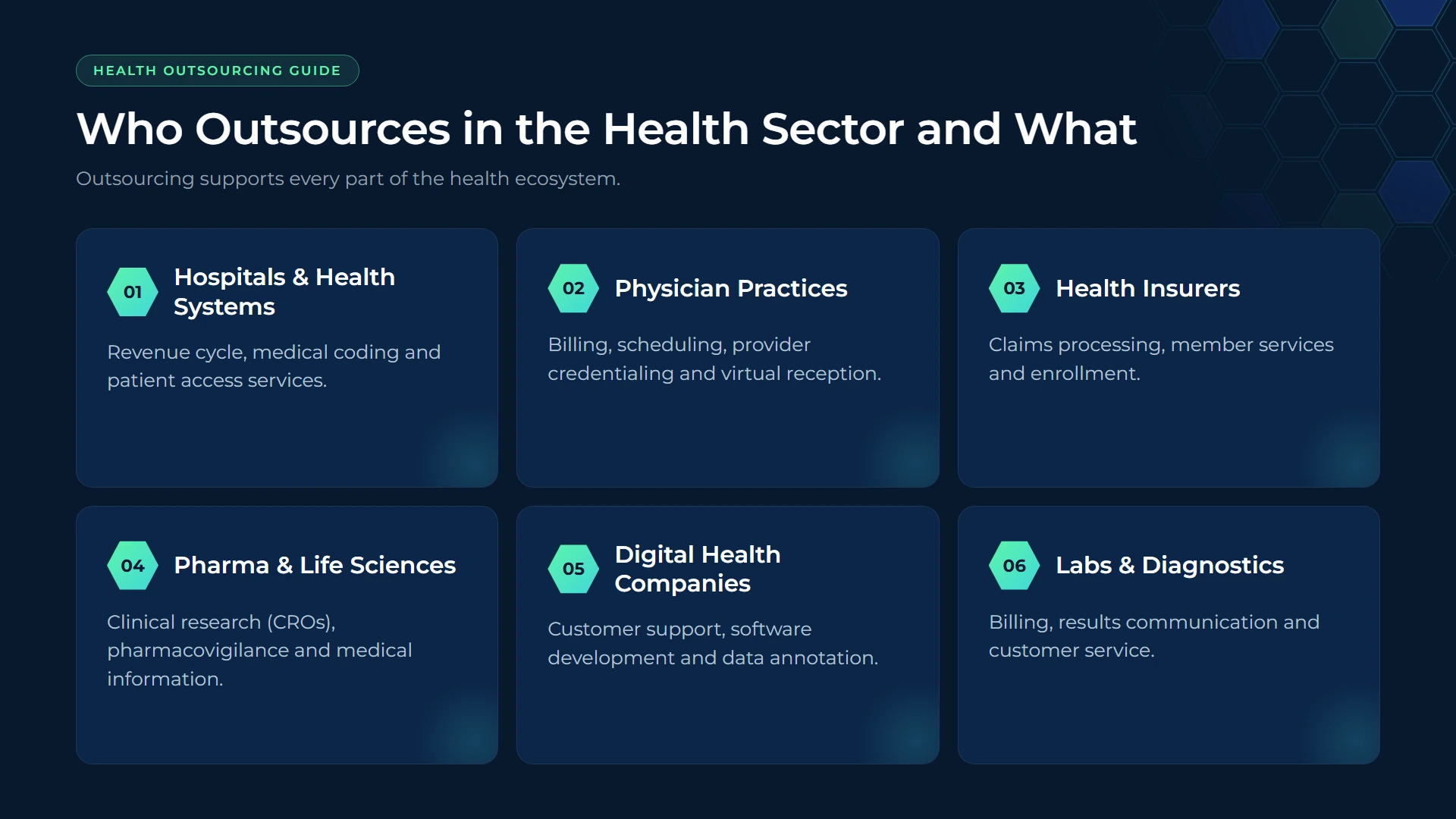
Common categories include revenue cycle management, medical billing and coding, IT and cybersecurity, patient scheduling and call-center support, transcription, recruitment, and increasingly, telehealth infrastructure. Some organizations also outsource compliance monitoring or credentialing, especially smaller practices that can't justify a full-time compliance officer.
Outsourcing vs. Insourcing
Insourcing has gained attention recently, particularly after NHS England issued formal guidance distinguishing it from temporary staffing arrangements. In NHS England guidance, insourcing means a third-party provider delivers an end-to-end clinical service on trust premises, using the provider’s own staff and clinical governance, typically in spare evening or weekend capacity. It is not the supply of temporary or agency workers. Outsourcing, in the same NHS usage, means the activity is delivered in the independent provider’s own facilities. The two aren't interchangeable, and regulators are paying closer attention to which model an organization is actually using.
Which Functions Should Be Outsourced First?
Not every task is a good candidate. The safest starting points are functions that are repetitive, rules-based, and don't require direct patient contact:
- Medical billing and coding: High volume, well-defined rules, and a direct link to cash flow.
- IT support and cybersecurity monitoring: Specialized skills that are expensive to keep in-house.
- Patient scheduling and call centers: Easy to measure, easy to scale up or down.
- Recruitment and credentialing: Agencies with healthcare-specific pipelines can cut hiring time significantly.
- Transcription and documentation: Low clinical risk, high time savings.
Functions that touch direct patient care — diagnosis, treatment planning, medication decisions — generally stay in-house, or are only outsourced through tightly regulated telehealth arrangements.

Build the Healthcare Support Team You Need
At NeoWork, we help healthcare organizations build remote teams for the administrative and operational work that keeps patient services moving. Depending on your needs, we can support functions such as patient communications, scheduling, insurance-related workflows, billing support, and other back-office tasks.
With our teams, you can:
- Add support for high-volume administrative workflows
- Extend patient service and scheduling capacity
- Build dedicated teams around billing and insurance processes
- Reduce the workload placed on in-house administrative staff
Contact us to discuss which healthcare processes you want to outsource and the roles required to support them.
Benefits of Health Outsourcing
The appeal is straightforward: lower fixed costs, access to specialized talent, and faster scaling. Organizations that outsource billing, for example, often report fewer claim denials simply because dedicated coding specialists catch errors generalist staff might miss.
Recruitment outsourcing tends to shorten time-to-hire for clinical roles, since agencies maintain active candidate pools rather than starting a search from zero. IT outsourcing gives smaller practices access to security expertise that would be unaffordable to hire full-time.
None of this is automatic, though. Savings and quality gains depend heavily on how the partnership is structured and monitored — more on that below.
Risks and Compliance Considerations
Here's the thing though — outsourcing moves data and responsibility outside the organization's direct control, and that's exactly where things go wrong if contracts are loose. Patient data handled by a billing vendor or call center still falls under the same privacy obligations as data handled internally, whether that's HIPAA in the US, UK GDPR, or equivalent frameworks elsewhere.
Key risks to watch for:
- Data security gaps: Vendors with weak access controls or outdated systems increase breach exposure.
- Inconsistent service quality: Especially with offshore call centers or billing teams unfamiliar with local payer rules.
- Compliance blind spots: Contracts that don't clearly assign regulatory responsibility can leave both parties exposed.
- Vendor dependency: Losing a key partner abruptly can disrupt revenue cycle or patient communication overnight.
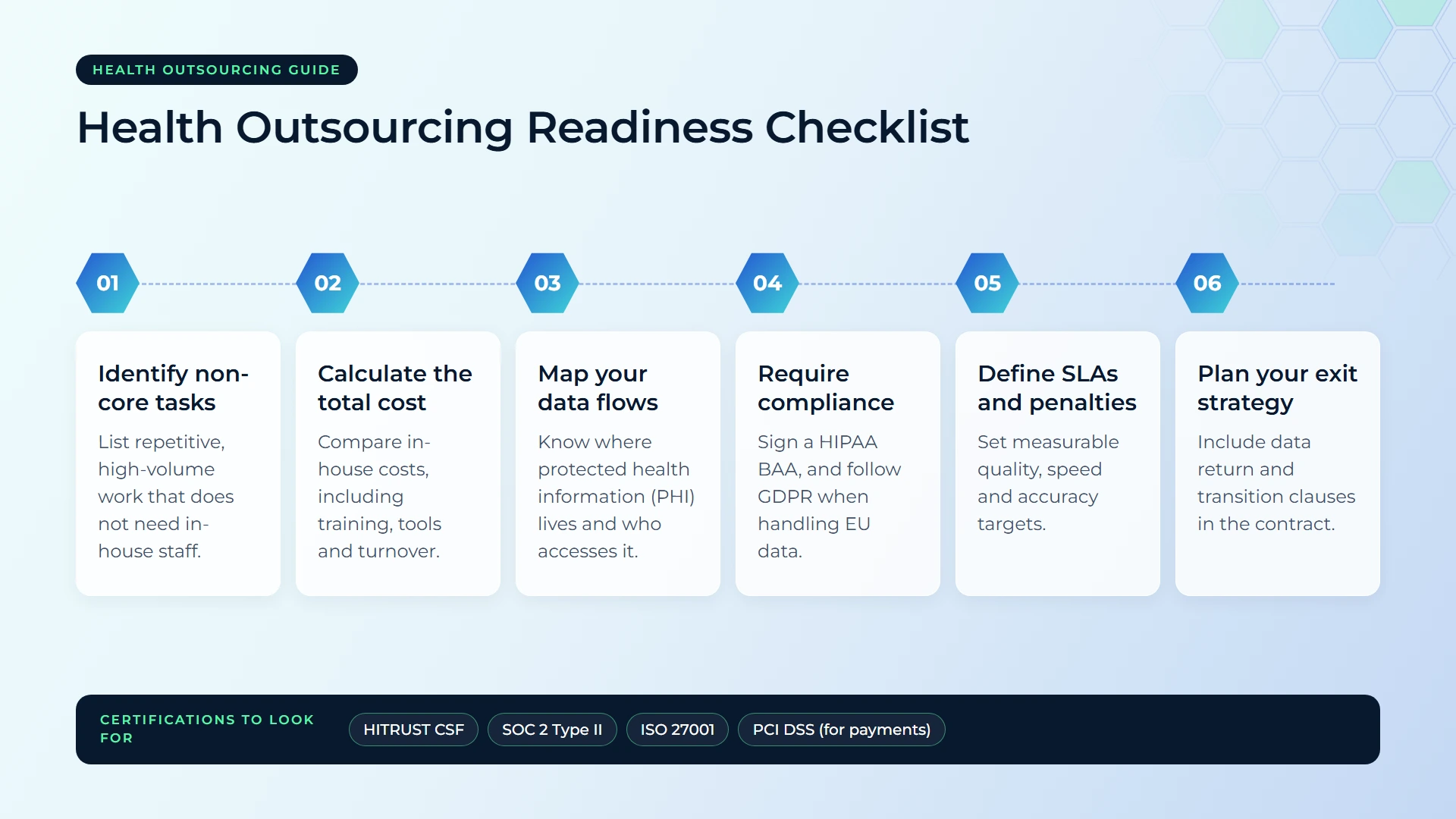
A Business Associate Agreement (or equivalent data-processing agreement outside the US) should be non-negotiable before any patient data changes hands. No signed agreement, no contract — full stop.
What Does Health Outsourcing Cost?
Pricing varies by function, region, and volume, so treat any flat percentage as a rough guide rather than a guarantee. Billing and coding vendors often charge a percentage of collected revenue, commonly in the range of about 4–10 percent, with lower rates more often negotiated at high volume, while IT support and call-center services are usually billed per seat or per transaction. Recruitment outsourcing fees are commonly tied to placement success rather than flat retainers.
The real cost comparison isn't outsourced fee versus zero — it's outsourced fee versus the fully loaded cost of in-house staff, including salary, benefits, software licenses, training, and turnover. For many administrative functions, outsourcing still comes out ahead even after accounting for vendor markup.
How to Choose an Outsourcing Partner
Price shouldn't be the first filter. Compliance credentials should be. A vendor unable to clearly explain how it handles data security, audit trails, and staff training isn't ready to handle protected health information, regardless of how competitive its rate looks:
- Verify compliance certifications and request references from similarly sized healthcare organizations.
- Confirm data security practices — encryption, access logging, breach notification timelines.
- Check specialty experience; a vendor skilled in general billing may struggle with specialty-specific coding rules.
- Review the contract's exit clause and data-return process before signing anything.
- Start with a pilot on one function before expanding scope.
Getting Started: A Simple Rollout Plan
Jumping straight into a multi-function, multi-year contract is where most outsourcing projects stumble. A phased approach works better almost every time.
Start by auditing current costs and pain points for one function — billing is a common entry point because its ROI is easy to measure. Run a pilot with a shortlisted vendor for 60-90 days, track denial rates or response times against a clear baseline, then decide whether to scale, renegotiate, or walk away. Only after that first function is stable should a second one be added.
So the pattern looks less like an overhaul and more like a series of small, measured bets — each one informing the next.
Final Thoughts
Health outsourcing isn't a single decision — it's a series of smaller ones, function by function, vendor by vendor. The organizations that get the most value tend to start narrow, demand proof of compliance before anything else, and measure results against a real baseline rather than a vendor's sales pitch.
Before signing with any provider, confirm its current compliance certifications, pricing structure, and security practices directly through its official site or a sales conversation — those details shift often enough that they're worth double-checking even against this guide.
Topics
Health Outsourcing Guide 2026: What to Outsource & Why

Quick Summary: Health outsourcing means handing specific non-clinical or administrative functions — billing, coding, IT, recruitment, call centers — to a third-party partner so internal teams can focus on patient care. Done well, it cuts overhead, improves compliance, and speeds up hiring; done poorly, it creates data-security gaps and service inconsistencies. The right approach starts small, with one function, a clear contract, and a partner who can prove regulatory compliance before anything else.
Staffing shortages, rising overhead, and tightening compliance rules have pushed more hospitals, clinics, and private practices toward outsourcing in 2026. But the term covers a lot of ground — from offshoring medical coding to hiring a local agency for after-hours scheduling. Figuring out what actually makes sense for a given organization is the hard part.
This guide breaks down what health outsourcing really involves, which functions tend to deliver the best return, what it costs, where the risks hide, and how to vet a partner without getting burned.
What Is Health Outsourcing?
Health outsourcing is the practice of contracting external organizations to handle administrative, technical, or sometimes clinical-support tasks that a healthcare provider would otherwise manage in-house. It's different from staffing agencies filling temporary shifts — outsourcing typically transfers an entire function, along with its processes and performance targets, to a vendor.
Common categories include revenue cycle management, medical billing and coding, IT and cybersecurity, patient scheduling and call-center support, transcription, recruitment, and increasingly, telehealth infrastructure. Some organizations also outsource compliance monitoring or credentialing, especially smaller practices that can't justify a full-time compliance officer.
Outsourcing vs. Insourcing
Insourcing has gained attention recently, particularly after NHS England issued formal guidance distinguishing it from temporary staffing arrangements. In NHS England guidance, insourcing means a third-party provider delivers an end-to-end clinical service on trust premises, using the provider’s own staff and clinical governance, typically in spare evening or weekend capacity. It is not the supply of temporary or agency workers. Outsourcing, in the same NHS usage, means the activity is delivered in the independent provider’s own facilities. The two aren't interchangeable, and regulators are paying closer attention to which model an organization is actually using.
Which Functions Should Be Outsourced First?
Not every task is a good candidate. The safest starting points are functions that are repetitive, rules-based, and don't require direct patient contact:
- Medical billing and coding: High volume, well-defined rules, and a direct link to cash flow.
- IT support and cybersecurity monitoring: Specialized skills that are expensive to keep in-house.
- Patient scheduling and call centers: Easy to measure, easy to scale up or down.
- Recruitment and credentialing: Agencies with healthcare-specific pipelines can cut hiring time significantly.
- Transcription and documentation: Low clinical risk, high time savings.
Functions that touch direct patient care — diagnosis, treatment planning, medication decisions — generally stay in-house, or are only outsourced through tightly regulated telehealth arrangements.
Build the Healthcare Support Team You Need
At NeoWork, we help healthcare organizations build remote teams for the administrative and operational work that keeps patient services moving. Depending on your needs, we can support functions such as patient communications, scheduling, insurance-related workflows, billing support, and other back-office tasks.
With our teams, you can:
- Add support for high-volume administrative workflows
- Extend patient service and scheduling capacity
- Build dedicated teams around billing and insurance processes
- Reduce the workload placed on in-house administrative staff
Contact us to discuss which healthcare processes you want to outsource and the roles required to support them.
Benefits of Health Outsourcing
The appeal is straightforward: lower fixed costs, access to specialized talent, and faster scaling. Organizations that outsource billing, for example, often report fewer claim denials simply because dedicated coding specialists catch errors generalist staff might miss.
Recruitment outsourcing tends to shorten time-to-hire for clinical roles, since agencies maintain active candidate pools rather than starting a search from zero. IT outsourcing gives smaller practices access to security expertise that would be unaffordable to hire full-time.
None of this is automatic, though. Savings and quality gains depend heavily on how the partnership is structured and monitored — more on that below.
Risks and Compliance Considerations
Here's the thing though — outsourcing moves data and responsibility outside the organization's direct control, and that's exactly where things go wrong if contracts are loose. Patient data handled by a billing vendor or call center still falls under the same privacy obligations as data handled internally, whether that's HIPAA in the US, UK GDPR, or equivalent frameworks elsewhere.
Key risks to watch for:
- Data security gaps: Vendors with weak access controls or outdated systems increase breach exposure.
- Inconsistent service quality: Especially with offshore call centers or billing teams unfamiliar with local payer rules.
- Compliance blind spots: Contracts that don't clearly assign regulatory responsibility can leave both parties exposed.
- Vendor dependency: Losing a key partner abruptly can disrupt revenue cycle or patient communication overnight.
A Business Associate Agreement (or equivalent data-processing agreement outside the US) should be non-negotiable before any patient data changes hands. No signed agreement, no contract — full stop.
What Does Health Outsourcing Cost?
Pricing varies by function, region, and volume, so treat any flat percentage as a rough guide rather than a guarantee. Billing and coding vendors often charge a percentage of collected revenue, commonly in the range of about 4–10 percent, with lower rates more often negotiated at high volume, while IT support and call-center services are usually billed per seat or per transaction. Recruitment outsourcing fees are commonly tied to placement success rather than flat retainers.
The real cost comparison isn't outsourced fee versus zero — it's outsourced fee versus the fully loaded cost of in-house staff, including salary, benefits, software licenses, training, and turnover. For many administrative functions, outsourcing still comes out ahead even after accounting for vendor markup.
How to Choose an Outsourcing Partner
Price shouldn't be the first filter. Compliance credentials should be. A vendor unable to clearly explain how it handles data security, audit trails, and staff training isn't ready to handle protected health information, regardless of how competitive its rate looks:
- Verify compliance certifications and request references from similarly sized healthcare organizations.
- Confirm data security practices — encryption, access logging, breach notification timelines.
- Check specialty experience; a vendor skilled in general billing may struggle with specialty-specific coding rules.
- Review the contract's exit clause and data-return process before signing anything.
- Start with a pilot on one function before expanding scope.
Getting Started: A Simple Rollout Plan
Jumping straight into a multi-function, multi-year contract is where most outsourcing projects stumble. A phased approach works better almost every time.
Start by auditing current costs and pain points for one function — billing is a common entry point because its ROI is easy to measure. Run a pilot with a shortlisted vendor for 60-90 days, track denial rates or response times against a clear baseline, then decide whether to scale, renegotiate, or walk away. Only after that first function is stable should a second one be added.
So the pattern looks less like an overhaul and more like a series of small, measured bets — each one informing the next.
Final Thoughts
Health outsourcing isn't a single decision — it's a series of smaller ones, function by function, vendor by vendor. The organizations that get the most value tend to start narrow, demand proof of compliance before anything else, and measure results against a real baseline rather than a vendor's sales pitch.
Before signing with any provider, confirm its current compliance certifications, pricing structure, and security practices directly through its official site or a sales conversation — those details shift often enough that they're worth double-checking even against this guide.
Topics
Related Blogs
Related Podcasts