

.avif)
.avif)

Healthcare Admin Outsourcing Guide: 2026 Best Practices


.svg)

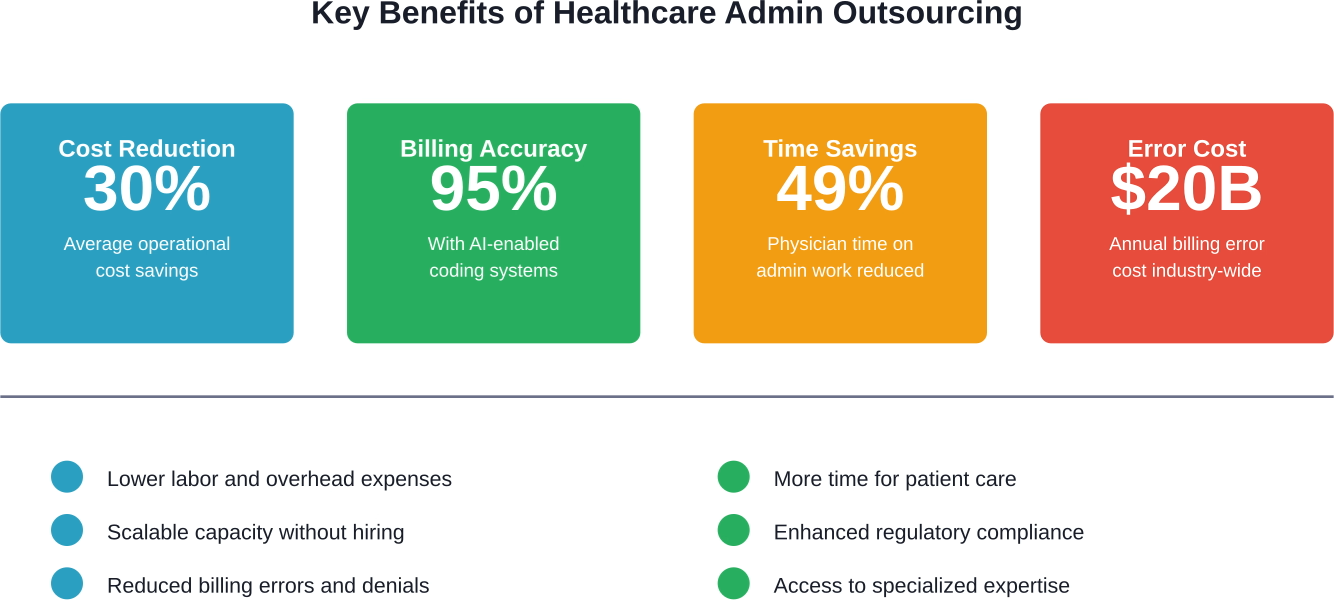
Healthcare admin outsourcing involves delegating non-clinical tasks like billing, scheduling, and coding to specialized third-party providers. Organizations pursue this to reduce operational costs by up to 30%, address staffing shortages, and refocus internal resources on patient care. Strategic outsourcing partnerships enhance compliance, improve billing accuracy to ~95%, and provide scalable support as demand fluctuates.
Healthcare providers in 2026 face a brutal operational reality. Reimbursement rates continue declining while administrative complexity explodes. Staffing shortages persist across clinical and back-office roles. The burden of regulatory compliance grows heavier each quarter.
Many organizations initially view outsourcing healthcare administration as a survival tactic—a way to slash expenses quickly. But the most successful practices are reframing the conversation entirely. They're treating outsourcing as a strategic capability that unlocks operational agility and scalable growth.
This guide walks through which administrative services to outsource, how to evaluate potential partners, and what results to expect. The goal isn't just cost reduction. It's building a more resilient operational model that allows clinical staff to focus on what actually matters: patient care.
What Is Healthcare Admin Outsourcing?
Healthcare admin outsourcing means contracting with external providers to handle non-clinical administrative functions. These tasks range from medical billing and coding to appointment scheduling, claims processing, and data entry.
The healthcare BPO (business process outsourcing) market is projected to reach $694.3 billion by 2030, growing at a CAGR of 10.7%. That growth reflects mounting pressure on providers to control costs while maintaining service quality.
Outsourcing can occur domestically or offshore. According to a 2014 report from the Office of Inspector General at HHS, state Medicaid agencies have utilized offshore outsourcing for various administrative functions, though direct contracting arrangements vary by jurisdiction.
Here's the thing though—outsourcing isn't just about moving tasks elsewhere. Strategic partners bring specialized expertise, proven workflows, and technology platforms that many mid-sized practices can't justify building in-house.
Why Healthcare Organizations Outsource Administrative Functions
The motivations for outsourcing have evolved. Cost reduction remains important, but it's no longer the only driver.
Cost Reduction and Operational Efficiency
Organizations can achieve up to 30% reduction in operational costs through healthcare outsourcing. That savings comes from multiple sources: lower labor costs, economies of scale, and reduced overhead for office space and equipment.
But there's another cost that often goes unmeasured. Medical billing errors alone cost the medical sector approximately $20 billion annually, according to Medical Healthcare Solutions Inc. Partnering with a specialist reduces those errors and the financial damage that follows.
Addressing Staffing Shortages
Recruiting and retaining qualified administrative staff has become increasingly difficult. Turnover creates knowledge gaps and training costs. Outsourcing providers maintain deep benches of trained personnel who can step in immediately.
The staffing flexibility becomes particularly valuable during volume fluctuations. Seasonal patient surges or unexpected staff departures don't create the same operational crisis when a partner can scale support up or down.
Focus on Core Competencies
Physicians spend 49% of their day on administrative work, according to healthcare industry data. That's nearly half their time not spent on clinical care.
By entrusting non-essential tasks to a qualified third-party, clinical teams reclaim time for patient interaction, complex case management, and continuing education. Administrative staff can similarly focus on patient-facing coordination rather than back-office processing.
Enhanced Compliance and Quality
Healthcare compliance requirements grow more complex each year. Between federal regulations, state-specific rules, and evolving payer policies, staying current requires dedicated expertise.
Specialized outsourcing partners maintain compliance teams focused exclusively on regulatory changes. They implement updated workflows faster than most internal teams can, reducing audit risk and potential penalties.
Streamline Healthcare Admin Outsourcing

Administrative overload slows healthcare providers down. NeoWork supplies remote admin teams that integrate into existing healthcare workflows. With a 91% annualized teammate retention rate and a 3.2% candidate selectivity rate, NeoWork ensures long-term staff stability and consistent execution. This reduces repetitive onboarding and improves operational flow.
Ready to Reduce Administrative Burden?
Talk with NeoWork to:
- build a structured healthcare admin team
- standardize workflows
- scale operations without expanding internal headcount
👉 Connect with NeoWork to structure your healthcare admin outsourcing.
Which Administrative Services to Outsource
Not all administrative functions are equally suited for outsourcing. Some deliver immediate ROI, while others require careful planning.
Medical Billing and Coding
This is the most commonly outsourced function—and for good reason. Medical billing and coding require specialized knowledge of CPT codes, ICD-10 classifications, and payer-specific requirements.
AI-enabled coding and claims management systems achieve approximately 95% coding accuracy. That precision translates directly to faster reimbursements and fewer denied claims.
Between 2022 and 2023, care denials increased an average of 20.2% for commercial claims and 55.7% for Medicare Advantage claims, according to the American Hospital Association. Those denial rates make billing accuracy more critical than ever.
Revenue Cycle Management
Revenue cycle management encompasses the full financial journey from patient registration through final payment. This includes eligibility verification, prior authorization, claims submission, payment posting, and accounts receivable follow-up.
Outsourcing partners bring purpose-built technology platforms that integrate with existing EHR systems. They also provide dedicated teams for denial management and appeals—work that's tedious but essential for financial health.
Patient Scheduling and Call Centers
Appointment scheduling sounds simple but involves complex coordination. No-show rates, wait time optimization, provider schedule management, and patient communication all impact operational efficiency.
Many small-to-mid-sized practices struggle with data analysis around scheduling. They know they're busy but don't understand why their no-show rate hits 15% or where bottlenecks occur. Outsourcing partners provide analytics alongside the service itself.
Medical Transcription and Documentation
Clinical documentation requirements continue expanding while physician time remains finite. Medical transcription services convert voice recordings into structured clinical notes, freeing providers from keyboard work.
Modern transcription now incorporates AI-assisted speech recognition with human quality review. The hybrid approach balances speed with accuracy for clinical documentation.
Claims Processing and Follow-Up
Claims don't always get paid on first submission. According to AHA data, hospital staff must expend valuable time and resources to overturn inappropriate denials, adding unnecessary cost and burden to the system.
Dedicated claims follow-up teams track outstanding claims, identify denial patterns, and resubmit with corrected information. This persistent attention recovers revenue that would otherwise be written off.
Compliance Considerations and Data Security
Healthcare data is among the most sensitive information organizations handle. Outsourcing administrative functions doesn't reduce compliance obligations—it extends them to the partner organization.
HIPAA Compliance Requirements
Any outsourcing partner handling protected health information must comply with HIPAA regulations. That means executing a Business Associate Agreement before any data exchange occurs.
The BAA defines exactly what PHI the partner can access, how they'll secure it, and what happens in case of a breach. The Office of Inspector General at HHS provides compliance resources specifically for healthcare providers entering outsourcing arrangements.
State-Specific Regulations
Healthcare regulations vary significantly by state. Some jurisdictions have additional privacy requirements beyond federal HIPAA rules. Others impose specific restrictions on offshore data storage or processing.
When evaluating partners, confirm they understand the regulatory environment in each state where the organization operates. Multi-state health systems face particularly complex compliance landscapes.
Cybersecurity Standards
The American Hospital Association has developed cybersecurity guidelines to help members prepare for and prevent cyber threats. These standards provide a baseline for evaluating partner security posture.
Key security requirements include data encryption in transit and at rest, multi-factor authentication, regular penetration testing, and documented incident response procedures. Partners should provide SOC 2 Type II audit reports demonstrating their security controls.
Selecting the Right Outsourcing Partner
The partner selection process determines whether outsourcing delivers strategic value or becomes another operational headache. Due diligence matters.
Industry Experience and Specialization
Healthcare outsourcing is fundamentally different from general business process outsourcing. Medical terminology, clinical workflows, and regulatory compliance require domain expertise.
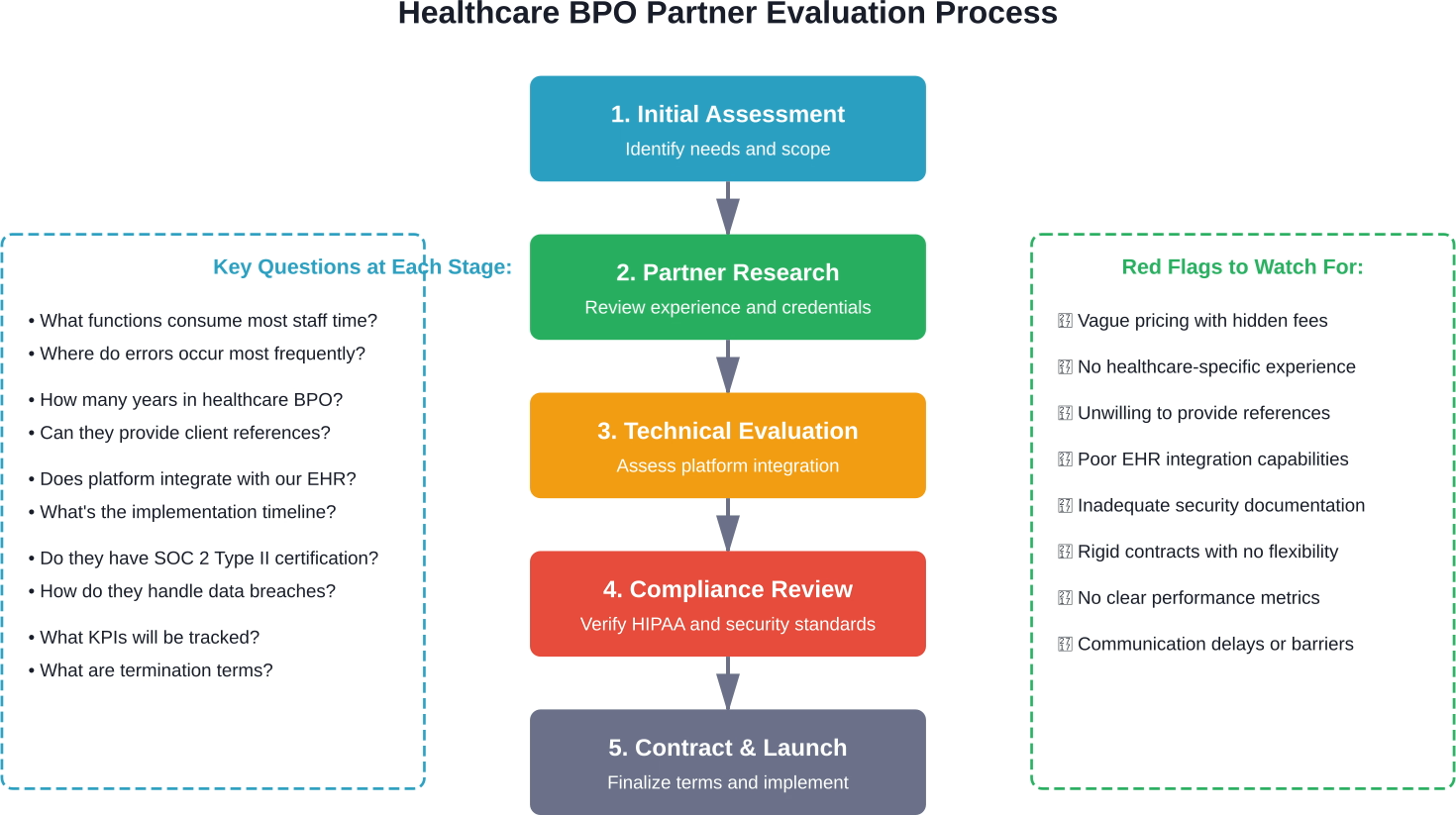
Look for partners with substantial healthcare experience. How long have they served medical practices? What percentage of their business is healthcare-focused? Can they provide references from similar organizations?
Technology Platform and Integration
The partner's technology stack needs to integrate seamlessly with existing systems. That typically means compatibility with the organization's EHR platform, practice management software, and billing systems.
Real talk: integration challenges sink more outsourcing relationships than any other factor. Demand detailed technical specifications and a documented integration plan before signing anything.
Scalability and Flexibility
Healthcare demand fluctuates. Patient volumes shift seasonally, practices expand to new locations, and services evolve over time. The outsourcing partner must scale support accordingly.
Ask about their capacity management approach. How quickly can they add staff to handle volume increases? What happens if the organization needs to scale down temporarily?
Performance Metrics and Reporting
Data-driven decision-making requires visibility into partner performance. The agreement should specify exactly which metrics will be tracked and how often they'll be reported.
Common KPIs include claims submission time, first-pass acceptance rate, denial rate, days in accounts receivable, and patient satisfaction scores for scheduling or call center services.
Pricing Structure and Hidden Costs
Outsourcing pricing models vary widely. Some partners charge per transaction (per claim, per appointment, per transcription line). Others use percentage-of-collections models for revenue cycle work. Some offer flat monthly fees.
Watch for hidden costs. Setup fees, software licensing, early termination penalties, and volume tier changes can significantly impact total cost. Get complete pricing in writing before moving forward.
Common Challenges and How to Mitigate Them
Even well-planned outsourcing relationships encounter obstacles. Anticipating these challenges allows organizations to build mitigation strategies upfront.
Communication and Cultural Barriers
When outsourcing offshore, time zone differences and language variations can complicate coordination. Daily handoffs between onshore and offshore teams require clear documentation and structured communication protocols.
Many organizations address this by requiring bilingual staff or implementing overlap hours where both teams are available simultaneously for urgent issues.
Quality Control and Consistency
Maintaining consistent quality when work moves outside direct supervision takes effort. Regular audits, spot-checking, and clearly defined quality standards are essential.
The partnership agreement should specify quality metrics and what happens when standards aren't met. That might include financial penalties, additional training requirements, or contract termination rights.
Data Integration and System Compatibility
Technical integration problems create operational friction. When systems don't communicate properly, staff waste time on manual workarounds.
Mitigate this by conducting a pilot program with a limited scope before full implementation. The pilot reveals integration issues while the stakes are still manageable.
Change Management and Staff Resistance
Internal staff may view outsourcing as a threat to their jobs. That fear creates resistance that can undermine implementation.
Transparent communication helps. Explain why outsourcing is happening, which roles are affected, and what opportunities exist for staff to shift into different responsibilities. In many cases, outsourcing eliminates tedious work while preserving patient-facing coordination roles.
Measuring ROI and Success Metrics
Outsourcing success requires measurement. Without clear metrics, it's impossible to know whether the partnership is delivering value.
Track these metrics monthly and review trends quarterly. Short-term fluctuations are normal during implementation, but sustained underperformance indicates a problem requiring intervention.
Future Trends in Healthcare Admin Outsourcing
The healthcare BPO landscape continues evolving. Several trends are reshaping what outsourcing looks like and what it can accomplish.
AI and Automation Integration
Artificial intelligence is transforming administrative workflows. AI-enabled coding systems already achieve ~95% accuracy. Natural language processing improves medical transcription quality while reducing turnaround time.
But wait—automation doesn't eliminate the need for outsourcing partners. Instead, leading partners combine AI tools with human expertise. The technology handles routine processing while specialists manage exceptions and complex cases.
Value-Based Care Support
As reimbursement shifts from volume to value, administrative support needs change. Partners must track quality metrics, coordinate care transitions, and support population health management initiatives.
This evolution pushes outsourcing beyond simple transaction processing toward strategic partnership in value-based care delivery.
Enhanced Data Analytics
Most small-to-mid-sized practices struggle with data analysis. High-level outsourcing partners provide more than labor—they deliver actionable intelligence about operational performance.
Expect partners to offer increasingly sophisticated analytics dashboards showing real-time performance across key metrics. That visibility enables proactive problem-solving rather than reactive firefighting.
Conclusion: Building Strategic Outsourcing Partnerships
Healthcare admin outsourcing in 2026 isn't about desperation cost-cutting. It's about building operational resilience and strategic capability.
Organizations that view outsourcing purely as expense reduction miss the bigger opportunity. The real value comes from accessing specialized expertise, achieving scalable capacity, and refocusing internal resources on core competencies that directly impact patient care.
Success requires careful partner selection, clear performance metrics, and realistic expectations about implementation timelines. The best partnerships feel like extensions of the internal team rather than distant vendors handling disconnected tasks.
Start by identifying which administrative functions consume disproportionate resources or generate frequent errors. Those high-pain areas offer the clearest ROI from outsourcing. Begin with a limited pilot to validate the partner's capabilities before expanding scope.
The healthcare industry faces unprecedented operational challenges. Strategic outsourcing provides one powerful tool for navigating that complexity while maintaining focus on what actually matters: delivering excellent patient care.
Ready to explore healthcare admin outsourcing for your organization? Begin with a comprehensive assessment of your current administrative costs, error rates, and staff capacity. That baseline data will guide partner selection and provide clear benchmarks for measuring success.
Frequently Asked Questions
Topics
Healthcare Admin Outsourcing Guide: 2026 Best Practices

Healthcare admin outsourcing involves delegating non-clinical tasks like billing, scheduling, and coding to specialized third-party providers. Organizations pursue this to reduce operational costs by up to 30%, address staffing shortages, and refocus internal resources on patient care. Strategic outsourcing partnerships enhance compliance, improve billing accuracy to ~95%, and provide scalable support as demand fluctuates.
Healthcare providers in 2026 face a brutal operational reality. Reimbursement rates continue declining while administrative complexity explodes. Staffing shortages persist across clinical and back-office roles. The burden of regulatory compliance grows heavier each quarter.
Many organizations initially view outsourcing healthcare administration as a survival tactic—a way to slash expenses quickly. But the most successful practices are reframing the conversation entirely. They're treating outsourcing as a strategic capability that unlocks operational agility and scalable growth.
This guide walks through which administrative services to outsource, how to evaluate potential partners, and what results to expect. The goal isn't just cost reduction. It's building a more resilient operational model that allows clinical staff to focus on what actually matters: patient care.
What Is Healthcare Admin Outsourcing?
Healthcare admin outsourcing means contracting with external providers to handle non-clinical administrative functions. These tasks range from medical billing and coding to appointment scheduling, claims processing, and data entry.
The healthcare BPO (business process outsourcing) market is projected to reach $694.3 billion by 2030, growing at a CAGR of 10.7%. That growth reflects mounting pressure on providers to control costs while maintaining service quality.
Outsourcing can occur domestically or offshore. According to a 2014 report from the Office of Inspector General at HHS, state Medicaid agencies have utilized offshore outsourcing for various administrative functions, though direct contracting arrangements vary by jurisdiction.
Here's the thing though—outsourcing isn't just about moving tasks elsewhere. Strategic partners bring specialized expertise, proven workflows, and technology platforms that many mid-sized practices can't justify building in-house.
Why Healthcare Organizations Outsource Administrative Functions
The motivations for outsourcing have evolved. Cost reduction remains important, but it's no longer the only driver.
Cost Reduction and Operational Efficiency
Organizations can achieve up to 30% reduction in operational costs through healthcare outsourcing. That savings comes from multiple sources: lower labor costs, economies of scale, and reduced overhead for office space and equipment.
But there's another cost that often goes unmeasured. Medical billing errors alone cost the medical sector approximately $20 billion annually, according to Medical Healthcare Solutions Inc. Partnering with a specialist reduces those errors and the financial damage that follows.
Addressing Staffing Shortages
Recruiting and retaining qualified administrative staff has become increasingly difficult. Turnover creates knowledge gaps and training costs. Outsourcing providers maintain deep benches of trained personnel who can step in immediately.
The staffing flexibility becomes particularly valuable during volume fluctuations. Seasonal patient surges or unexpected staff departures don't create the same operational crisis when a partner can scale support up or down.
Focus on Core Competencies
Physicians spend 49% of their day on administrative work, according to healthcare industry data. That's nearly half their time not spent on clinical care.
By entrusting non-essential tasks to a qualified third-party, clinical teams reclaim time for patient interaction, complex case management, and continuing education. Administrative staff can similarly focus on patient-facing coordination rather than back-office processing.
Enhanced Compliance and Quality
Healthcare compliance requirements grow more complex each year. Between federal regulations, state-specific rules, and evolving payer policies, staying current requires dedicated expertise.
Specialized outsourcing partners maintain compliance teams focused exclusively on regulatory changes. They implement updated workflows faster than most internal teams can, reducing audit risk and potential penalties.
Streamline Healthcare Admin Outsourcing
Administrative overload slows healthcare providers down. NeoWork supplies remote admin teams that integrate into existing healthcare workflows. With a 91% annualized teammate retention rate and a 3.2% candidate selectivity rate, NeoWork ensures long-term staff stability and consistent execution. This reduces repetitive onboarding and improves operational flow.
Ready to Reduce Administrative Burden?
Talk with NeoWork to:
- build a structured healthcare admin team
- standardize workflows
- scale operations without expanding internal headcount
👉 Connect with NeoWork to structure your healthcare admin outsourcing.
Which Administrative Services to Outsource
Not all administrative functions are equally suited for outsourcing. Some deliver immediate ROI, while others require careful planning.
Medical Billing and Coding
This is the most commonly outsourced function—and for good reason. Medical billing and coding require specialized knowledge of CPT codes, ICD-10 classifications, and payer-specific requirements.
AI-enabled coding and claims management systems achieve approximately 95% coding accuracy. That precision translates directly to faster reimbursements and fewer denied claims.
Between 2022 and 2023, care denials increased an average of 20.2% for commercial claims and 55.7% for Medicare Advantage claims, according to the American Hospital Association. Those denial rates make billing accuracy more critical than ever.
Revenue Cycle Management
Revenue cycle management encompasses the full financial journey from patient registration through final payment. This includes eligibility verification, prior authorization, claims submission, payment posting, and accounts receivable follow-up.
Outsourcing partners bring purpose-built technology platforms that integrate with existing EHR systems. They also provide dedicated teams for denial management and appeals—work that's tedious but essential for financial health.
Patient Scheduling and Call Centers
Appointment scheduling sounds simple but involves complex coordination. No-show rates, wait time optimization, provider schedule management, and patient communication all impact operational efficiency.
Many small-to-mid-sized practices struggle with data analysis around scheduling. They know they're busy but don't understand why their no-show rate hits 15% or where bottlenecks occur. Outsourcing partners provide analytics alongside the service itself.
Medical Transcription and Documentation
Clinical documentation requirements continue expanding while physician time remains finite. Medical transcription services convert voice recordings into structured clinical notes, freeing providers from keyboard work.
Modern transcription now incorporates AI-assisted speech recognition with human quality review. The hybrid approach balances speed with accuracy for clinical documentation.
Claims Processing and Follow-Up
Claims don't always get paid on first submission. According to AHA data, hospital staff must expend valuable time and resources to overturn inappropriate denials, adding unnecessary cost and burden to the system.
Dedicated claims follow-up teams track outstanding claims, identify denial patterns, and resubmit with corrected information. This persistent attention recovers revenue that would otherwise be written off.
Compliance Considerations and Data Security
Healthcare data is among the most sensitive information organizations handle. Outsourcing administrative functions doesn't reduce compliance obligations—it extends them to the partner organization.
HIPAA Compliance Requirements
Any outsourcing partner handling protected health information must comply with HIPAA regulations. That means executing a Business Associate Agreement before any data exchange occurs.
The BAA defines exactly what PHI the partner can access, how they'll secure it, and what happens in case of a breach. The Office of Inspector General at HHS provides compliance resources specifically for healthcare providers entering outsourcing arrangements.
State-Specific Regulations
Healthcare regulations vary significantly by state. Some jurisdictions have additional privacy requirements beyond federal HIPAA rules. Others impose specific restrictions on offshore data storage or processing.
When evaluating partners, confirm they understand the regulatory environment in each state where the organization operates. Multi-state health systems face particularly complex compliance landscapes.
Cybersecurity Standards
The American Hospital Association has developed cybersecurity guidelines to help members prepare for and prevent cyber threats. These standards provide a baseline for evaluating partner security posture.
Key security requirements include data encryption in transit and at rest, multi-factor authentication, regular penetration testing, and documented incident response procedures. Partners should provide SOC 2 Type II audit reports demonstrating their security controls.
Selecting the Right Outsourcing Partner
The partner selection process determines whether outsourcing delivers strategic value or becomes another operational headache. Due diligence matters.
Industry Experience and Specialization
Healthcare outsourcing is fundamentally different from general business process outsourcing. Medical terminology, clinical workflows, and regulatory compliance require domain expertise.
Look for partners with substantial healthcare experience. How long have they served medical practices? What percentage of their business is healthcare-focused? Can they provide references from similar organizations?
Technology Platform and Integration
The partner's technology stack needs to integrate seamlessly with existing systems. That typically means compatibility with the organization's EHR platform, practice management software, and billing systems.
Real talk: integration challenges sink more outsourcing relationships than any other factor. Demand detailed technical specifications and a documented integration plan before signing anything.
Scalability and Flexibility
Healthcare demand fluctuates. Patient volumes shift seasonally, practices expand to new locations, and services evolve over time. The outsourcing partner must scale support accordingly.
Ask about their capacity management approach. How quickly can they add staff to handle volume increases? What happens if the organization needs to scale down temporarily?
Performance Metrics and Reporting
Data-driven decision-making requires visibility into partner performance. The agreement should specify exactly which metrics will be tracked and how often they'll be reported.
Common KPIs include claims submission time, first-pass acceptance rate, denial rate, days in accounts receivable, and patient satisfaction scores for scheduling or call center services.
Pricing Structure and Hidden Costs
Outsourcing pricing models vary widely. Some partners charge per transaction (per claim, per appointment, per transcription line). Others use percentage-of-collections models for revenue cycle work. Some offer flat monthly fees.
Watch for hidden costs. Setup fees, software licensing, early termination penalties, and volume tier changes can significantly impact total cost. Get complete pricing in writing before moving forward.
Common Challenges and How to Mitigate Them
Even well-planned outsourcing relationships encounter obstacles. Anticipating these challenges allows organizations to build mitigation strategies upfront.
Communication and Cultural Barriers
When outsourcing offshore, time zone differences and language variations can complicate coordination. Daily handoffs between onshore and offshore teams require clear documentation and structured communication protocols.
Many organizations address this by requiring bilingual staff or implementing overlap hours where both teams are available simultaneously for urgent issues.
Quality Control and Consistency
Maintaining consistent quality when work moves outside direct supervision takes effort. Regular audits, spot-checking, and clearly defined quality standards are essential.
The partnership agreement should specify quality metrics and what happens when standards aren't met. That might include financial penalties, additional training requirements, or contract termination rights.
Data Integration and System Compatibility
Technical integration problems create operational friction. When systems don't communicate properly, staff waste time on manual workarounds.
Mitigate this by conducting a pilot program with a limited scope before full implementation. The pilot reveals integration issues while the stakes are still manageable.
Change Management and Staff Resistance
Internal staff may view outsourcing as a threat to their jobs. That fear creates resistance that can undermine implementation.
Transparent communication helps. Explain why outsourcing is happening, which roles are affected, and what opportunities exist for staff to shift into different responsibilities. In many cases, outsourcing eliminates tedious work while preserving patient-facing coordination roles.
Measuring ROI and Success Metrics
Outsourcing success requires measurement. Without clear metrics, it's impossible to know whether the partnership is delivering value.
Track these metrics monthly and review trends quarterly. Short-term fluctuations are normal during implementation, but sustained underperformance indicates a problem requiring intervention.
Future Trends in Healthcare Admin Outsourcing
The healthcare BPO landscape continues evolving. Several trends are reshaping what outsourcing looks like and what it can accomplish.
AI and Automation Integration
Artificial intelligence is transforming administrative workflows. AI-enabled coding systems already achieve ~95% accuracy. Natural language processing improves medical transcription quality while reducing turnaround time.
But wait—automation doesn't eliminate the need for outsourcing partners. Instead, leading partners combine AI tools with human expertise. The technology handles routine processing while specialists manage exceptions and complex cases.
Value-Based Care Support
As reimbursement shifts from volume to value, administrative support needs change. Partners must track quality metrics, coordinate care transitions, and support population health management initiatives.
This evolution pushes outsourcing beyond simple transaction processing toward strategic partnership in value-based care delivery.
Enhanced Data Analytics
Most small-to-mid-sized practices struggle with data analysis. High-level outsourcing partners provide more than labor—they deliver actionable intelligence about operational performance.
Expect partners to offer increasingly sophisticated analytics dashboards showing real-time performance across key metrics. That visibility enables proactive problem-solving rather than reactive firefighting.
Conclusion: Building Strategic Outsourcing Partnerships
Healthcare admin outsourcing in 2026 isn't about desperation cost-cutting. It's about building operational resilience and strategic capability.
Organizations that view outsourcing purely as expense reduction miss the bigger opportunity. The real value comes from accessing specialized expertise, achieving scalable capacity, and refocusing internal resources on core competencies that directly impact patient care.
Success requires careful partner selection, clear performance metrics, and realistic expectations about implementation timelines. The best partnerships feel like extensions of the internal team rather than distant vendors handling disconnected tasks.
Start by identifying which administrative functions consume disproportionate resources or generate frequent errors. Those high-pain areas offer the clearest ROI from outsourcing. Begin with a limited pilot to validate the partner's capabilities before expanding scope.
The healthcare industry faces unprecedented operational challenges. Strategic outsourcing provides one powerful tool for navigating that complexity while maintaining focus on what actually matters: delivering excellent patient care.
Ready to explore healthcare admin outsourcing for your organization? Begin with a comprehensive assessment of your current administrative costs, error rates, and staff capacity. That baseline data will guide partner selection and provide clear benchmarks for measuring success.
Frequently Asked Questions
Topics
Related Blogs
Related Podcasts


.webp)
.webp)



