

.avif)
.avif)

IT Consulting and Staff Augmentation Guide for 2026


.svg)

Quick Summary: IT staff augmentation adds vetted external developers or engineers to an existing team under in-house direction, while IT consulting brings in outside experts to diagnose problems and recommend a strategy. Staff augmentation suits teams that already know what needs building and just need more hands; consulting suits teams that need direction before they even start building. Most growing companies end up using both at different stages of a project.
Every engineering leader eventually hits the same wall: too much roadmap, not enough headcount. Hiring takes months. Budgets don't stretch that far. And the skill gap on the team is usually narrower than a full-time hire would justify.
That's the moment IT consulting and staff augmentation both start looking attractive. They solve overlapping problems but in very different ways, and picking the wrong one wastes money and time. This guide breaks down what each model actually delivers, what it costs, and how to decide between them without guessing.
What Is IT Staff Augmentation?
Staff augmentation means bringing in external professionals — developers, QA engineers, DevOps specialists, data analysts — to work inside an existing team, under existing management, for a defined stretch of time. The augmented staff don't own the project. They execute against a backlog someone else has already prioritized.
Think of it as renting capacity rather than buying expertise. A company that already knows exactly what it needs to build, but doesn't have enough engineers to build it fast enough, is the classic staff augmentation use case. The vendor handles recruiting, payroll, and compliance; the client handles direction, code review, and day-to-day management.
What Is IT Consulting?
Consulting flips the equation. Instead of adding hands, it adds a brain. A consulting engagement typically starts with a discovery phase — audits, interviews, technical assessments — and ends with a recommendation: an architecture, a roadmap, a migration plan, a vendor selection. The consultant might implement part of that plan too, but the core deliverable is judgment, not headcount.
Companies reach for consulting when they're not sure what "right" even looks like yet. Should the platform move to microservices? Is the cloud spend out of control because of architecture or because of habits? A staff augmentation contractor won't answer that. A consultant will.
Staff Augmentation vs Consulting vs Managed Services
There's a third option that gets lumped in with these two, and it deserves its own line: managed services. Staff augmentation buys hands a client directs. Consulting buys a recommendation the client acts on. Managed services buys an outcome — the vendor owns delivery, staffing, and results under a service-level agreement, with far less day-to-day client oversight.
Staff Augmentation vs Contractors: What's Actually Different?
On paper, an independent contractor and an augmented staff member look similar — both are external, both bill hourly or on retainer. The real difference is process. A staff augmentation partner typically pre-vets candidates against a technical bar, handles replacement if someone doesn't work out, and manages contracts and compliance across regions. Hiring a lone contractor means doing all of that sourcing and vetting internally, which is fine for a single specialist but doesn't scale well past two or three people.
When Staff Augmentation Makes Sense
- A product deadline is fixed and the backlog is bigger than current capacity.
- A specific, narrow skill is missing — say, a Kubernetes specialist for a two-month migration.
- Full-time hiring would take too long or the need isn't permanent.
- Internal leads already know the architecture and just need more execution capacity.
- Budget needs to stay flexible; augmented staff can be scaled up or down between sprints.
It tends to work poorly when the internal team lacks the technical leadership to direct outside contributors — augmented staff amplify existing direction, they don't create it.
When Consulting Makes More Sense
Consulting earns its cost when the question is bigger than "who can build this." Cloud cost overruns, security posture reviews, legacy system modernization decisions, or choosing between build-vs-buy for a core platform — these all benefit from an outside perspective that isn't tangled up in internal politics or sunk-cost thinking.
A useful rule of thumb: if the engagement starts with "we need to figure out what to do," that's consulting. If it starts with "we already know what to do, we just need more people," that's staff augmentation.

Combine IT Consulting and Staff Augmentation with NeoWork
IT consulting and staff augmentation can help companies close technical gaps while adding execution capacity to existing teams. NeoWork provides remote professionals across software engineering, data science, cloud architecture, IT, and related technical functions. NeoWork handles recruitment, benefits, training, and ongoing engagement, while teammates work within the client’s systems and delivery processes. Its 91% annualized teammate retention rate and 3.2% candidate selectivity rate reflect a focus on selective hiring and longer-term team stability.
NeoWork's technical staffing model offers:
- technical professionals across multiple functions
- integration with the client’s tools and processes
- recruitment and ongoing teammate support
Contact NeoWork to add technical capacity around your current projects and operational needs.
How Much Does Each Model Cost?
Pricing varies heavily by region, seniority, and specialization, so treat any number here as a rough planning range rather than a quote — check current rate cards on vendor sites for anything binding.
Consulting almost always costs more per hour because clients are paying for judgment concentrated into a shorter engagement, not for sustained execution. Staff augmentation costs less per hour but usually runs for months rather than weeks, so total spend can end up comparable or higher over a full project.
Best Practices for Managing Augmented Staff
Bringing in outside talent is the easy part. Getting real productivity out of it is where most companies stumble. A few practices consistently separate the engagements that work from the ones that quietly fail:
- Assign a real internal owner. Augmented staff need someone accountable for their priorities, not a rotating cast of Slack messages.
- Document before onboarding. Architecture docs, coding standards, and a working local environment cut ramp-up time dramatically.
- Include them in rituals. Standups, retros, and planning sessions turn "outside contractors" into functioning team members faster than any onboarding doc.
- Set a review cadence. Thirty and sixty-day check-ins catch mismatches before they become expensive.
- Plan the offboarding. Knowledge transfer shouldn't be an afterthought on the last day of the contract.
Common Pitfalls
The most frequent mistake is treating staff augmentation as a substitute for technical leadership rather than a multiplier of it. Adding five contractors to a team with no clear architecture just produces five times the inconsistent code, faster. Another common trap: picking a vendor purely on hourly rate. Cheap talent that needs constant rework isn't actually cheap once management overhead gets factored in.
On the consulting side, the biggest risk is a report that never gets implemented. A brilliant strategy document is worthless if nobody owns turning it into action after the consultant leaves.
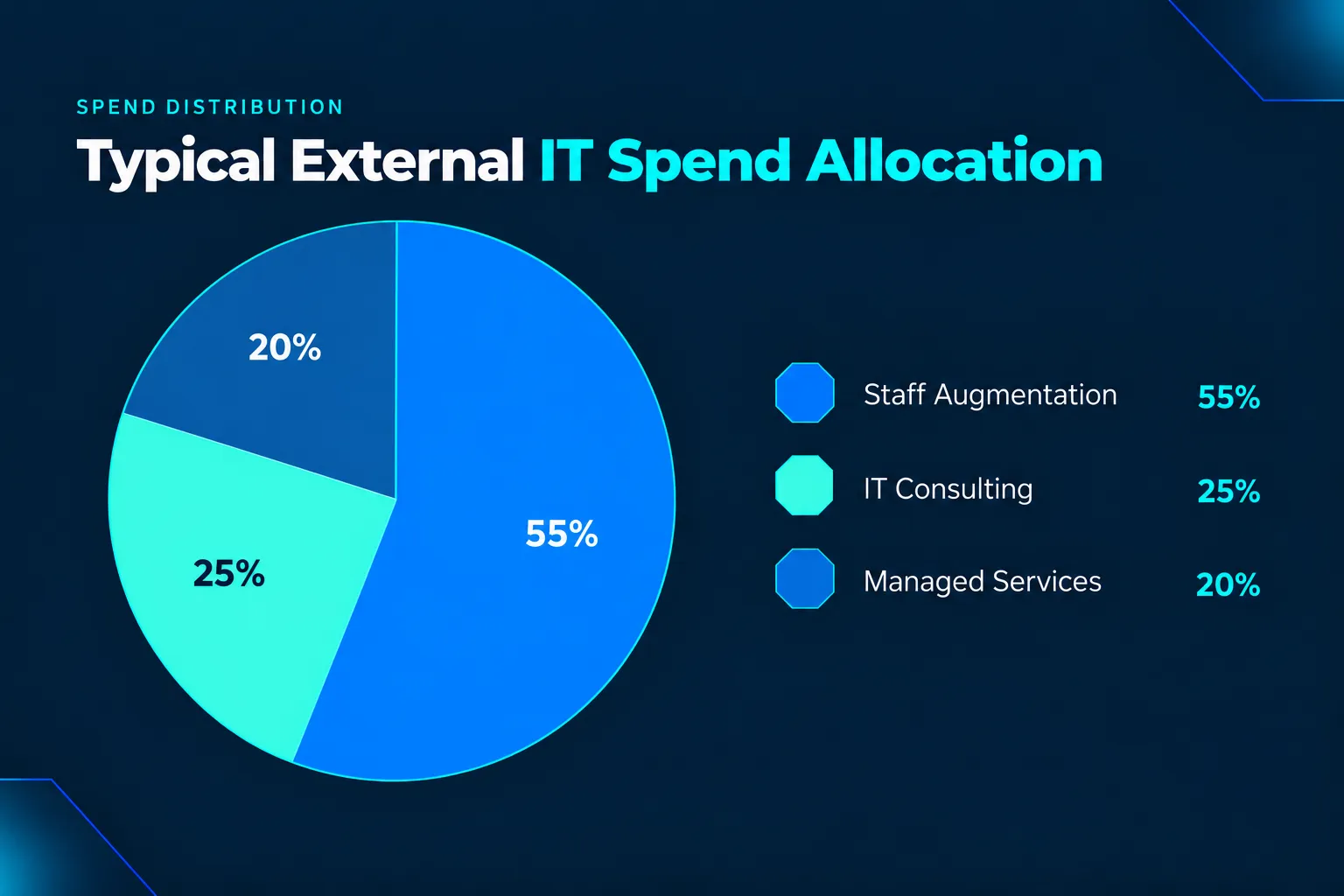
How Companies Typically Split Their External IT Spend
Spend patterns vary by company size and maturity, but a common pattern among mid-size tech organizations leans heavily toward augmentation for ongoing execution, with smaller, sharper bursts of consulting and managed services layered in.
How to Choose a Vendor
Whether the need is augmentation or consulting, a few screening questions cut through most marketing copy fast:
- Can they show engineers or consultants with direct experience in the specific stack, not just adjacent ones?
- What's the replacement policy if a placed engineer isn't performing?
- How is intellectual property and code ownership handled contractually?
- What's the actual time zone overlap with the internal team?
- Do they offer a trial period or paid pilot before a longer commitment?
References matter more here than in most procurement decisions — ask for a client in a similar industry and actually call them.
Final Thoughts
There's no universally "better" model here — only a better fit for the problem in front of a team. Staff augmentation solves a capacity problem. Consulting solves a clarity problem. Managed services solves an ownership problem. Most mature IT organizations end up drawing from all three at different points in a product's life.
The real work is being honest about which problem is actually being solved before signing a contract. Get that diagnosis right, and the rest — vendor selection, pricing, onboarding — gets a lot easier to navigate.
Frequently Asked Questions
Topics
IT Consulting and Staff Augmentation Guide for 2026

Quick Summary: IT staff augmentation adds vetted external developers or engineers to an existing team under in-house direction, while IT consulting brings in outside experts to diagnose problems and recommend a strategy. Staff augmentation suits teams that already know what needs building and just need more hands; consulting suits teams that need direction before they even start building. Most growing companies end up using both at different stages of a project.
Every engineering leader eventually hits the same wall: too much roadmap, not enough headcount. Hiring takes months. Budgets don't stretch that far. And the skill gap on the team is usually narrower than a full-time hire would justify.
That's the moment IT consulting and staff augmentation both start looking attractive. They solve overlapping problems but in very different ways, and picking the wrong one wastes money and time. This guide breaks down what each model actually delivers, what it costs, and how to decide between them without guessing.
What Is IT Staff Augmentation?
Staff augmentation means bringing in external professionals — developers, QA engineers, DevOps specialists, data analysts — to work inside an existing team, under existing management, for a defined stretch of time. The augmented staff don't own the project. They execute against a backlog someone else has already prioritized.
Think of it as renting capacity rather than buying expertise. A company that already knows exactly what it needs to build, but doesn't have enough engineers to build it fast enough, is the classic staff augmentation use case. The vendor handles recruiting, payroll, and compliance; the client handles direction, code review, and day-to-day management.
What Is IT Consulting?
Consulting flips the equation. Instead of adding hands, it adds a brain. A consulting engagement typically starts with a discovery phase — audits, interviews, technical assessments — and ends with a recommendation: an architecture, a roadmap, a migration plan, a vendor selection. The consultant might implement part of that plan too, but the core deliverable is judgment, not headcount.
Companies reach for consulting when they're not sure what "right" even looks like yet. Should the platform move to microservices? Is the cloud spend out of control because of architecture or because of habits? A staff augmentation contractor won't answer that. A consultant will.
Staff Augmentation vs Consulting vs Managed Services
There's a third option that gets lumped in with these two, and it deserves its own line: managed services. Staff augmentation buys hands a client directs. Consulting buys a recommendation the client acts on. Managed services buys an outcome — the vendor owns delivery, staffing, and results under a service-level agreement, with far less day-to-day client oversight.
Staff Augmentation vs Contractors: What's Actually Different?
On paper, an independent contractor and an augmented staff member look similar — both are external, both bill hourly or on retainer. The real difference is process. A staff augmentation partner typically pre-vets candidates against a technical bar, handles replacement if someone doesn't work out, and manages contracts and compliance across regions. Hiring a lone contractor means doing all of that sourcing and vetting internally, which is fine for a single specialist but doesn't scale well past two or three people.
When Staff Augmentation Makes Sense
- A product deadline is fixed and the backlog is bigger than current capacity.
- A specific, narrow skill is missing — say, a Kubernetes specialist for a two-month migration.
- Full-time hiring would take too long or the need isn't permanent.
- Internal leads already know the architecture and just need more execution capacity.
- Budget needs to stay flexible; augmented staff can be scaled up or down between sprints.
It tends to work poorly when the internal team lacks the technical leadership to direct outside contributors — augmented staff amplify existing direction, they don't create it.
When Consulting Makes More Sense
Consulting earns its cost when the question is bigger than "who can build this." Cloud cost overruns, security posture reviews, legacy system modernization decisions, or choosing between build-vs-buy for a core platform — these all benefit from an outside perspective that isn't tangled up in internal politics or sunk-cost thinking.
A useful rule of thumb: if the engagement starts with "we need to figure out what to do," that's consulting. If it starts with "we already know what to do, we just need more people," that's staff augmentation.
Combine IT Consulting and Staff Augmentation with NeoWork
IT consulting and staff augmentation can help companies close technical gaps while adding execution capacity to existing teams. NeoWork provides remote professionals across software engineering, data science, cloud architecture, IT, and related technical functions. NeoWork handles recruitment, benefits, training, and ongoing engagement, while teammates work within the client’s systems and delivery processes. Its 91% annualized teammate retention rate and 3.2% candidate selectivity rate reflect a focus on selective hiring and longer-term team stability.
NeoWork's technical staffing model offers:
- technical professionals across multiple functions
- integration with the client’s tools and processes
- recruitment and ongoing teammate support
Contact NeoWork to add technical capacity around your current projects and operational needs.
How Much Does Each Model Cost?
Pricing varies heavily by region, seniority, and specialization, so treat any number here as a rough planning range rather than a quote — check current rate cards on vendor sites for anything binding.
Consulting almost always costs more per hour because clients are paying for judgment concentrated into a shorter engagement, not for sustained execution. Staff augmentation costs less per hour but usually runs for months rather than weeks, so total spend can end up comparable or higher over a full project.
Best Practices for Managing Augmented Staff
Bringing in outside talent is the easy part. Getting real productivity out of it is where most companies stumble. A few practices consistently separate the engagements that work from the ones that quietly fail:
- Assign a real internal owner. Augmented staff need someone accountable for their priorities, not a rotating cast of Slack messages.
- Document before onboarding. Architecture docs, coding standards, and a working local environment cut ramp-up time dramatically.
- Include them in rituals. Standups, retros, and planning sessions turn "outside contractors" into functioning team members faster than any onboarding doc.
- Set a review cadence. Thirty and sixty-day check-ins catch mismatches before they become expensive.
- Plan the offboarding. Knowledge transfer shouldn't be an afterthought on the last day of the contract.
Common Pitfalls
The most frequent mistake is treating staff augmentation as a substitute for technical leadership rather than a multiplier of it. Adding five contractors to a team with no clear architecture just produces five times the inconsistent code, faster. Another common trap: picking a vendor purely on hourly rate. Cheap talent that needs constant rework isn't actually cheap once management overhead gets factored in.
On the consulting side, the biggest risk is a report that never gets implemented. A brilliant strategy document is worthless if nobody owns turning it into action after the consultant leaves.
How Companies Typically Split Their External IT Spend
Spend patterns vary by company size and maturity, but a common pattern among mid-size tech organizations leans heavily toward augmentation for ongoing execution, with smaller, sharper bursts of consulting and managed services layered in.
How to Choose a Vendor
Whether the need is augmentation or consulting, a few screening questions cut through most marketing copy fast:
- Can they show engineers or consultants with direct experience in the specific stack, not just adjacent ones?
- What's the replacement policy if a placed engineer isn't performing?
- How is intellectual property and code ownership handled contractually?
- What's the actual time zone overlap with the internal team?
- Do they offer a trial period or paid pilot before a longer commitment?
References matter more here than in most procurement decisions — ask for a client in a similar industry and actually call them.
Final Thoughts
There's no universally "better" model here — only a better fit for the problem in front of a team. Staff augmentation solves a capacity problem. Consulting solves a clarity problem. Managed services solves an ownership problem. Most mature IT organizations end up drawing from all three at different points in a product's life.
The real work is being honest about which problem is actually being solved before signing a contract. Get that diagnosis right, and the rest — vendor selection, pricing, onboarding — gets a lot easier to navigate.
Frequently Asked Questions
Topics
Related Blogs
Related Podcasts


.webp)

.webp)
.webp)



