
Green glowing circular pattern with concentric rings and faint hexagonal grid on the left side.
Blue abstract hexagonal pattern with glowing circular gradient edges on a black background.Glowing greenish-blue hexagonal pattern with concentric circular gradients on a black background.

Java Team Augmentation Guide: How It Works in 2026

Calendar Icon
Published:
Oct 29
2026
,
Updated:
Oct 30
2026
Ann
Facebook IconInstagram Icon

Build your team with NeoWork

Talk to us about how we staff and manage high-performing remote teams for companies like yours.

Get a Java Team Augmentation Quote

Quick Summary: Java team augmentation is when a company adds external Java engineers, or a complete Java pod, to its existing development team to deliver features, modernize legacy systems, or scale backend capacity. The augmented engineers work in your repositories and processes and report to your engineering leadership. Java remains one of the most widely used languages in enterprise software and consistently ranks among the most used programming languages in Stack Overflow's developer surveys. Recent long-term support releases, Java 21 and Java 25, brought features such as virtual threads, record patterns, and better performance, which gives many companies a strong reason to modernize. This guide covers Java roles you can add, when augmentation makes sense, how to vet Java engineers, what it costs, and how to onboard an augmented team.

Java runs a large share of the systems businesses depend on: banking platforms, insurance cores, ecommerce backends, logistics systems, and internal enterprise applications. Many of those systems are years or decades old, still running on Java 8 or 11, with monolithic architectures and limited test coverage. At the same time, teams are asked to build new APIs, move to the cloud, integrate AI features, and keep everything secure.

Java team augmentation gives you experienced engineers to handle that load without months of recruiting. This guide explains how to set it up so the new engineers add capacity instead of complexity.

What Is Java Team Augmentation?

Java team augmentation is an engagement model in which a provider supplies dedicated Java developers who integrate with your engineering organization. They pick up work from your backlog, follow your coding standards, participate in code reviews and sprint ceremonies, and use your CI/CD pipelines. The provider handles recruiting, employment, benefits, and replacements.

You can add individual engineers to strengthen an existing team, or a pod with a technical lead, backend engineers, and QA to own a workstream such as a migration or a new service.
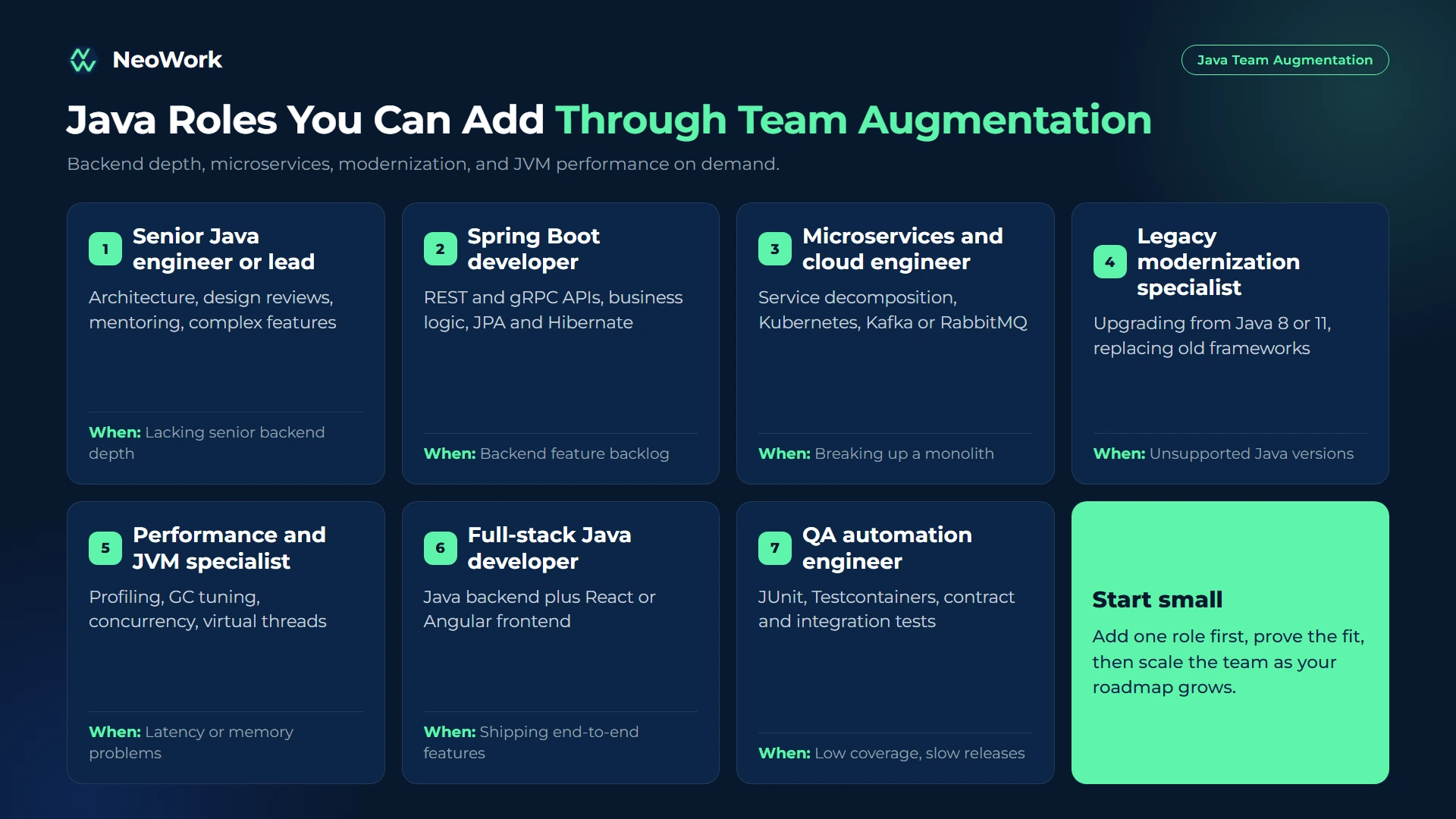
Java Roles You Can Add

Role What They Do When You Need One
Senior Java engineer or tech lead Architecture, design reviews, mentoring, complex features Your team lacks senior backend depth
Spring Boot backend developer REST and gRPC APIs, business logic, data access with JPA and Hibernate Backlog of backend features and services
Microservices and cloud engineer Service decomposition, Kubernetes, messaging with Kafka or RabbitMQ Breaking up a monolith or scaling services
Legacy modernization specialist Upgrading from Java 8 or 11, replacing outdated frameworks, refactoring Running unsupported Java versions or legacy stacks
Performance and JVM specialist Profiling, garbage collection tuning, concurrency, virtual threads Latency, memory, or throughput problems
Full-stack Java developer Java backend plus a frontend framework such as React or Angular Product teams shipping end-to-end features
QA automation engineer JUnit, Testcontainers, contract and integration tests, CI pipelines Low test coverage or slow releases
Java team augmentation roles including senior Java engineer, Spring Boot developer, microservices engineer, legacy modernization specialist, JVM performance specialist, full-stack Java developer, and QA automation engineer

Scale Your Java Team With Vetted Engineers

At NeoWork, we help companies add dedicated Java engineers and complete development teams that work inside their codebase, tools, and engineering process. We recruit for your stack and seniority needs, onboard engineers into your workflows, and handle employment, benefits, and ongoing teammate support.

Our model includes:

  • Dedicated Java developers or full pods integrated into your sprints and code reviews
  • A 3.2% candidate selectivity rate, with hands-on Java technical assessments
  • Industry-leading 91% annualized teammate retention rate, so system knowledge stays on your team
  • Team size that scales up or down with your roadmap

Contact us to share your Java stack and goals. We will propose engineer profiles and a team setup that fit.

When Java Team Augmentation Makes Sense

Legacy modernization is the most common reason companies augment Java teams. Moving from Java 8 or 11 to a current LTS release, or from an older framework to Spring Boot, is a large, focused effort that internal teams struggle to fit around their daily responsibilities. Augmented engineers who have done similar migrations can work through the upgrade path systematically while your team keeps the business running.

Monolith decomposition is a close second. Breaking a large application into services requires experience with service boundaries, messaging, data ownership, and observability, and mistakes are expensive to undo. Adding engineers who have done this before reduces the risk considerably. In both cases, augmentation also brings in specialist skills such as JVM tuning or Kafka that may not exist on your current team.

Finally, many enterprises simply have more roadmap than capacity. Java roadmaps in large organizations rarely shrink, and senior Java hiring is slow and competitive. Augmentation lets you match capacity to demand without permanently expanding headcount, which is especially useful in regulated industries where every new hire also goes through lengthy compliance processes.

Java Team Augmentation vs. Other Models

Model Who Manages Delivery Best For Trade-Offs
Team augmentation Your engineering leads Ongoing development, modernization, added capacity Needs internal technical leadership
Project outsourcing The vendor Fixed-scope builds with clear specifications Less control and knowledge transfer
Managed services The vendor, under SLAs Maintaining stable systems Little room for new development
In-house hiring Your team Long-term core roles Slow and costly for senior engineers

If you want to compare locations, our overviews of nearshore staff augmentation companies and offshore staff augmentation companies cover the trade-offs.

How to Vet Java Engineers

  • Core Java depth: Collections, generics, streams, exceptions, and concurrency fundamentals.
  • Modern Java features: Records, sealed classes, pattern matching, and virtual threads, all available in Java 21 and later.
  • Spring ecosystem: Spring Boot, Spring Data, Spring Security, configuration, and testing.
  • Data access: JPA and Hibernate pitfalls such as lazy loading problems and N+1 queries, plus SQL skills.
  • Distributed systems: Messaging, idempotency, retries, transactions across services, and observability.
  • Testing: JUnit, Mockito, Testcontainers, and integration testing strategies.
  • Practical exercise: A small service with an API, persistence, and tests, or a review of an existing pull request, shows real skills better than algorithm puzzles.

How Much Does Java Team Augmentation Cost?

Java engineer rates depend on seniority, specialization, and location. Senior engineers with microservices, cloud, or JVM performance experience cost more than mid-level developers. Common pricing models:

  • Monthly rate per engineer: A fixed fee per dedicated full-time developer. The most common model.
  • Monthly team rate: A single price for a full pod with lead, engineers, and QA.
  • Hourly rate: For part-time or short engagements.

Nearshore and offshore markets with strong Java communities can offer experienced engineers at significantly lower cost than onshore hiring. See how we structure dedicated teams on our pricing page.

How to Onboard an Augmented Java Team

[Insert infographic here: java-team-augmentation-onboarding.png - How to Onboard an Augmented Java Team]

Alt text: Java team augmentation onboarding steps from architecture walkthrough and environment setup to first tickets, code reviews, service ownership, and monthly reviews

  1. Document the architecture. Share service maps, data flows, deployment diagrams, and known technical debt.
  2. Prepare environments. Make sure services build and run locally or in dev environments with clear instructions.
  3. Grant access by role. Use individual accounts for repositories, CI/CD, cloud consoles, and observability tools, with least-privilege permissions.
  4. Start with contained tickets. Bug fixes and small features in one service help engineers learn safely.
  5. Use code reviews actively. Align on patterns, naming, error handling, and test expectations.
  6. Hand over ownership. Assign services or modules to the augmented engineers once they are productive.
  7. Review regularly. Track delivery, defect rates, and collaboration, and adjust the team as needed.

Questions Worth Asking Any Provider

  • How do you assess Java and Spring skills?
  • Have your engineers modernized legacy Java systems?
  • Can we interview engineers before they join?
  • What time zone overlap will we have?
  • How do you handle replacements and knowledge transfer?
  • Who owns the code and intellectual property?

Common Java Team Augmentation Mistakes

The most expensive mistake is adding engineers to a system nobody has documented. New engineers cannot make good decisions in a system they do not understand, and in large Java codebases the result is often duplicated logic, inconsistent patterns, and subtle bugs at service boundaries. A few days spent on architecture documentation pays back many times over.

A second mistake is growing the team without a modernization plan. Adding capacity to a system that runs on an unsupported Java version simply increases the amount of code that will eventually need to be upgraded. Unclear ownership causes similar problems: shared services without a designated owner tend to collect conflicting changes and regressions.

Testing is the last common gap. Large Java systems need strong automated tests before any team, internal or augmented, can move quickly without breaking things. And as with any technical role, choosing purely on rate tends to backfire, because inexperienced engineers can introduce performance and security problems that are expensive to fix.

Final Thoughts

Java team augmentation is a reliable way to add backend capacity, modernize legacy systems, and bring in specialist skills without long hiring cycles. It works best when you document your architecture, vet engineers on practical skills, keep ownership clear, and treat augmented engineers as part of your team.

If your Java roadmap needs more hands, explore our software development teams at NeoWork.

FAQ

What is Java team augmentation?

It is a model where an external provider supplies dedicated Java engineers who join your development team, work in your codebase and processes, and report to your engineering leads.

Why do companies augment Java teams?

Common reasons include legacy modernization, microservices migrations, growing backlogs, and the need for specialist skills such as JVM performance tuning or Kafka.

Which Java version should augmented engineers know?

Ideally they know both your current version and modern LTS releases such as Java 21 and Java 25, so they can maintain today's code and help you upgrade.

How much does Java team augmentation cost?

Most providers charge a monthly rate per engineer or a monthly team rate. Cost depends on seniority, specialization, and location.

Can augmented engineers work on regulated systems?

Yes, with the right controls: individual accounts, least-privilege access, secure coding standards, code reviews, and compliance with your industry's requirements.

How quickly can augmented Java engineers start?

Providers can often present candidates within days to a couple of weeks. With good documentation and environments, engineers usually contribute within the first sprint.

Should I add individual engineers or a full pod?

Add individuals to strengthen an existing team. Add a pod when you want a group to own a service, a migration, or a new product area end to end.

Topics
No items found.

Java Team Augmentation Guide: How It Works in 2026

Paper
Calendar Icon
Oct 29, 2026
Ann

Quick Summary: Java team augmentation is when a company adds external Java engineers, or a complete Java pod, to its existing development team to deliver features, modernize legacy systems, or scale backend capacity. The augmented engineers work in your repositories and processes and report to your engineering leadership. Java remains one of the most widely used languages in enterprise software and consistently ranks among the most used programming languages in Stack Overflow's developer surveys. Recent long-term support releases, Java 21 and Java 25, brought features such as virtual threads, record patterns, and better performance, which gives many companies a strong reason to modernize. This guide covers Java roles you can add, when augmentation makes sense, how to vet Java engineers, what it costs, and how to onboard an augmented team.

Java runs a large share of the systems businesses depend on: banking platforms, insurance cores, ecommerce backends, logistics systems, and internal enterprise applications. Many of those systems are years or decades old, still running on Java 8 or 11, with monolithic architectures and limited test coverage. At the same time, teams are asked to build new APIs, move to the cloud, integrate AI features, and keep everything secure.

Java team augmentation gives you experienced engineers to handle that load without months of recruiting. This guide explains how to set it up so the new engineers add capacity instead of complexity.

What Is Java Team Augmentation?

Java team augmentation is an engagement model in which a provider supplies dedicated Java developers who integrate with your engineering organization. They pick up work from your backlog, follow your coding standards, participate in code reviews and sprint ceremonies, and use your CI/CD pipelines. The provider handles recruiting, employment, benefits, and replacements.

You can add individual engineers to strengthen an existing team, or a pod with a technical lead, backend engineers, and QA to own a workstream such as a migration or a new service.

Java Roles You Can Add

Role What They Do When You Need One
Senior Java engineer or tech lead Architecture, design reviews, mentoring, complex features Your team lacks senior backend depth
Spring Boot backend developer REST and gRPC APIs, business logic, data access with JPA and Hibernate Backlog of backend features and services
Microservices and cloud engineer Service decomposition, Kubernetes, messaging with Kafka or RabbitMQ Breaking up a monolith or scaling services
Legacy modernization specialist Upgrading from Java 8 or 11, replacing outdated frameworks, refactoring Running unsupported Java versions or legacy stacks
Performance and JVM specialist Profiling, garbage collection tuning, concurrency, virtual threads Latency, memory, or throughput problems
Full-stack Java developer Java backend plus a frontend framework such as React or Angular Product teams shipping end-to-end features
QA automation engineer JUnit, Testcontainers, contract and integration tests, CI pipelines Low test coverage or slow releases
Java team augmentation roles including senior Java engineer, Spring Boot developer, microservices engineer, legacy modernization specialist, JVM performance specialist, full-stack Java developer, and QA automation engineer

Scale Your Java Team With Vetted Engineers

At NeoWork, we help companies add dedicated Java engineers and complete development teams that work inside their codebase, tools, and engineering process. We recruit for your stack and seniority needs, onboard engineers into your workflows, and handle employment, benefits, and ongoing teammate support.

Our model includes:

  • Dedicated Java developers or full pods integrated into your sprints and code reviews
  • A 3.2% candidate selectivity rate, with hands-on Java technical assessments
  • Industry-leading 91% annualized teammate retention rate, so system knowledge stays on your team
  • Team size that scales up or down with your roadmap

Contact us to share your Java stack and goals. We will propose engineer profiles and a team setup that fit.

When Java Team Augmentation Makes Sense

Legacy modernization is the most common reason companies augment Java teams. Moving from Java 8 or 11 to a current LTS release, or from an older framework to Spring Boot, is a large, focused effort that internal teams struggle to fit around their daily responsibilities. Augmented engineers who have done similar migrations can work through the upgrade path systematically while your team keeps the business running.

Monolith decomposition is a close second. Breaking a large application into services requires experience with service boundaries, messaging, data ownership, and observability, and mistakes are expensive to undo. Adding engineers who have done this before reduces the risk considerably. In both cases, augmentation also brings in specialist skills such as JVM tuning or Kafka that may not exist on your current team.

Finally, many enterprises simply have more roadmap than capacity. Java roadmaps in large organizations rarely shrink, and senior Java hiring is slow and competitive. Augmentation lets you match capacity to demand without permanently expanding headcount, which is especially useful in regulated industries where every new hire also goes through lengthy compliance processes.

Java Team Augmentation vs. Other Models

Model Who Manages Delivery Best For Trade-Offs
Team augmentation Your engineering leads Ongoing development, modernization, added capacity Needs internal technical leadership
Project outsourcing The vendor Fixed-scope builds with clear specifications Less control and knowledge transfer
Managed services The vendor, under SLAs Maintaining stable systems Little room for new development
In-house hiring Your team Long-term core roles Slow and costly for senior engineers

If you want to compare locations, our overviews of nearshore staff augmentation companies and offshore staff augmentation companies cover the trade-offs.

How to Vet Java Engineers

  • Core Java depth: Collections, generics, streams, exceptions, and concurrency fundamentals.
  • Modern Java features: Records, sealed classes, pattern matching, and virtual threads, all available in Java 21 and later.
  • Spring ecosystem: Spring Boot, Spring Data, Spring Security, configuration, and testing.
  • Data access: JPA and Hibernate pitfalls such as lazy loading problems and N+1 queries, plus SQL skills.
  • Distributed systems: Messaging, idempotency, retries, transactions across services, and observability.
  • Testing: JUnit, Mockito, Testcontainers, and integration testing strategies.
  • Practical exercise: A small service with an API, persistence, and tests, or a review of an existing pull request, shows real skills better than algorithm puzzles.

How Much Does Java Team Augmentation Cost?

Java engineer rates depend on seniority, specialization, and location. Senior engineers with microservices, cloud, or JVM performance experience cost more than mid-level developers. Common pricing models:

  • Monthly rate per engineer: A fixed fee per dedicated full-time developer. The most common model.
  • Monthly team rate: A single price for a full pod with lead, engineers, and QA.
  • Hourly rate: For part-time or short engagements.

Nearshore and offshore markets with strong Java communities can offer experienced engineers at significantly lower cost than onshore hiring. See how we structure dedicated teams on our pricing page.

How to Onboard an Augmented Java Team

[Insert infographic here: java-team-augmentation-onboarding.png - How to Onboard an Augmented Java Team]

Alt text: Java team augmentation onboarding steps from architecture walkthrough and environment setup to first tickets, code reviews, service ownership, and monthly reviews

  1. Document the architecture. Share service maps, data flows, deployment diagrams, and known technical debt.
  2. Prepare environments. Make sure services build and run locally or in dev environments with clear instructions.
  3. Grant access by role. Use individual accounts for repositories, CI/CD, cloud consoles, and observability tools, with least-privilege permissions.
  4. Start with contained tickets. Bug fixes and small features in one service help engineers learn safely.
  5. Use code reviews actively. Align on patterns, naming, error handling, and test expectations.
  6. Hand over ownership. Assign services or modules to the augmented engineers once they are productive.
  7. Review regularly. Track delivery, defect rates, and collaboration, and adjust the team as needed.

Questions Worth Asking Any Provider

  • How do you assess Java and Spring skills?
  • Have your engineers modernized legacy Java systems?
  • Can we interview engineers before they join?
  • What time zone overlap will we have?
  • How do you handle replacements and knowledge transfer?
  • Who owns the code and intellectual property?

Common Java Team Augmentation Mistakes

The most expensive mistake is adding engineers to a system nobody has documented. New engineers cannot make good decisions in a system they do not understand, and in large Java codebases the result is often duplicated logic, inconsistent patterns, and subtle bugs at service boundaries. A few days spent on architecture documentation pays back many times over.

A second mistake is growing the team without a modernization plan. Adding capacity to a system that runs on an unsupported Java version simply increases the amount of code that will eventually need to be upgraded. Unclear ownership causes similar problems: shared services without a designated owner tend to collect conflicting changes and regressions.

Testing is the last common gap. Large Java systems need strong automated tests before any team, internal or augmented, can move quickly without breaking things. And as with any technical role, choosing purely on rate tends to backfire, because inexperienced engineers can introduce performance and security problems that are expensive to fix.

Final Thoughts

Java team augmentation is a reliable way to add backend capacity, modernize legacy systems, and bring in specialist skills without long hiring cycles. It works best when you document your architecture, vet engineers on practical skills, keep ownership clear, and treat augmented engineers as part of your team.

If your Java roadmap needs more hands, explore our software development teams at NeoWork.

FAQ

What is Java team augmentation?

It is a model where an external provider supplies dedicated Java engineers who join your development team, work in your codebase and processes, and report to your engineering leads.

Why do companies augment Java teams?

Common reasons include legacy modernization, microservices migrations, growing backlogs, and the need for specialist skills such as JVM performance tuning or Kafka.

Which Java version should augmented engineers know?

Ideally they know both your current version and modern LTS releases such as Java 21 and Java 25, so they can maintain today's code and help you upgrade.

How much does Java team augmentation cost?

Most providers charge a monthly rate per engineer or a monthly team rate. Cost depends on seniority, specialization, and location.

Can augmented engineers work on regulated systems?

Yes, with the right controls: individual accounts, least-privilege access, secure coding standards, code reviews, and compliance with your industry's requirements.

How quickly can augmented Java engineers start?

Providers can often present candidates within days to a couple of weeks. With good documentation and environments, engineers usually contribute within the first sprint.

Should I add individual engineers or a full pod?

Add individuals to strengthen an existing team. Add a pod when you want a group to own a service, a migration, or a new product area end to end.

Topics

No items found.
Blue gradient banner with rounded corners at the top.
CTA Hexagon LeftCTA Hexagon LeftCTA Hexagon RightCTA Hexagon Right Mobile

Navigate the shadows of tech leadership – all while enjoying the comfort food that binds us all.

CTA Hexagon LeftCTA Hexagon LeftCTA Hexagon RightCTA Hexagon Right Mobile

Book a consultation

Build your team with NeoWork

Talk to us about how we staff and manage high-performing remote teams for companies like yours.