

.avif)
.avif)

Link Building Outsourcing Guide: 2026 Expert Tips


.svg)

Link building outsourcing involves delegating backlink acquisition to specialized agencies, freelancers, or white-label providers to save time, access expertise, and scale SEO efforts. According to Search Engine Land, a reasonable cost per link is between $300 and $500+, with 95% of companies recommended to outsource link building according to an industry expert with 17 years of experience. This guide covers when to outsource, how to select providers, cost structures, and best practices for 2026.
Building backlinks is one of those SEO tasks everyone agrees matters, but few people actually want to do. It's time-intensive, requires specialized skills, and the results can feel unpredictable.
Here's the reality: with over 66% of pages having zero backlinks pointing to them, having a strong link profile isn't optional anymore. But building that profile in-house? That's where things get complicated.
Outsourcing link building has become the pragmatic solution for businesses that want results without burning internal resources. This isn't about taking shortcuts. It's about recognizing that specialized providers can often build better links, faster, and at a lower total cost than internal teams.
This guide breaks down everything about link building outsourcing in 2026—from cost structures to provider selection, warning signs to watch for, and the specific scenarios where outsourcing makes strategic sense.
What Link Building Outsourcing Actually Means
Link building outsourcing is the practice of delegating backlink acquisition to external specialists rather than handling it internally. These specialists can be agencies, freelancers, white-label providers, or link building marketplaces.
The core concept is simple: instead of your team spending 10-20 hours per week on outreach, negotiation, content creation, and relationship management, you pay experts who already have the infrastructure, relationships, and experience to do it more effectively.
But it's not just about offloading work. Outsourcing gives access to established networks of publishers, refined outreach templates that actually get responses, and technical expertise in evaluating link quality.
The Three Main Outsourcing Models
Understanding the different approaches helps in selecting the right fit for specific business needs.
White-label services represent a specialized category—these providers operate under an agency's brand, making them ideal for marketing agencies that want to offer link building without building that capability internally.
When Outsourcing Makes Strategic Sense
Not every situation calls for outsourcing. Some companies genuinely benefit from keeping link building in-house. The decision comes down to specific business conditions and resource availability.
Clear Signals That Outsourcing Is the Right Move
Certain patterns indicate that external help will deliver better ROI than internal efforts:
- Ranking plateaus despite solid content and technical SEO: When on-page optimization and technical fixes stop moving the needle, the missing piece is almost always link authority. This is particularly common for sites stuck on pages two or three of search results.
- Outreach consuming 10-20 hours per week with minimal results: If internal teams are spending significant time on outreach but seeing acceptance rates below 5%, that's a signal that specialized expertise would deliver better efficiency.
- Need to scale from 5-10 links to 20-50+ monthly: Scaling link acquisition requires infrastructure—outreach tools, publisher databases, relationship management systems. Building that infrastructure internally rarely makes financial sense unless operating at very high volumes.
- Operating in competitive niches like SaaS, fintech, or healthcare: These industries require high-authority links from specialized publishers. Generic outreach approaches don't work. Providers with established relationships in these verticals deliver dramatically better results.
When In-House Makes More Sense
In-house link building offers advantages when certain conditions are met.
Companies with dedicated link building teams of two or more specialists, established publisher relationships in their niche, and budgets supporting $60,000-$100,000+ annual salaries often see better results keeping the function internal.
Full control over brand messaging, direct relationship ownership, and the ability to move instantly on time-sensitive opportunities represent genuine advantages. But these benefits come with high costs—not just salaries, but tools, training, and management overhead.
Understanding Link Building Costs in 2026
Pricing varies dramatically based on link quality, provider type, and industry. Having realistic cost expectations prevents both overpaying and falling for suspiciously cheap offers.
Market Rate Benchmarks
According to Search Engine Land's analysis of white-label link building services, a reasonable cost per link is between $300 and $500. Prices significantly below this range should raise red flags about quality or methodology.
Freelancers in the US typically charge nearly $45-$50 per hour. Experienced SEO freelancers and link building specialists in the US typically charge between $50 and $150+ per hour. The wide range reflects experience levels, specialization, and geographic location. Offshore freelancers may offer lower rates, but communication challenges and quality consistency become considerations.
Full-service agencies structure pricing differently. Campaign-based pricing ranges from $150 for 1–3 links to $5,000+ for full link-building campaigns.
What Drives Cost Variations
Link quality isn't uniform. Several factors influence pricing legitimately:
- Domain authority and traffic: Links from sites with Domain Rating above 50 and organic traffic above 10,000 monthly visitors command premium pricing. These metrics correlate with genuine link value.
- Editorial placement requirements: Links requiring custom content creation cost more than those added to existing content. Guest posts requiring 1,500+ words of original content naturally carry higher price tags than link insertions.
- Industry specialization: Healthcare, legal, and financial sectors require links from highly regulated or specialized publishers. These placements cost 2-3x standard rates but deliver proportionally higher authority.
- Link attributes: Dofollow links pass more SEO value than nofollow, though search engines like Google consider both in ranking algorithms. Dofollow links typically cost 20-40% more.
Selecting the Right Link Building Provider
Choosing a partner requires more than comparing price sheets. The wrong provider can waste budgets on low-value links or, worse, damage rankings through black-hat techniques.
Essential Evaluation Criteria
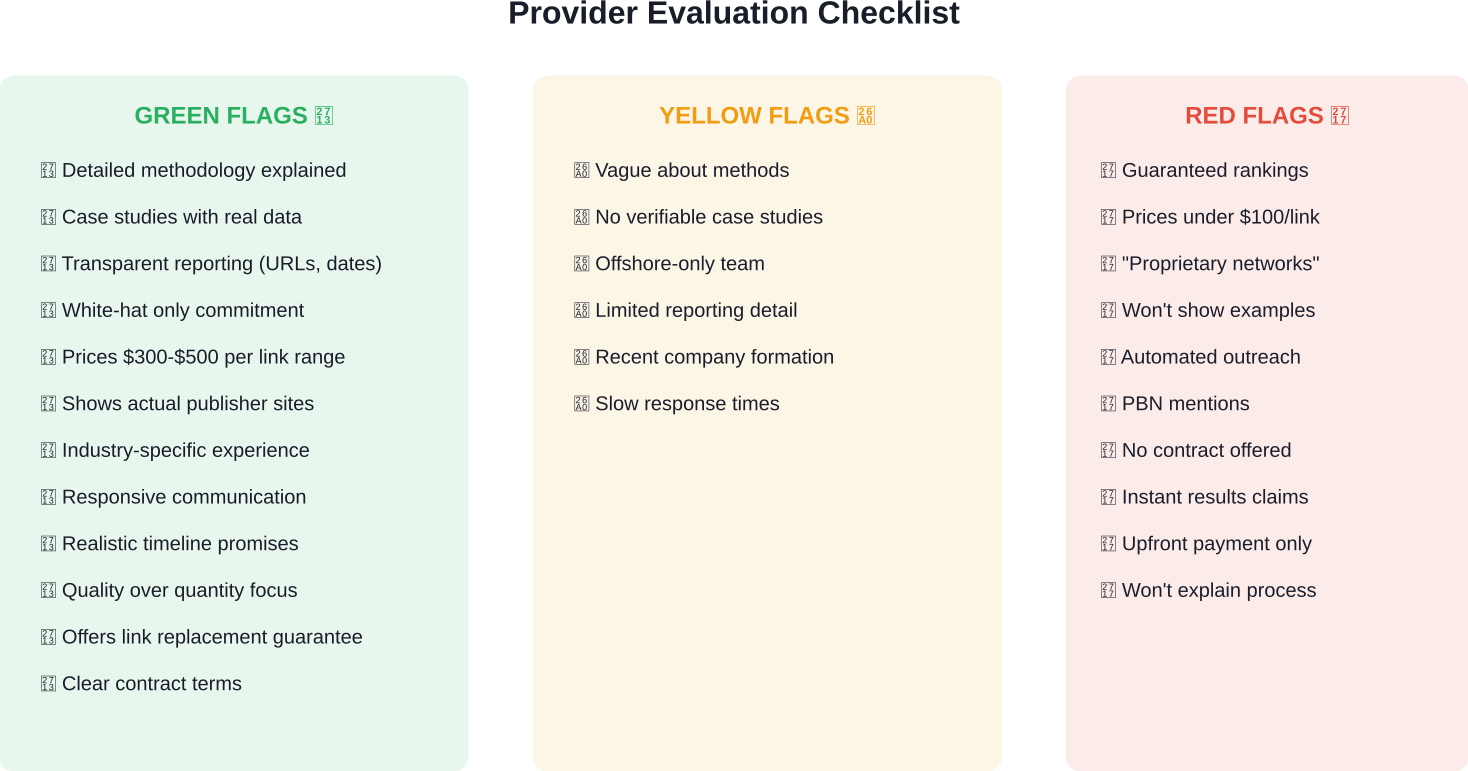
Several non-negotiable factors separate legitimate providers from risky ones:
- Transparent methodology: Reputable providers explain exactly how they acquire links—outreach processes, content creation workflows, and quality criteria. Vague answers or promises of "proprietary networks" are warning signs.
- Verifiable case studies: Look for specific examples showing starting rankings, link acquisition details, and resulting improvements. Generic claims about "hundreds of satisfied clients" without data mean nothing.
- White-hat commitment: Providers should explicitly reject Private Blog Networks (PBNs), link farms, and automated outreach. Ask directly about their stance on these practices and walk away from equivocal answers.
- Reporting and attribution: Quality providers offer detailed reports showing exact URLs where links were placed, anchor text used, link attributes (dofollow vs. nofollow), and placement dates. Lack of transparency here suggests problematic practices.
Questions to Ask During Vetting
Direct questions reveal provider quality faster than marketing materials:
- "Can you show me three actual sites where you've placed links recently?" This separates providers with real publisher relationships from intermediaries or those using questionable methods.
- "What's your acceptance rate on outreach campaigns?" Professional link builders maintain 10-20% acceptance rates. Rates significantly lower suggest poor targeting or weak outreach. Rates significantly higher suggest paid placements being misrepresented as organic.
- "How do you handle links that get removed?" According to Ahrefs data cited in Search Engine Land, 66.5% of links were lost in the previous nine years. Quality providers offer replacement guarantees for links removed within 6-12 months.
- "Do you use PBNs or link farms?" Direct question. Any answer other than an immediate "no" disqualifies the provider.
White-Hat vs. Black-Hat Link Building Methods
Understanding the distinction between legitimate and risky link building practices is critical. Google's algorithms have become sophisticated at detecting manipulative link schemes, and penalties can devastate organic traffic.
What White-Hat Link Building Looks Like
White-hat approaches focus on earning links through genuine value creation and relationship building:
- Guest posting on relevant sites: Creating original, high-quality content for publishers in the same industry or niche. The content provides genuine value to the publisher's audience, and the link is editorially justified.
- Digital PR and newsworthy content: Creating research, data studies, or stories that journalists want to reference. This approach generates links from news sites and authoritative publications organically.
- Resource page outreach: Identifying pages that curate useful resources in a niche and suggesting additions where genuinely relevant. This works because it helps the page owner provide better value to their audience.
- Broken link building: Finding broken links on relevant sites and suggesting replacements with similar content from your site. This approach provides value by helping site owners fix their pages.
Black-Hat Practices to Avoid Completely
These techniques may offer short-term gains but carry significant penalty risks:
- Private Blog Networks (PBNs): Networks of sites created solely to generate backlinks. Google's algorithms detect PBN footprints through hosting patterns, content similarity, and link patterns. Sites using PBNs face manual penalties requiring disavow files and lengthy recovery periods.
- Link farms and exchange schemes: Reciprocal linking arrangements or sites existing only to link out. These are among the easiest manipulative patterns for algorithms to detect.
- Automated link building software: Tools that submit to directories, comment on blogs, or create forum profiles at scale. These generate the lowest-quality links and waste time rather than providing value.
- Hacked site exploitation: Some unethical providers exploit hacked sites to insert links without owner knowledge. According to Moz's guide on avoiding SEO scams, site owners won't be notified about hacks, making this particularly insidious.
The Gray-Hat Middle Ground
Some tactics fall into ambiguous territory—not explicitly violating guidelines but not fully transparent either.
Paid guest posts where the payment isn't disclosed to readers operate in this zone. While the content may be high-quality, failing to disclose the commercial relationship technically violates Federal Trade Commission guidelines on endorsements.
Similarly, links from sponsored content or advertorials require proper disclosure. The FTC's guidance states that even benefits worth only a few dollars require disclosure to consumers.
The safest approach? Stick to genuinely white-hat methods. The marginal gains from gray-hat tactics aren't worth the penalty risk or ethical compromises.
Best Practices for Managing Outsourced Link Building
Outsourcing doesn't mean abdicating responsibility. Effective management ensures quality, maintains brand alignment, and maximizes ROI.
Set Clear Objectives and KPIs
Vague goals produce vague results. Specific targets enable provider accountability.
Define monthly link targets based on realistic expectations—10-15 high-quality links per month represents a solid starting point for most businesses. Specify quality criteria: minimum Domain Rating thresholds (typically DR 30+), relevance requirements (same industry or complementary topics), and traffic minimums for target sites.
According to First Page Sage data, the average click-through rate for Google's first three organic results is 68%. Setting ranking improvement goals for specific keywords provides clearer success metrics than link counts alone.
Implement Proper Vetting Processes
Even with trusted providers, validate link quality before accepting placements.
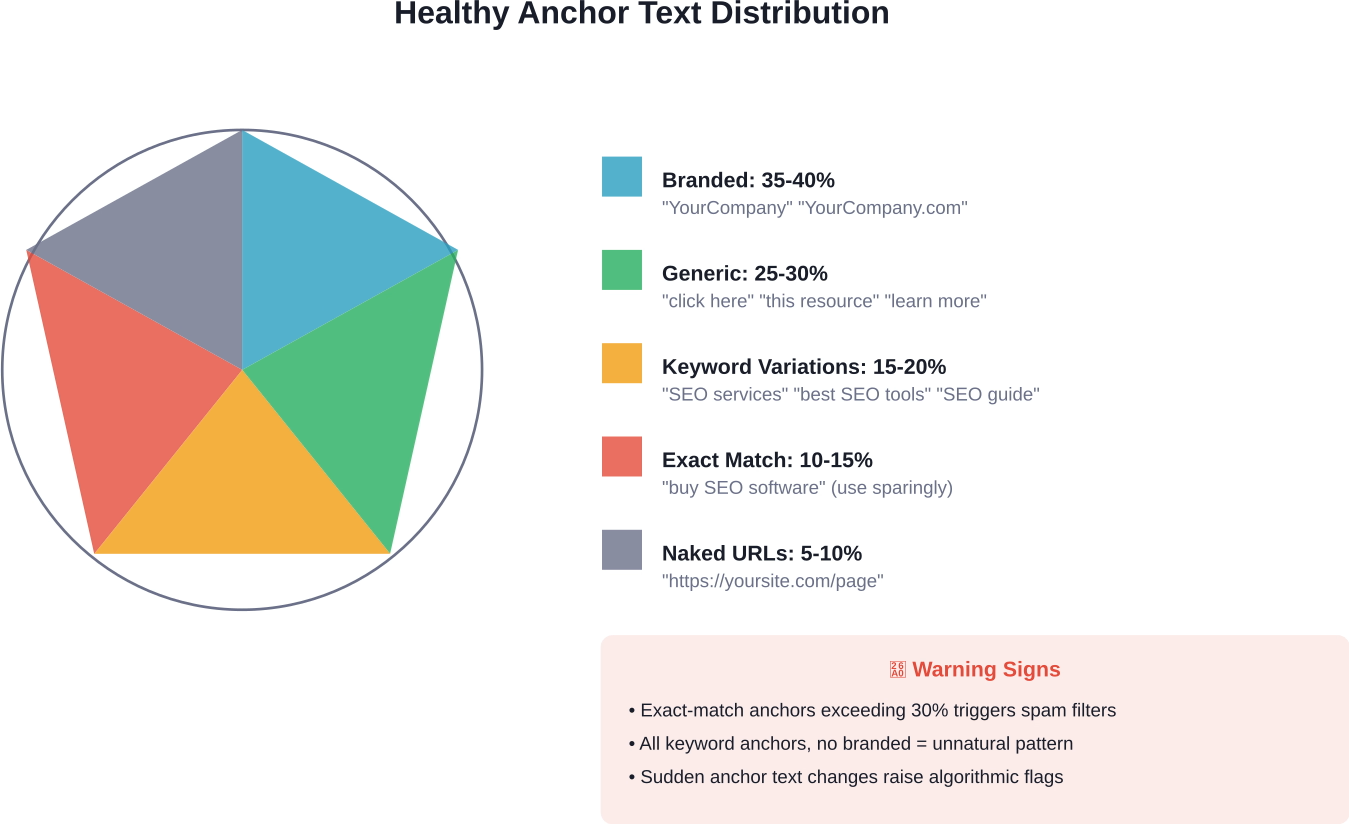
Review each proposed placement site using standard SEO tools. Check Domain Rating, organic traffic estimates, spam scores, and anchor text profiles. Sites with spam scores above 5% or suspicious anchor text ratios (exact-match anchors exceeding 30% of profile) warrant rejection.
Verify relevance manually. Does the linking site's content genuinely relate to your industry? Would the link make sense to a human reader, or does it feel forced?
Check for traffic quality, not just quantity. Sites with high traffic but low engagement metrics (bounce rates above 80%, session durations under 20 seconds) may be delivering low-value visitors or using questionable traffic sources.
Maintain Anchor Text Diversity
Unnatural anchor text patterns trigger algorithmic filters.
A healthy link profile includes branded anchors (company name), generic anchors ("click here," "this article"), naked URLs, and varied keyword anchors. Exact-match keyword anchors should comprise no more than 15-20% of total backlink anchors.
Provide anchor text guidelines to providers. Specify ratios for branded vs. generic vs. keyword anchors and list keyword variations to use rather than repeating identical phrases.
Monitor Link Persistence
Links disappear over time through site redesigns, content deletions, or editorial changes.
Set up monthly link monitoring using tools like Ahrefs or Semrush. These platforms track backlink profiles and alert when links are lost. Given that 66.5% of links were lost in the previous nine years according to Ahrefs data cited in Search Engine Land, ongoing monitoring is essential.
Negotiate link replacement guarantees in provider contracts. Standard terms cover replacements for links lost within 6-12 months of placement.
Align Link Building with Content Strategy
Links work best when supporting content that deserves to rank.
Prioritize link building for pages with strong on-page optimization, valuable content, and clear conversion paths. Building links to thin content wastes resources and sends confusing signals to search engines.
Coordinate content creation with link acquisition. If pursuing guest post placements, align topics with internal content clusters to strengthen topical authority.

Build Link Building That Doesn’t Break After a Few Months
A lot of link building issues come from how it’s structured. Outreach gets handed off, responses sit in different inboxes, and over time it turns into scattered activity rather than something you can rely on.
NeoWork sets things up differently. Instead of passing work between freelancers or agencies, they build a dedicated team that handles link building as an ongoing process. The same people stay involved, track conversations, and keep things moving without restarting campaigns every few weeks. With a 3.2% selection rate, the focus stays on people who can manage that consistency, and a 91% retention rate helps keep the workflow stable.
If you want link building handled in a more structured, continuous way, reach out to NeoWork and start a conversation about how they can support your workflow.
Common Outsourcing Mistakes to Avoid
Even well-intentioned outsourcing efforts can fail through preventable errors.
Prioritizing Quantity Over Quality
One high-authority link from a DR 70+ site in a relevant niche provides more ranking impact than 20 low-quality directory links.
Resist providers offering bulk packages of 50+ links for suspiciously low prices. These inevitably involve low-quality placements that provide minimal value and potentially carry penalty risk.
Insufficient Provider Due Diligence
According to Moz's guide on avoiding digital marketing scams, at least 50 companies with $1 million+ in annual gross revenue outsource almost all of their services. This creates a chain where businesses outsource to agencies who outsource to providers, creating multiple layers of separation from actual work.
Verify that the provider actually performs the work rather than simply reselling another provider's services. Ask directly about their team structure and whether they use sub-contractors.
No Clear Success Metrics
Link building without defined success metrics makes ROI assessment impossible.
Track not just link counts but ranking improvements for target keywords, organic traffic changes, and ultimately conversion metrics. According to HubSpot's analytics guidance, conversion rates and revenue attribution reveal whether content moves business needles—5,000 visitors converting at 15% provides more value than 100,000 visitors who bounce.
Ignoring Relevance for Authority
A link from a DR 80 site in an unrelated industry provides less value than a DR 40 site in the same niche.
Topical relevance matters increasingly in modern SEO. Search engines evaluate not just link authority but semantic relevance between linking and linked content. A software company getting links from health blogs signals manipulation, not authority.
White-Label Link Building for Agencies
Marketing agencies often need link building capabilities without building entire departments internally. White-label solutions fill this gap.
What White-Label Services Provide
White-label providers operate behind the scenes while agencies maintain client relationships and branding.
Services include outreach, content creation, link placement, and reporting—all delivered under the agency's brand. Clients receive reports with the agency's logo and branding, unaware that work was performed by a third party.
This model allows agencies to offer comprehensive SEO services without hiring specialized link builders, managing outreach infrastructure, or building publisher relationships.
Evaluating White-Label Partners
White-label relationships require additional considerations beyond standard provider evaluation:
- Absolute confidentiality: The provider must never contact clients directly or disclose the white-label relationship. Breaches destroy agency credibility instantly.
- Customizable reporting: Reports should accommodate agency branding, formatting preferences, and specific metrics clients expect. Rigid reporting formats create friction in client relationships.
- Transparent pricing structure: Understand markup expectations. According to Moz, when working through agencies, you can reasonably expect your rates to be ~50% or less of the agency's hourly rate, as agencies take a cut.
- Quality consistency: With white-label arrangements, the agency's reputation depends entirely on provider performance. Inconsistent quality creates client churn and reputation damage.
Measuring Link Building ROI
Proving link building value requires connecting link acquisition to business outcomes.
Tracking Framework
Effective measurement requires tracking multiple metrics across the funnel.
Attribution Challenges
Link building shows delayed effects, making direct attribution complex.
Search engines typically take 4-8 weeks to discover and credit new links. Ranking improvements appear gradually rather than immediately. According to Ahrefs' content marketing ROI guidance, calculating ROI requires tracking conversions and revenue attribution from organic traffic.
Set realistic expectations: meaningful ranking improvements typically appear 3-6 months after consistent link acquisition begins. Immediate results promises indicate unrealistic expectations or black-hat methods.
Calculating Cost Per Acquisition
The most meaningful ROI calculation connects link building investment to customer acquisition.
Track organic traffic to conversion rates. If link building costs $3,000 monthly and generates 500 additional organic visitors monthly, with a 3% conversion rate, that produces 15 leads. If 20% of leads become customers at $5,000 average customer value, that's three customers worth $15,000 from a $3,000 investment.
This framework provides clear ROI justification and helps optimize spending across link building tactics.
Future-Proofing Link Building Strategy
Search evolves constantly. Effective link building strategies account for emerging trends rather than optimizing for current algorithms alone.
AI and Generative Search Implications
Generative AI systems like ChatGPT and Google's AI Overviews change how users discover content.
Early research from Seer Interactive found that 87% of ChatGPT's SearchGPT citations matched Bing's top organic results. This indicates that pages with strong traditional SEO signals, including robust link authority, are more likely to be quoted by AI assistants.
Link building remains relevant in AI-powered search environments—but the focus shifts toward building brand authority that AI systems recognize and reference. This reinforces the importance of links from genuinely authoritative sources rather than quantity-focused approaches.
Brand Authority as Core Strategy
Search engines increasingly evaluate E-E-A-T (Experience, Expertise, Authoritativeness, Trustworthiness) signals.
Links from authoritative sources signal these qualities to algorithms. But building genuine brand authority requires more than just link acquisition—it demands thought leadership content, media mentions, speaking engagements, and recognized expertise.
Link building should support broader brand authority initiatives rather than existing in isolation. The most valuable links come from publishers who reference brands as authorities, not just as link targets.
Emphasis on Relevance and Context
Search algorithms grow more sophisticated at understanding semantic relationships between content.
Generic high-authority links provide less value than contextually relevant placements from moderately authoritative sources. A SaaS company gets more ranking benefit from links on software review sites and industry blogs than from generic business directories with higher Domain Ratings.
Future-focused link building prioritizes topical authority within specific niches over generic authority across unrelated topics.
Conclusion
Link building outsourcing represents a strategic decision for most businesses pursuing SEO growth. The combination of specialized expertise, established publisher relationships, and time savings typically delivers better ROI than in-house efforts for companies building fewer than 50 links monthly.
Success requires careful provider selection, realistic budget allocation, clear success metrics, and ongoing management. The $300-$500+ per link benchmark provides a reasonable quality threshold—prices significantly below this range warrant skepticism about methods or value.
White-hat methods remain the only sustainable approach. Black-hat shortcuts like PBNs or link farms create short-term gains followed by penalties that require months or years to recover from. With search evolving toward AI-powered systems and increasing emphasis on brand authority, legitimate link building becomes even more critical.
The businesses seeing best results from outsourcing combine professional link acquisition with strong content strategies, technical SEO fundamentals, and genuine value creation. Links amplify existing quality rather than compensating for its absence.
Ready to scale your link building efforts? Start by auditing your current backlink profile, identifying gaps in domain authority and topical relevance, then selecting a provider whose methodology, transparency, and pricing align with your business goals and risk tolerance.
Frequently Asked Questions
Topics
Link Building Outsourcing Guide: 2026 Expert Tips

Link building outsourcing involves delegating backlink acquisition to specialized agencies, freelancers, or white-label providers to save time, access expertise, and scale SEO efforts. According to Search Engine Land, a reasonable cost per link is between $300 and $500+, with 95% of companies recommended to outsource link building according to an industry expert with 17 years of experience. This guide covers when to outsource, how to select providers, cost structures, and best practices for 2026.
Building backlinks is one of those SEO tasks everyone agrees matters, but few people actually want to do. It's time-intensive, requires specialized skills, and the results can feel unpredictable.
Here's the reality: with over 66% of pages having zero backlinks pointing to them, having a strong link profile isn't optional anymore. But building that profile in-house? That's where things get complicated.
Outsourcing link building has become the pragmatic solution for businesses that want results without burning internal resources. This isn't about taking shortcuts. It's about recognizing that specialized providers can often build better links, faster, and at a lower total cost than internal teams.
This guide breaks down everything about link building outsourcing in 2026—from cost structures to provider selection, warning signs to watch for, and the specific scenarios where outsourcing makes strategic sense.
What Link Building Outsourcing Actually Means
Link building outsourcing is the practice of delegating backlink acquisition to external specialists rather than handling it internally. These specialists can be agencies, freelancers, white-label providers, or link building marketplaces.
The core concept is simple: instead of your team spending 10-20 hours per week on outreach, negotiation, content creation, and relationship management, you pay experts who already have the infrastructure, relationships, and experience to do it more effectively.
But it's not just about offloading work. Outsourcing gives access to established networks of publishers, refined outreach templates that actually get responses, and technical expertise in evaluating link quality.
The Three Main Outsourcing Models
Understanding the different approaches helps in selecting the right fit for specific business needs.
White-label services represent a specialized category—these providers operate under an agency's brand, making them ideal for marketing agencies that want to offer link building without building that capability internally.
When Outsourcing Makes Strategic Sense
Not every situation calls for outsourcing. Some companies genuinely benefit from keeping link building in-house. The decision comes down to specific business conditions and resource availability.
Clear Signals That Outsourcing Is the Right Move
Certain patterns indicate that external help will deliver better ROI than internal efforts:
- Ranking plateaus despite solid content and technical SEO: When on-page optimization and technical fixes stop moving the needle, the missing piece is almost always link authority. This is particularly common for sites stuck on pages two or three of search results.
- Outreach consuming 10-20 hours per week with minimal results: If internal teams are spending significant time on outreach but seeing acceptance rates below 5%, that's a signal that specialized expertise would deliver better efficiency.
- Need to scale from 5-10 links to 20-50+ monthly: Scaling link acquisition requires infrastructure—outreach tools, publisher databases, relationship management systems. Building that infrastructure internally rarely makes financial sense unless operating at very high volumes.
- Operating in competitive niches like SaaS, fintech, or healthcare: These industries require high-authority links from specialized publishers. Generic outreach approaches don't work. Providers with established relationships in these verticals deliver dramatically better results.
When In-House Makes More Sense
In-house link building offers advantages when certain conditions are met.
Companies with dedicated link building teams of two or more specialists, established publisher relationships in their niche, and budgets supporting $60,000-$100,000+ annual salaries often see better results keeping the function internal.
Full control over brand messaging, direct relationship ownership, and the ability to move instantly on time-sensitive opportunities represent genuine advantages. But these benefits come with high costs—not just salaries, but tools, training, and management overhead.
Understanding Link Building Costs in 2026
Pricing varies dramatically based on link quality, provider type, and industry. Having realistic cost expectations prevents both overpaying and falling for suspiciously cheap offers.
Market Rate Benchmarks
According to Search Engine Land's analysis of white-label link building services, a reasonable cost per link is between $300 and $500. Prices significantly below this range should raise red flags about quality or methodology.
Freelancers in the US typically charge nearly $45-$50 per hour. Experienced SEO freelancers and link building specialists in the US typically charge between $50 and $150+ per hour. The wide range reflects experience levels, specialization, and geographic location. Offshore freelancers may offer lower rates, but communication challenges and quality consistency become considerations.
Full-service agencies structure pricing differently. Campaign-based pricing ranges from $150 for 1–3 links to $5,000+ for full link-building campaigns.
What Drives Cost Variations
Link quality isn't uniform. Several factors influence pricing legitimately:
- Domain authority and traffic: Links from sites with Domain Rating above 50 and organic traffic above 10,000 monthly visitors command premium pricing. These metrics correlate with genuine link value.
- Editorial placement requirements: Links requiring custom content creation cost more than those added to existing content. Guest posts requiring 1,500+ words of original content naturally carry higher price tags than link insertions.
- Industry specialization: Healthcare, legal, and financial sectors require links from highly regulated or specialized publishers. These placements cost 2-3x standard rates but deliver proportionally higher authority.
- Link attributes: Dofollow links pass more SEO value than nofollow, though search engines like Google consider both in ranking algorithms. Dofollow links typically cost 20-40% more.
Selecting the Right Link Building Provider
Choosing a partner requires more than comparing price sheets. The wrong provider can waste budgets on low-value links or, worse, damage rankings through black-hat techniques.
Essential Evaluation Criteria
Several non-negotiable factors separate legitimate providers from risky ones:
- Transparent methodology: Reputable providers explain exactly how they acquire links—outreach processes, content creation workflows, and quality criteria. Vague answers or promises of "proprietary networks" are warning signs.
- Verifiable case studies: Look for specific examples showing starting rankings, link acquisition details, and resulting improvements. Generic claims about "hundreds of satisfied clients" without data mean nothing.
- White-hat commitment: Providers should explicitly reject Private Blog Networks (PBNs), link farms, and automated outreach. Ask directly about their stance on these practices and walk away from equivocal answers.
- Reporting and attribution: Quality providers offer detailed reports showing exact URLs where links were placed, anchor text used, link attributes (dofollow vs. nofollow), and placement dates. Lack of transparency here suggests problematic practices.
Questions to Ask During Vetting
Direct questions reveal provider quality faster than marketing materials:
- "Can you show me three actual sites where you've placed links recently?" This separates providers with real publisher relationships from intermediaries or those using questionable methods.
- "What's your acceptance rate on outreach campaigns?" Professional link builders maintain 10-20% acceptance rates. Rates significantly lower suggest poor targeting or weak outreach. Rates significantly higher suggest paid placements being misrepresented as organic.
- "How do you handle links that get removed?" According to Ahrefs data cited in Search Engine Land, 66.5% of links were lost in the previous nine years. Quality providers offer replacement guarantees for links removed within 6-12 months.
- "Do you use PBNs or link farms?" Direct question. Any answer other than an immediate "no" disqualifies the provider.
White-Hat vs. Black-Hat Link Building Methods
Understanding the distinction between legitimate and risky link building practices is critical. Google's algorithms have become sophisticated at detecting manipulative link schemes, and penalties can devastate organic traffic.
What White-Hat Link Building Looks Like
White-hat approaches focus on earning links through genuine value creation and relationship building:
- Guest posting on relevant sites: Creating original, high-quality content for publishers in the same industry or niche. The content provides genuine value to the publisher's audience, and the link is editorially justified.
- Digital PR and newsworthy content: Creating research, data studies, or stories that journalists want to reference. This approach generates links from news sites and authoritative publications organically.
- Resource page outreach: Identifying pages that curate useful resources in a niche and suggesting additions where genuinely relevant. This works because it helps the page owner provide better value to their audience.
- Broken link building: Finding broken links on relevant sites and suggesting replacements with similar content from your site. This approach provides value by helping site owners fix their pages.
Black-Hat Practices to Avoid Completely
These techniques may offer short-term gains but carry significant penalty risks:
- Private Blog Networks (PBNs): Networks of sites created solely to generate backlinks. Google's algorithms detect PBN footprints through hosting patterns, content similarity, and link patterns. Sites using PBNs face manual penalties requiring disavow files and lengthy recovery periods.
- Link farms and exchange schemes: Reciprocal linking arrangements or sites existing only to link out. These are among the easiest manipulative patterns for algorithms to detect.
- Automated link building software: Tools that submit to directories, comment on blogs, or create forum profiles at scale. These generate the lowest-quality links and waste time rather than providing value.
- Hacked site exploitation: Some unethical providers exploit hacked sites to insert links without owner knowledge. According to Moz's guide on avoiding SEO scams, site owners won't be notified about hacks, making this particularly insidious.
The Gray-Hat Middle Ground
Some tactics fall into ambiguous territory—not explicitly violating guidelines but not fully transparent either.
Paid guest posts where the payment isn't disclosed to readers operate in this zone. While the content may be high-quality, failing to disclose the commercial relationship technically violates Federal Trade Commission guidelines on endorsements.
Similarly, links from sponsored content or advertorials require proper disclosure. The FTC's guidance states that even benefits worth only a few dollars require disclosure to consumers.
The safest approach? Stick to genuinely white-hat methods. The marginal gains from gray-hat tactics aren't worth the penalty risk or ethical compromises.
Best Practices for Managing Outsourced Link Building
Outsourcing doesn't mean abdicating responsibility. Effective management ensures quality, maintains brand alignment, and maximizes ROI.
Set Clear Objectives and KPIs
Vague goals produce vague results. Specific targets enable provider accountability.
Define monthly link targets based on realistic expectations—10-15 high-quality links per month represents a solid starting point for most businesses. Specify quality criteria: minimum Domain Rating thresholds (typically DR 30+), relevance requirements (same industry or complementary topics), and traffic minimums for target sites.
According to First Page Sage data, the average click-through rate for Google's first three organic results is 68%. Setting ranking improvement goals for specific keywords provides clearer success metrics than link counts alone.
Implement Proper Vetting Processes
Even with trusted providers, validate link quality before accepting placements.
Review each proposed placement site using standard SEO tools. Check Domain Rating, organic traffic estimates, spam scores, and anchor text profiles. Sites with spam scores above 5% or suspicious anchor text ratios (exact-match anchors exceeding 30% of profile) warrant rejection.
Verify relevance manually. Does the linking site's content genuinely relate to your industry? Would the link make sense to a human reader, or does it feel forced?
Check for traffic quality, not just quantity. Sites with high traffic but low engagement metrics (bounce rates above 80%, session durations under 20 seconds) may be delivering low-value visitors or using questionable traffic sources.
Maintain Anchor Text Diversity
Unnatural anchor text patterns trigger algorithmic filters.
A healthy link profile includes branded anchors (company name), generic anchors ("click here," "this article"), naked URLs, and varied keyword anchors. Exact-match keyword anchors should comprise no more than 15-20% of total backlink anchors.
Provide anchor text guidelines to providers. Specify ratios for branded vs. generic vs. keyword anchors and list keyword variations to use rather than repeating identical phrases.
Monitor Link Persistence
Links disappear over time through site redesigns, content deletions, or editorial changes.
Set up monthly link monitoring using tools like Ahrefs or Semrush. These platforms track backlink profiles and alert when links are lost. Given that 66.5% of links were lost in the previous nine years according to Ahrefs data cited in Search Engine Land, ongoing monitoring is essential.
Negotiate link replacement guarantees in provider contracts. Standard terms cover replacements for links lost within 6-12 months of placement.
Align Link Building with Content Strategy
Links work best when supporting content that deserves to rank.
Prioritize link building for pages with strong on-page optimization, valuable content, and clear conversion paths. Building links to thin content wastes resources and sends confusing signals to search engines.
Coordinate content creation with link acquisition. If pursuing guest post placements, align topics with internal content clusters to strengthen topical authority.
Build Link Building That Doesn’t Break After a Few Months
A lot of link building issues come from how it’s structured. Outreach gets handed off, responses sit in different inboxes, and over time it turns into scattered activity rather than something you can rely on.
NeoWork sets things up differently. Instead of passing work between freelancers or agencies, they build a dedicated team that handles link building as an ongoing process. The same people stay involved, track conversations, and keep things moving without restarting campaigns every few weeks. With a 3.2% selection rate, the focus stays on people who can manage that consistency, and a 91% retention rate helps keep the workflow stable.
If you want link building handled in a more structured, continuous way, reach out to NeoWork and start a conversation about how they can support your workflow.
Common Outsourcing Mistakes to Avoid
Even well-intentioned outsourcing efforts can fail through preventable errors.
Prioritizing Quantity Over Quality
One high-authority link from a DR 70+ site in a relevant niche provides more ranking impact than 20 low-quality directory links.
Resist providers offering bulk packages of 50+ links for suspiciously low prices. These inevitably involve low-quality placements that provide minimal value and potentially carry penalty risk.
Insufficient Provider Due Diligence
According to Moz's guide on avoiding digital marketing scams, at least 50 companies with $1 million+ in annual gross revenue outsource almost all of their services. This creates a chain where businesses outsource to agencies who outsource to providers, creating multiple layers of separation from actual work.
Verify that the provider actually performs the work rather than simply reselling another provider's services. Ask directly about their team structure and whether they use sub-contractors.
No Clear Success Metrics
Link building without defined success metrics makes ROI assessment impossible.
Track not just link counts but ranking improvements for target keywords, organic traffic changes, and ultimately conversion metrics. According to HubSpot's analytics guidance, conversion rates and revenue attribution reveal whether content moves business needles—5,000 visitors converting at 15% provides more value than 100,000 visitors who bounce.
Ignoring Relevance for Authority
A link from a DR 80 site in an unrelated industry provides less value than a DR 40 site in the same niche.
Topical relevance matters increasingly in modern SEO. Search engines evaluate not just link authority but semantic relevance between linking and linked content. A software company getting links from health blogs signals manipulation, not authority.
White-Label Link Building for Agencies
Marketing agencies often need link building capabilities without building entire departments internally. White-label solutions fill this gap.
What White-Label Services Provide
White-label providers operate behind the scenes while agencies maintain client relationships and branding.
Services include outreach, content creation, link placement, and reporting—all delivered under the agency's brand. Clients receive reports with the agency's logo and branding, unaware that work was performed by a third party.
This model allows agencies to offer comprehensive SEO services without hiring specialized link builders, managing outreach infrastructure, or building publisher relationships.
Evaluating White-Label Partners
White-label relationships require additional considerations beyond standard provider evaluation:
- Absolute confidentiality: The provider must never contact clients directly or disclose the white-label relationship. Breaches destroy agency credibility instantly.
- Customizable reporting: Reports should accommodate agency branding, formatting preferences, and specific metrics clients expect. Rigid reporting formats create friction in client relationships.
- Transparent pricing structure: Understand markup expectations. According to Moz, when working through agencies, you can reasonably expect your rates to be ~50% or less of the agency's hourly rate, as agencies take a cut.
- Quality consistency: With white-label arrangements, the agency's reputation depends entirely on provider performance. Inconsistent quality creates client churn and reputation damage.
Measuring Link Building ROI
Proving link building value requires connecting link acquisition to business outcomes.
Tracking Framework
Effective measurement requires tracking multiple metrics across the funnel.
Attribution Challenges
Link building shows delayed effects, making direct attribution complex.
Search engines typically take 4-8 weeks to discover and credit new links. Ranking improvements appear gradually rather than immediately. According to Ahrefs' content marketing ROI guidance, calculating ROI requires tracking conversions and revenue attribution from organic traffic.
Set realistic expectations: meaningful ranking improvements typically appear 3-6 months after consistent link acquisition begins. Immediate results promises indicate unrealistic expectations or black-hat methods.
Calculating Cost Per Acquisition
The most meaningful ROI calculation connects link building investment to customer acquisition.
Track organic traffic to conversion rates. If link building costs $3,000 monthly and generates 500 additional organic visitors monthly, with a 3% conversion rate, that produces 15 leads. If 20% of leads become customers at $5,000 average customer value, that's three customers worth $15,000 from a $3,000 investment.
This framework provides clear ROI justification and helps optimize spending across link building tactics.
Future-Proofing Link Building Strategy
Search evolves constantly. Effective link building strategies account for emerging trends rather than optimizing for current algorithms alone.
AI and Generative Search Implications
Generative AI systems like ChatGPT and Google's AI Overviews change how users discover content.
Early research from Seer Interactive found that 87% of ChatGPT's SearchGPT citations matched Bing's top organic results. This indicates that pages with strong traditional SEO signals, including robust link authority, are more likely to be quoted by AI assistants.
Link building remains relevant in AI-powered search environments—but the focus shifts toward building brand authority that AI systems recognize and reference. This reinforces the importance of links from genuinely authoritative sources rather than quantity-focused approaches.
Brand Authority as Core Strategy
Search engines increasingly evaluate E-E-A-T (Experience, Expertise, Authoritativeness, Trustworthiness) signals.
Links from authoritative sources signal these qualities to algorithms. But building genuine brand authority requires more than just link acquisition—it demands thought leadership content, media mentions, speaking engagements, and recognized expertise.
Link building should support broader brand authority initiatives rather than existing in isolation. The most valuable links come from publishers who reference brands as authorities, not just as link targets.
Emphasis on Relevance and Context
Search algorithms grow more sophisticated at understanding semantic relationships between content.
Generic high-authority links provide less value than contextually relevant placements from moderately authoritative sources. A SaaS company gets more ranking benefit from links on software review sites and industry blogs than from generic business directories with higher Domain Ratings.
Future-focused link building prioritizes topical authority within specific niches over generic authority across unrelated topics.
Conclusion
Link building outsourcing represents a strategic decision for most businesses pursuing SEO growth. The combination of specialized expertise, established publisher relationships, and time savings typically delivers better ROI than in-house efforts for companies building fewer than 50 links monthly.
Success requires careful provider selection, realistic budget allocation, clear success metrics, and ongoing management. The $300-$500+ per link benchmark provides a reasonable quality threshold—prices significantly below this range warrant skepticism about methods or value.
White-hat methods remain the only sustainable approach. Black-hat shortcuts like PBNs or link farms create short-term gains followed by penalties that require months or years to recover from. With search evolving toward AI-powered systems and increasing emphasis on brand authority, legitimate link building becomes even more critical.
The businesses seeing best results from outsourcing combine professional link acquisition with strong content strategies, technical SEO fundamentals, and genuine value creation. Links amplify existing quality rather than compensating for its absence.
Ready to scale your link building efforts? Start by auditing your current backlink profile, identifying gaps in domain authority and topical relevance, then selecting a provider whose methodology, transparency, and pricing align with your business goals and risk tolerance.
Frequently Asked Questions
Topics
Related Blogs
Related Podcasts


.webp)

.webp)
.webp)



