

.avif)
.avif)

Market Research Outsourcing Guide: 2026 Best Practices


.svg)

Market research outsourcing lets businesses delegate data collection, analysis, and consumer insights to external specialists, while accessing expert methodologies. This guide covers the key benefits, types of services available, vendor selection criteria, and best practices for successful outsourcing partnerships that deliver actionable intelligence without building internal research teams.
Conducting thorough market research is among the best ways to determine customer needs and understand market behavior. But building an in-house research team demands substantial investment in personnel, tools, and ongoing training.
That's where outsourcing comes in. Market research outsourcing transfers data collection, analysis, and consumer insight generation to external specialists who already have the expertise and infrastructure.
The professional, scientific, and technical services sector—which includes market research and public opinion polling—continues to show strong growth. According to the U.S. Bureau of Labor Statistics, this sector represents one of the fastest growing industry segments, reflecting increasing business demand for specialized research capabilities.
What Market Research Outsourcing Actually Means
Market research outsourcing is the practice of delegating research operations to external service providers rather than maintaining internal teams. These providers handle everything from survey design and data collection to advanced analytics and reporting.
The approach gives businesses access to specialist knowledge without the overhead of full-time research staff. Companies can scale research efforts up or down based on immediate needs, paying only for services when required.
Outsourced market research covers both primary research (collecting new data directly from consumers) and secondary research (analyzing existing data sources). The scope ranges from simple survey administration to complex competitive intelligence gathering.
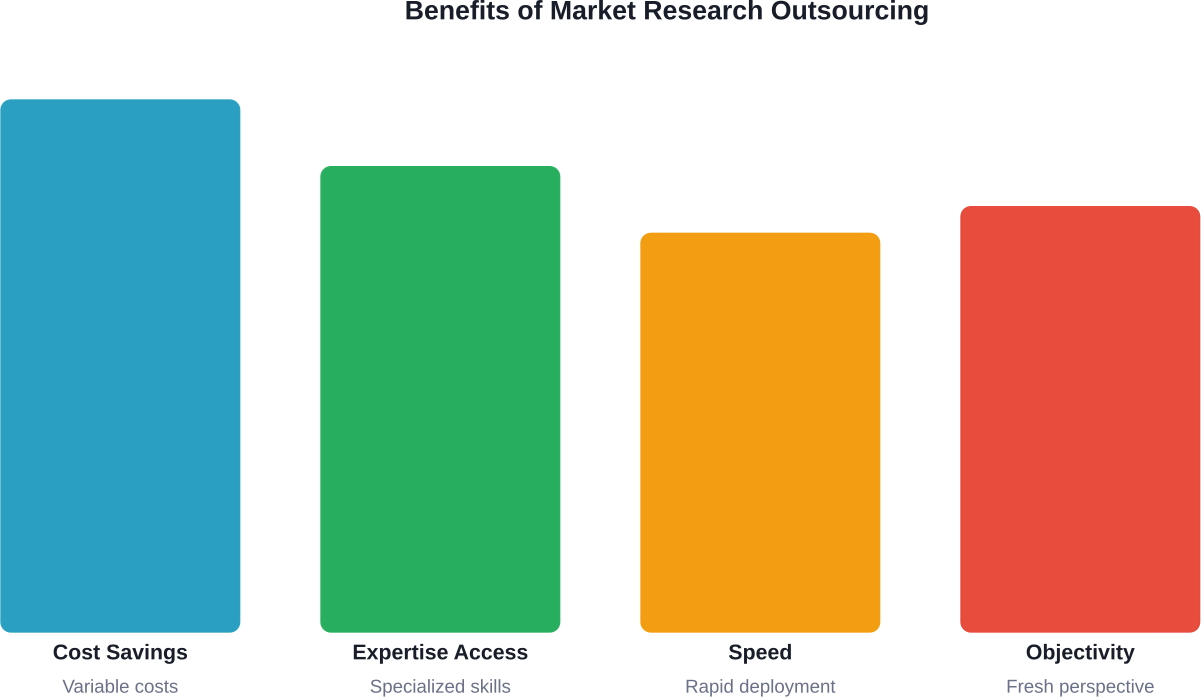
Core Benefits That Drive Outsourcing Decisions
The advantages of outsourcing market research extend beyond simple cost reduction. Here's what businesses actually gain.
Significant Cost Savings
Building an in-house research team means salaries, benefits, office space, software licenses, and training costs. Outsourcing converts these fixed expenses into variable costs that scale with project needs.
Businesses may reduce research spending when switching from in-house to outsourced operations, as outsourcing converts fixed expenses into variable costs. Those savings come from shared infrastructure, specialized tools, and economies of scale that research firms achieve across multiple clients.
Access to Specialized Expertise
Quality market research demands expertise in survey methodology, statistical analysis, sampling techniques, and industry-specific knowledge. Research firms employ specialists across these domains, giving clients access to capabilities that would be impractical to develop internally.
According to research on technology innovation, companies integrating predictive analytics into their market research strategies may experience improvements in decision-making outcomes. Specialized research providers already have these advanced capabilities deployed.
Speed and Flexibility
Internal research teams can get bottlenecked with competing priorities. Executive leadership gets pulled into daily operations, reports, and client management, leaving limited time for deep research work.
External providers can mobilize quickly on new projects without the delays of internal resource allocation. They scale teams based on project timelines, delivering insights faster than most in-house operations can manage.
Objectivity and Fresh Perspectives
Internal teams sometimes develop blind spots or unconscious biases about their own products and markets. External researchers bring objectivity, questioning assumptions that internal staff might take for granted.
This outside perspective often reveals market opportunities or threats that internal analysis misses.
Types of Market Research Services Available
Market research outsourcing isn't a single service—it's an ecosystem of specialized capabilities. Understanding what's available helps businesses select the right providers.
Primary Research Services
Primary research involves collecting new data directly from target markets. Services include survey design and administration, focus group facilitation, in-depth interviews, ethnographic studies, and customer satisfaction tracking.
Providers handle everything from questionnaire development through fieldwork management to final analysis and reporting.
Secondary Research and Competitive Intelligence
Secondary research analyzes existing data sources to extract insights. This includes industry reports, competitor analysis, regulatory filings, patent databases, and market trend analysis.
Research firms have access to premium databases and analytical tools that most businesses can't justify purchasing for occasional use.
Data Analytics and Predictive Modeling
Advanced analytics services transform raw data into actionable intelligence. This includes segmentation analysis, predictive modeling, customer journey mapping, and churn analysis.
These services require specialized statistical expertise and software platforms that research firms maintain as core capabilities.
Brand and Product Research
Specialized services for brand tracking, positioning studies, concept testing, packaging research, and product launch support help businesses make strategic marketing decisions.
These projects combine qualitative and quantitative methods tailored to specific business questions.
When Outsourcing Makes Strategic Sense
Not every research need justifies outsourcing. Certain situations make external providers the clear choice.
Companies should consider outsourcing when they lack internal research expertise, need specialized methodologies, require rapid project turnaround, want to maintain objectivity, or need to scale research capacity temporarily.
Outsourcing also makes sense when internal teams are fully committed to other priorities. Executive leadership already spends time leading teams, working with clients, and managing daily business operations—adding complex research projects creates bottlenecks.
But here's the thing: simple, repetitive research tasks might stay in-house if clear processes exist and staff capacity allows. The decision hinges on complexity, required expertise, and opportunity cost of internal resources.
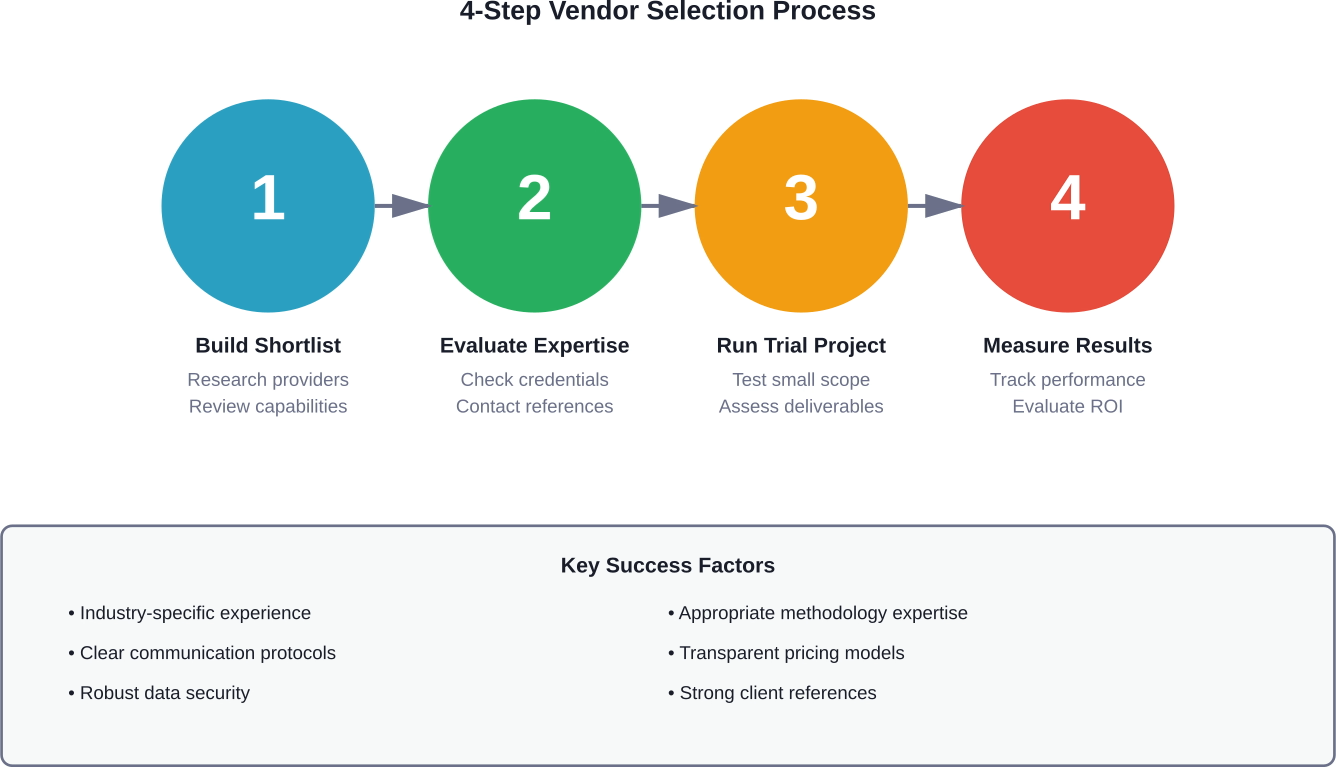
Selecting the Right Research Provider
Choosing a research vendor determines project success. The selection process demands attention to several critical factors.
Build Your Shortlist Strategically
Start by identifying providers with relevant industry experience and appropriate service offerings. Review case studies, client testimonials, and published research to assess capabilities.
Look for firms that demonstrate expertise in specific methodologies needed for current projects. A provider excellent at quantitative surveys might lack qualitative research depth.
Evaluate Expertise and Infrastructure
Assess the team's credentials, analytical tools, data security practices, and quality control processes. Ask about panel access, sampling methodologies, and how they ensure data accuracy.
Request references from clients with similar project requirements. Speak directly with those references about working relationships, deliverable quality, and problem resolution.
Start With Trial Projects
Rather than committing to major initiatives immediately, begin with smaller pilot projects. This tests communication patterns, deliverable quality, and operational compatibility before scaling the relationship.
Successful pilots build confidence and reveal potential issues in low-risk scenarios. Failed pilots cost less than failed major projects.
Evaluate Performance Systematically
After initial projects, assess vendor performance across multiple dimensions: insight quality, timeliness, communication responsiveness, budget adherence, and strategic value delivered.
Strong vendors don't just deliver data—they provide actionable recommendations that inform business decisions.
Best Practices for Delegating Research Tasks
Successful outsourcing requires more than just hiring the right vendor. How businesses structure and manage delegated research tasks directly impacts results.
Create Clear Research Briefs
A clear brief is the foundation of successful delegation. Define core research questions, desired outcomes, target audience specifications, timeline requirements, and budget constraints upfront.
If a research objective can't be clearly explained in a brief, the task needs more internal clarity before anyone—internal or external—can tackle it effectively. Take 15 minutes to outline questions and outcomes before approaching vendors.
Define Acceptance Criteria Early
Before work begins, establish how success will be measured. What format should deliverables take? What level of detail is required? What decision will the research inform?
Clear acceptance criteria prevent misunderstandings and scope creep. They also help vendors prioritize the most valuable aspects of each project.
Establish Communication Rhythms
Set regular check-in schedules for longer projects. Weekly or bi-weekly status updates keep projects on track and surface issues before they become problems.
But avoid micromanaging. Research firms need autonomy to apply their expertise and methodologies effectively.
Provide Business Context
Share relevant background about market position, competitive dynamics, and strategic priorities. Context helps researchers ask better questions and interpret findings more meaningfully.
The best research insights connect data to business strategy—that connection requires contextual understanding.

Get Market Research That Doesn’t Lose Context Midway
Market research often starts strong and then drifts. Different people pick up parts of the work, notes get scattered, and by the time insights come together, some of the original context is already gone.
NeoWork handles this by setting up dedicated teams that stay with the research from start to finish. Instead of splitting tasks across multiple contributors, the same people track inputs, organize findings, and adjust as new questions come up. With a 3.2% selection rate, the focus is on people who can manage detail and consistency, and a 91% retention rate helps keep that continuity intact over longer projects.
If you want to see how this kind of setup would work in your case, you can contact NeoWork and walk through your current research process with them.
Outsourced vs In-House: Making the Decision
Many businesses wrestle with the outsource-versus-internal question. The answer usually isn't binary—most companies benefit from hybrid approaches.
Companies often maintain small internal teams for ongoing tracking and strategic coordination while outsourcing specialized projects, complex methodologies, and capacity overflow.
This hybrid model captures the benefits of both approaches: institutional knowledge and strategic continuity from internal staff, plus specialist expertise and scalability from external providers.
Current Trends Shaping Research Outsourcing
The market research outsourcing landscape continues evolving with technology and methodology advances.
As automation becomes more sophisticated, firms increasingly utilize predictive modeling tools to improve market-entry strategies. This shift reflects broader adoption of advanced analytics across research operations.
Artificial intelligence and machine learning now automate data collection, sentiment analysis, and pattern recognition tasks that previously required extensive manual effort. This increases research speed while reducing costs.
Real-time tracking dashboards give businesses continuous access to market intelligence rather than waiting for periodic reports. This shift from periodic studies to continuous monitoring changes how companies use research insights.
Mobile-first methodologies acknowledge that consumers increasingly interact with brands through mobile devices. Research techniques adapt accordingly, with mobile surveys, in-app feedback, and location-based studies becoming standard.
Common Pitfalls and How to Avoid Them
Even well-planned outsourcing relationships encounter challenges. Awareness of common problems helps prevent them.
Vague project scopes lead to deliverables that miss the mark. Combat this by investing time in detailed briefs that specify exactly what questions need answering and how results will be used.
Selecting vendors based solely on price often backfires. Low-cost providers may lack necessary expertise, use questionable methodologies, or deliver superficial analysis. Evaluate value, not just cost.
Insufficient communication creates misalignment. Establish regular touchpoints and encourage vendors to ask clarifying questions rather than making assumptions.
Failing to provide business context results in technically correct research that lacks strategic relevance. Share enough background for researchers to connect findings to business implications.
Not planning for implementation means insights sit unused. Before commissioning research, consider how findings will inform decisions and who needs to act on them.
Taking Action on Market Research Outsourcing
Market research outsourcing delivers expert insights, specialized capabilities, and cost efficiency that most businesses can't replicate internally. The strategy works best when companies invest time in vendor selection, create clear project briefs, and establish collaborative working relationships.
Start by identifying one or two research questions that internal teams lack time or expertise to address properly. Build a shortlist of potential vendors with relevant experience. Run a pilot project to test capabilities and compatibility.
The employment projections from the U.S. Bureau of Labor Statistics show continued growth in professional research services, reflecting sustained business demand for external research expertise. That trend suggests market research outsourcing will only become more central to how companies gather and analyze market intelligence.
Time remains the most valuable resource for executive leadership and business teams. Delegating research operations to qualified specialists frees internal capacity for strategic decisions and core business functions. Done well, outsourcing transforms research from a resource constraint into a competitive advantage.
Frequently Asked Questions
Topics
Market Research Outsourcing Guide: 2026 Best Practices

Market research outsourcing lets businesses delegate data collection, analysis, and consumer insights to external specialists, while accessing expert methodologies. This guide covers the key benefits, types of services available, vendor selection criteria, and best practices for successful outsourcing partnerships that deliver actionable intelligence without building internal research teams.
Conducting thorough market research is among the best ways to determine customer needs and understand market behavior. But building an in-house research team demands substantial investment in personnel, tools, and ongoing training.
That's where outsourcing comes in. Market research outsourcing transfers data collection, analysis, and consumer insight generation to external specialists who already have the expertise and infrastructure.
The professional, scientific, and technical services sector—which includes market research and public opinion polling—continues to show strong growth. According to the U.S. Bureau of Labor Statistics, this sector represents one of the fastest growing industry segments, reflecting increasing business demand for specialized research capabilities.
What Market Research Outsourcing Actually Means
Market research outsourcing is the practice of delegating research operations to external service providers rather than maintaining internal teams. These providers handle everything from survey design and data collection to advanced analytics and reporting.
The approach gives businesses access to specialist knowledge without the overhead of full-time research staff. Companies can scale research efforts up or down based on immediate needs, paying only for services when required.
Outsourced market research covers both primary research (collecting new data directly from consumers) and secondary research (analyzing existing data sources). The scope ranges from simple survey administration to complex competitive intelligence gathering.
Core Benefits That Drive Outsourcing Decisions
The advantages of outsourcing market research extend beyond simple cost reduction. Here's what businesses actually gain.
Significant Cost Savings
Building an in-house research team means salaries, benefits, office space, software licenses, and training costs. Outsourcing converts these fixed expenses into variable costs that scale with project needs.
Businesses may reduce research spending when switching from in-house to outsourced operations, as outsourcing converts fixed expenses into variable costs. Those savings come from shared infrastructure, specialized tools, and economies of scale that research firms achieve across multiple clients.
Access to Specialized Expertise
Quality market research demands expertise in survey methodology, statistical analysis, sampling techniques, and industry-specific knowledge. Research firms employ specialists across these domains, giving clients access to capabilities that would be impractical to develop internally.
According to research on technology innovation, companies integrating predictive analytics into their market research strategies may experience improvements in decision-making outcomes. Specialized research providers already have these advanced capabilities deployed.
Speed and Flexibility
Internal research teams can get bottlenecked with competing priorities. Executive leadership gets pulled into daily operations, reports, and client management, leaving limited time for deep research work.
External providers can mobilize quickly on new projects without the delays of internal resource allocation. They scale teams based on project timelines, delivering insights faster than most in-house operations can manage.
Objectivity and Fresh Perspectives
Internal teams sometimes develop blind spots or unconscious biases about their own products and markets. External researchers bring objectivity, questioning assumptions that internal staff might take for granted.
This outside perspective often reveals market opportunities or threats that internal analysis misses.
Types of Market Research Services Available
Market research outsourcing isn't a single service—it's an ecosystem of specialized capabilities. Understanding what's available helps businesses select the right providers.
Primary Research Services
Primary research involves collecting new data directly from target markets. Services include survey design and administration, focus group facilitation, in-depth interviews, ethnographic studies, and customer satisfaction tracking.
Providers handle everything from questionnaire development through fieldwork management to final analysis and reporting.
Secondary Research and Competitive Intelligence
Secondary research analyzes existing data sources to extract insights. This includes industry reports, competitor analysis, regulatory filings, patent databases, and market trend analysis.
Research firms have access to premium databases and analytical tools that most businesses can't justify purchasing for occasional use.
Data Analytics and Predictive Modeling
Advanced analytics services transform raw data into actionable intelligence. This includes segmentation analysis, predictive modeling, customer journey mapping, and churn analysis.
These services require specialized statistical expertise and software platforms that research firms maintain as core capabilities.
Brand and Product Research
Specialized services for brand tracking, positioning studies, concept testing, packaging research, and product launch support help businesses make strategic marketing decisions.
These projects combine qualitative and quantitative methods tailored to specific business questions.
When Outsourcing Makes Strategic Sense
Not every research need justifies outsourcing. Certain situations make external providers the clear choice.
Companies should consider outsourcing when they lack internal research expertise, need specialized methodologies, require rapid project turnaround, want to maintain objectivity, or need to scale research capacity temporarily.
Outsourcing also makes sense when internal teams are fully committed to other priorities. Executive leadership already spends time leading teams, working with clients, and managing daily business operations—adding complex research projects creates bottlenecks.
But here's the thing: simple, repetitive research tasks might stay in-house if clear processes exist and staff capacity allows. The decision hinges on complexity, required expertise, and opportunity cost of internal resources.
Selecting the Right Research Provider
Choosing a research vendor determines project success. The selection process demands attention to several critical factors.
Build Your Shortlist Strategically
Start by identifying providers with relevant industry experience and appropriate service offerings. Review case studies, client testimonials, and published research to assess capabilities.
Look for firms that demonstrate expertise in specific methodologies needed for current projects. A provider excellent at quantitative surveys might lack qualitative research depth.
Evaluate Expertise and Infrastructure
Assess the team's credentials, analytical tools, data security practices, and quality control processes. Ask about panel access, sampling methodologies, and how they ensure data accuracy.
Request references from clients with similar project requirements. Speak directly with those references about working relationships, deliverable quality, and problem resolution.
Start With Trial Projects
Rather than committing to major initiatives immediately, begin with smaller pilot projects. This tests communication patterns, deliverable quality, and operational compatibility before scaling the relationship.
Successful pilots build confidence and reveal potential issues in low-risk scenarios. Failed pilots cost less than failed major projects.
Evaluate Performance Systematically
After initial projects, assess vendor performance across multiple dimensions: insight quality, timeliness, communication responsiveness, budget adherence, and strategic value delivered.
Strong vendors don't just deliver data—they provide actionable recommendations that inform business decisions.
Best Practices for Delegating Research Tasks
Successful outsourcing requires more than just hiring the right vendor. How businesses structure and manage delegated research tasks directly impacts results.
Create Clear Research Briefs
A clear brief is the foundation of successful delegation. Define core research questions, desired outcomes, target audience specifications, timeline requirements, and budget constraints upfront.
If a research objective can't be clearly explained in a brief, the task needs more internal clarity before anyone—internal or external—can tackle it effectively. Take 15 minutes to outline questions and outcomes before approaching vendors.
Define Acceptance Criteria Early
Before work begins, establish how success will be measured. What format should deliverables take? What level of detail is required? What decision will the research inform?
Clear acceptance criteria prevent misunderstandings and scope creep. They also help vendors prioritize the most valuable aspects of each project.
Establish Communication Rhythms
Set regular check-in schedules for longer projects. Weekly or bi-weekly status updates keep projects on track and surface issues before they become problems.
But avoid micromanaging. Research firms need autonomy to apply their expertise and methodologies effectively.
Provide Business Context
Share relevant background about market position, competitive dynamics, and strategic priorities. Context helps researchers ask better questions and interpret findings more meaningfully.
The best research insights connect data to business strategy—that connection requires contextual understanding.
Get Market Research That Doesn’t Lose Context Midway
Market research often starts strong and then drifts. Different people pick up parts of the work, notes get scattered, and by the time insights come together, some of the original context is already gone.
NeoWork handles this by setting up dedicated teams that stay with the research from start to finish. Instead of splitting tasks across multiple contributors, the same people track inputs, organize findings, and adjust as new questions come up. With a 3.2% selection rate, the focus is on people who can manage detail and consistency, and a 91% retention rate helps keep that continuity intact over longer projects.
If you want to see how this kind of setup would work in your case, you can contact NeoWork and walk through your current research process with them.
Outsourced vs In-House: Making the Decision
Many businesses wrestle with the outsource-versus-internal question. The answer usually isn't binary—most companies benefit from hybrid approaches.
Companies often maintain small internal teams for ongoing tracking and strategic coordination while outsourcing specialized projects, complex methodologies, and capacity overflow.
This hybrid model captures the benefits of both approaches: institutional knowledge and strategic continuity from internal staff, plus specialist expertise and scalability from external providers.
Current Trends Shaping Research Outsourcing
The market research outsourcing landscape continues evolving with technology and methodology advances.
As automation becomes more sophisticated, firms increasingly utilize predictive modeling tools to improve market-entry strategies. This shift reflects broader adoption of advanced analytics across research operations.
Artificial intelligence and machine learning now automate data collection, sentiment analysis, and pattern recognition tasks that previously required extensive manual effort. This increases research speed while reducing costs.
Real-time tracking dashboards give businesses continuous access to market intelligence rather than waiting for periodic reports. This shift from periodic studies to continuous monitoring changes how companies use research insights.
Mobile-first methodologies acknowledge that consumers increasingly interact with brands through mobile devices. Research techniques adapt accordingly, with mobile surveys, in-app feedback, and location-based studies becoming standard.
Common Pitfalls and How to Avoid Them
Even well-planned outsourcing relationships encounter challenges. Awareness of common problems helps prevent them.
Vague project scopes lead to deliverables that miss the mark. Combat this by investing time in detailed briefs that specify exactly what questions need answering and how results will be used.
Selecting vendors based solely on price often backfires. Low-cost providers may lack necessary expertise, use questionable methodologies, or deliver superficial analysis. Evaluate value, not just cost.
Insufficient communication creates misalignment. Establish regular touchpoints and encourage vendors to ask clarifying questions rather than making assumptions.
Failing to provide business context results in technically correct research that lacks strategic relevance. Share enough background for researchers to connect findings to business implications.
Not planning for implementation means insights sit unused. Before commissioning research, consider how findings will inform decisions and who needs to act on them.
Taking Action on Market Research Outsourcing
Market research outsourcing delivers expert insights, specialized capabilities, and cost efficiency that most businesses can't replicate internally. The strategy works best when companies invest time in vendor selection, create clear project briefs, and establish collaborative working relationships.
Start by identifying one or two research questions that internal teams lack time or expertise to address properly. Build a shortlist of potential vendors with relevant experience. Run a pilot project to test capabilities and compatibility.
The employment projections from the U.S. Bureau of Labor Statistics show continued growth in professional research services, reflecting sustained business demand for external research expertise. That trend suggests market research outsourcing will only become more central to how companies gather and analyze market intelligence.
Time remains the most valuable resource for executive leadership and business teams. Delegating research operations to qualified specialists frees internal capacity for strategic decisions and core business functions. Done well, outsourcing transforms research from a resource constraint into a competitive advantage.
Frequently Asked Questions
Topics
Related Blogs
Related Podcasts


.webp)
.webp)



