
Green glowing circular pattern with concentric rings and faint hexagonal grid on the left side.
Blue abstract hexagonal pattern with glowing circular gradient edges on a black background.Glowing greenish-blue hexagonal pattern with concentric circular gradients on a black background.

Marketplace Management Outsourcing Guide: How It Works in 2026

Calendar Icon
Published:
Oct 29
2026
,
Updated:
Oct 30
2026
Ann
Facebook IconInstagram Icon

Build your team with NeoWork

Talk to us about how we staff and manage high-performing remote teams for companies like yours.

Get a Marketplace Management Outsourcing Quote

Quick Summary: Marketplace management outsourcing means handing the day-to-day work of selling on Amazon, Walmart, eBay, TikTok Shop, and similar platforms (listings, catalog upkeep, inventory, orders, buyer messages, account health, and often advertising) to an external team. Third-party sellers accounted for 60% of worldwide paid units on Amazon in Q1 2026, according to Marketplace Pulse, which shows how much of ecommerce now runs through seller accounts that someone has to operate every day. Most brands hand over listings, orders, and buyer messages first, keep pricing and assortment strategy in-house, and choose between a full-service agency, a dedicated team, freelancers, or a hybrid of these. The safest handovers use individual user permissions instead of shared logins and write platform metrics into the service agreement.

Every marketplace a brand adds comes with its own listing rules, category requirements, fee changes, performance thresholds, and message inbox, and none of it pauses for weekends or Q4. As channels multiply, the founder or ecommerce manager often ends up spending more time fixing suppressed listings and answering buyer questions than planning growth.

Outsourcing is a common answer, but "outsourcing marketplace management" can mean very different things. It can be a part-time virtual assistant who updates prices, a full-service agency that also runs your ads, or a dedicated team that works inside your Seller Central like in-house staff. The right choice depends on your catalog size, channel mix, and budget.

What Is Marketplace Management Outsourcing?

Marketplace management outsourcing is a form of ecommerce outsourcing in which a brand or retailer delegates the operation of its marketplace seller accounts to an external provider. The provider supplies trained people, documented processes, and usually reporting, and works inside the brand's existing accounts and tools rather than selling the products on its own behalf.

It differs from two things it is often confused with:

  • Not reselling or wholesale. Under a 1P or wholesale arrangement, someone else buys your stock and controls the listing. With outsourced management, you keep ownership of the account, the inventory, the pricing decisions, and the customer data.
  • Not just software. Multichannel listing and repricing tools automate parts of the job, but they still need someone to set rules, fix errors, handle exceptions, and talk to buyers. Outsourcing supplies the people who do that work.

Which Marketplace Tasks Can You Outsource?

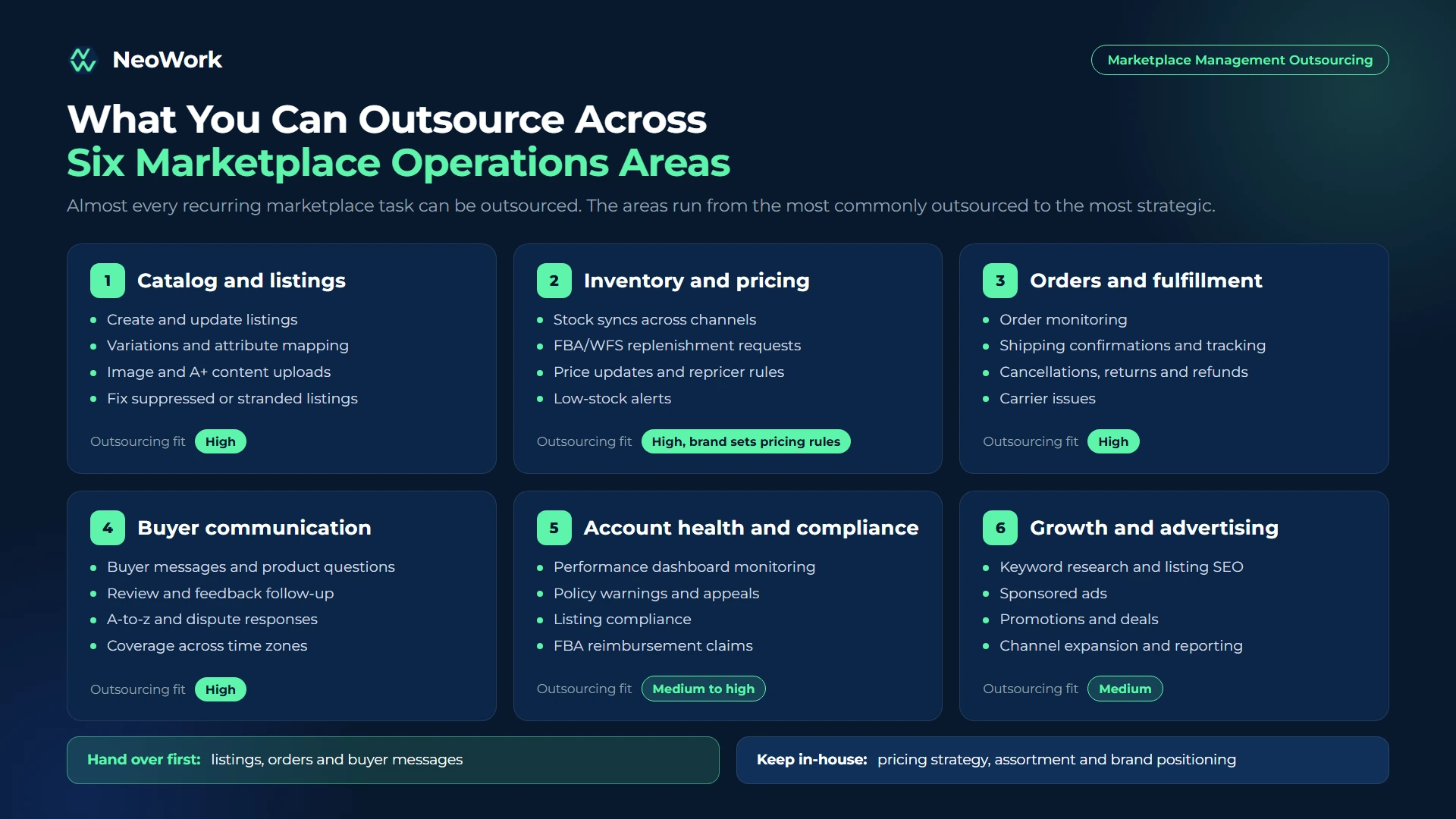
Almost every recurring marketplace task can be outsourced. The question is which ones are worth handing over first. The table below groups the work into six areas, from the most commonly outsourced to the most strategic.
Area Typical Tasks Outsourcing Fit
Catalog and listings Creating and updating listings, flat-file uploads, variations, category and attribute mapping, image and A+ content uploads, fixing suppressed or stranded listings High: repetitive, rule-based, and easy to document
Inventory and pricing Stock syncs across channels, FBA/WFS replenishment requests, price updates, repricer rules, low-stock alerts High, with pricing rules set by the brand
Orders and fulfillment Order monitoring, shipping confirmations, tracking uploads, cancellations, returns and refunds, carrier issues High: time-sensitive and directly tied to performance metrics
Buyer communication Answering buyer messages, product questions, review and feedback follow-up, A-to-z and dispute responses High: needs fast response times, often across time zones
Account health and compliance Monitoring performance dashboards, policy warnings, listing compliance, appeals, reimbursement claims for lost or damaged FBA inventory Medium to high: needs experienced specialists and clear escalation rules
Growth and advertising Keyword research, listing SEO, sponsored ads, promotions and deals, channel expansion, reporting Medium: often split between a dedicated team and a specialist agency
Marketplace management outsourcing task map showing six areas of marketplace operations: catalog and listings, inventory and pricing, orders and fulfillment, buyer communication, account health, and growth and advertising

A practical rule: start with the work that is high-volume, time-sensitive, and already (or easily) written down as a process. Listings, orders, and buyer messages usually come first. Pricing strategy, assortment decisions, and brand positioning tend to stay in-house.

Keep Every Marketplace Running Without Building an In-House Team

At NeoWork, we build dedicated marketplace teams that take over your daily marketplace operations. Our teammates manage listings and catalog updates, keep inventory and orders moving, answer buyer messages, and watch account health, working directly inside your seller accounts, tools, and SOPs as an extension of your team.

We handle everything that comes with staffing that team: recruiting, onboarding, benefits, and ongoing teammate support. You get people who learn your catalog and stay on your account, without adding headcount or management overhead.

What we bring:

  • Dedicated marketplace specialists or full teams trained on your products and processes
  • A selective hiring process with a 3.2% candidate selectivity rate
  • Coverage across time zones, including nights, weekends, and peak seasons
  • Industry-leading 91% annualized teammate retention rate, so the knowledge of your account stays with your team

Contact us to tell us which marketplaces you sell on and where your team is stretched thin. We will map out the roles that can take that work over and how fast we can have them running.

Signs It Is Time to Outsource Marketplace Management

Brands rarely outsource because everything is going well. These are the most common triggers:

  • Listing work is backing up. New SKUs wait weeks to go live, or suppressed listings stay down for days because nobody had time to fix them.
  • Buyer messages are going unanswered. Amazon tracks whether buyer messages are answered within 24 hours, Walmart expects at least 95% of customer messages to be answered within 48 hours, and slow replies show up in both performance dashboards.
  • Performance metrics are drifting. Late shipments, cancellations, or invalid tracking numbers are creeping toward the platform thresholds.
  • You are adding a channel. Launching on Walmart, TikTok Shop, or a new Amazon region adds another catalog to maintain, another inventory feed, another inbox, and another set of performance metrics, while your team stays the same size.
  • Peak season is more than your team can handle. Q4 order volume overwhelms the people who handle everything the rest of the year.
  • Your senior people are doing junior work. The ecommerce lead spends most of the week uploading flat files instead of planning assortment and growth.

Marketplace Management Outsourcing Models Compared

There are four main ways to outsource marketplace work. They differ in who owns the strategy, who does the execution, and how much control you keep.

Model How It Works Best For Watch Out For
Full-service marketplace agency Agency owns strategy and execution, often including ads, usually billed as a retainer plus a share of revenue Brands that want a hands-off growth partner and have budget for it Shared account managers, less day-to-day control, costs that scale with your sales
Dedicated outsourced team Provider recruits specialists who work only on your accounts, inside your tools, following your SOPs Brands with steady operational volume that want in-house-style control without hiring You still need someone internally to set priorities and own strategy
Freelancers and virtual assistants Individual contractors handle specific tasks on an hourly or project basis Small catalogs, one-off projects, short-term gaps No backup when someone leaves, inconsistent quality, access security risks
Hybrid A dedicated team runs operations while a specialist agency handles advertising or a specific channel Multi-channel brands with meaningful ad spend Needs clear ownership lines so tasks do not fall between partners

A common setup for growing brands is the hybrid model: a dedicated operations team covering listings, orders, and buyer communication across every channel, plus an ads specialist where advertising spend justifies it. This keeps the high-volume work predictable in cost while letting a specialist optimize the part that directly drives revenue.

How Much Does Marketplace Management Outsourcing Cost?

Pricing depends heavily on the model, the number of channels and SKUs, and whether advertising is included. The most common structures are:

  • Flat monthly retainer: A fixed fee for a defined scope. The 2026 pricing guide from Amazon agency AMZDudes lists retainers from 1,500 to 3,000 US dollars per month at the entry level, 7,500 to 15,000 US dollars for full-service management, and 15,000 US dollars or more for enterprise and multi-marketplace accounts.
  • Percentage of revenue: Agencies often charge a share of marketplace sales. Agency pricing guides published in 2026, including those from AMZDudes and SupplyKick, put this model at roughly 3% to 10% of monthly revenue.
  • Retainer plus revenue share: A base fee plus a smaller percentage of sales, common with agencies that also run growth work.
  • Percentage of ad spend: For advertising management, the same guides list fees of around 10% to 20% of monthly ad spend.
  • Per-teammate (FTE) pricing: A fixed monthly cost per dedicated specialist, regardless of your sales volume. This is the usual structure for dedicated team providers and makes costs predictable as revenue grows.

Treat any published figure as a rough range: most of them come from agencies describing their own market. The more useful exercise is to compare total cost at your current revenue and at your target revenue a year out. A revenue-share deal that looks cheap at today's volume can become the most expensive option once sales double, while per-teammate pricing stays flat until you decide to add capacity.

Also ask about extras that are often billed separately: onboarding fees, creative and A+ content production, minimum contract terms, and surcharges for each additional marketplace.

Marketplace Metrics to Hold Your Partner To

The clearest way to judge an outsourced marketplace team is by the same metrics the platforms use to judge you. If these slip, listings can be suppressed or an account can be deactivated, so they belong in the service agreement from day one.

Metric Amazon Requirement Walmart Requirement Suggested Internal Target
Order defect rate Below 1% No ODR metric; negative feedback rate of 2% or less, with return and item-not-received rates also monitored Below 0.5%
Late shipment / on-time delivery Late shipment rate below 4% On-time delivery of at least 90% Late shipments below 2%; on-time delivery above 95%
Cancellation rate Pre-fulfillment cancel rate below 2.5% Seller cancellations of 2% or less Below 1%
Valid tracking rate Above 95% At least 99% 99% or higher on every channel
Buyer message response Within 24 hours At least 95% of messages answered within 48 hours Within 12 hours, 7 days a week

Platform thresholds above are based on Amazon Seller Central account health standards and Walmart Marketplace seller performance standards as of 2026. Platforms update these periodically (Walmart added negative feedback, return, and item-not-received rates to its standards in 2026), so confirm the current figures in your own dashboards.
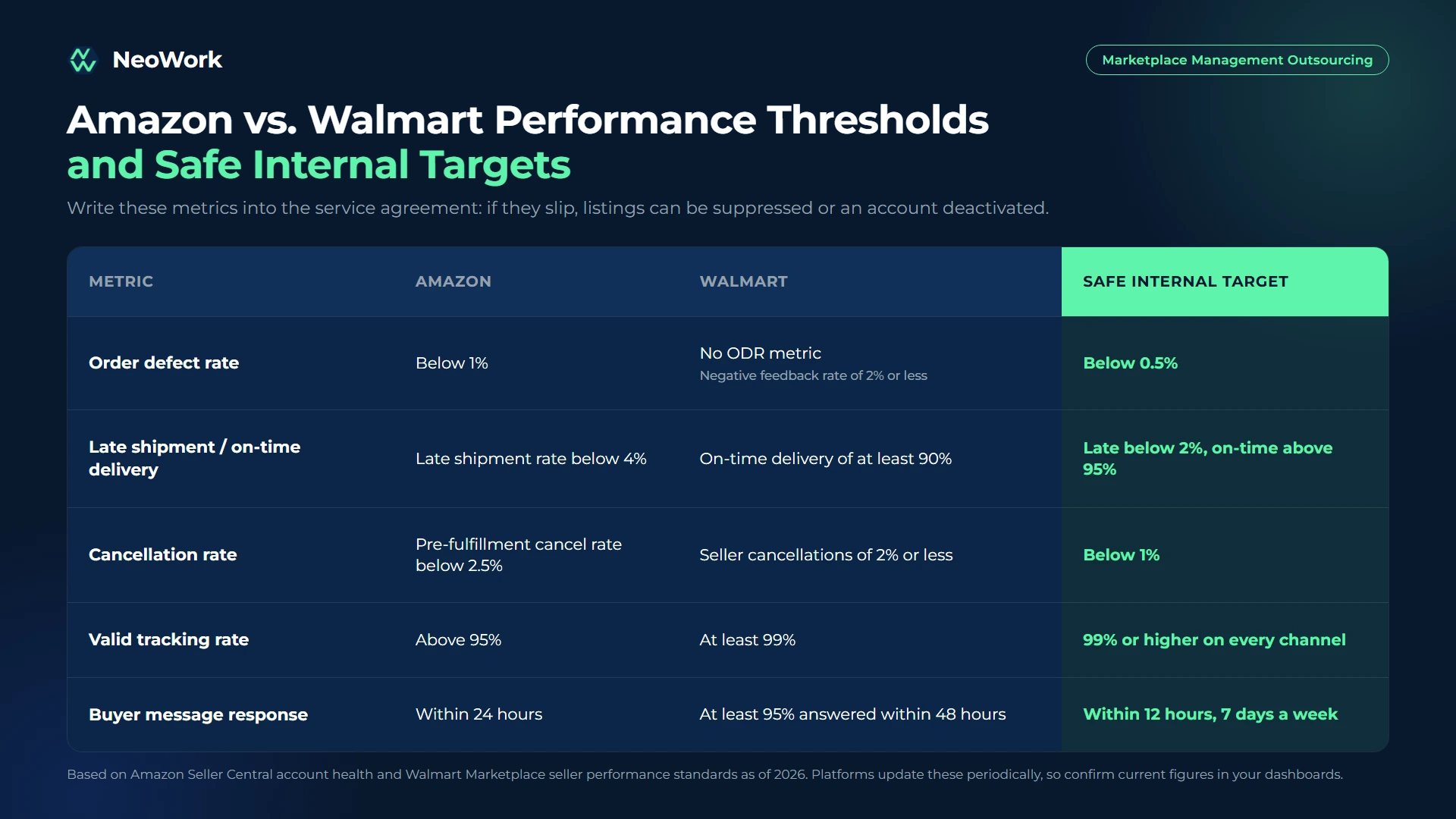
Comparison of Amazon and Walmart seller performance thresholds for order defect rate, late shipments, cancellations, and valid tracking, with recommended internal targets for an outsourced marketplace team

Beyond platform metrics, add operational KPIs that show whether the team is reducing your workload: time to publish a new SKU, time to fix a suppressed listing, number of open account health issues, and FBA reimbursements recovered per month.

How to Outsource Marketplace Management Step by Step

A good handover usually takes several weeks. Most successful transitions follow the same sequence.
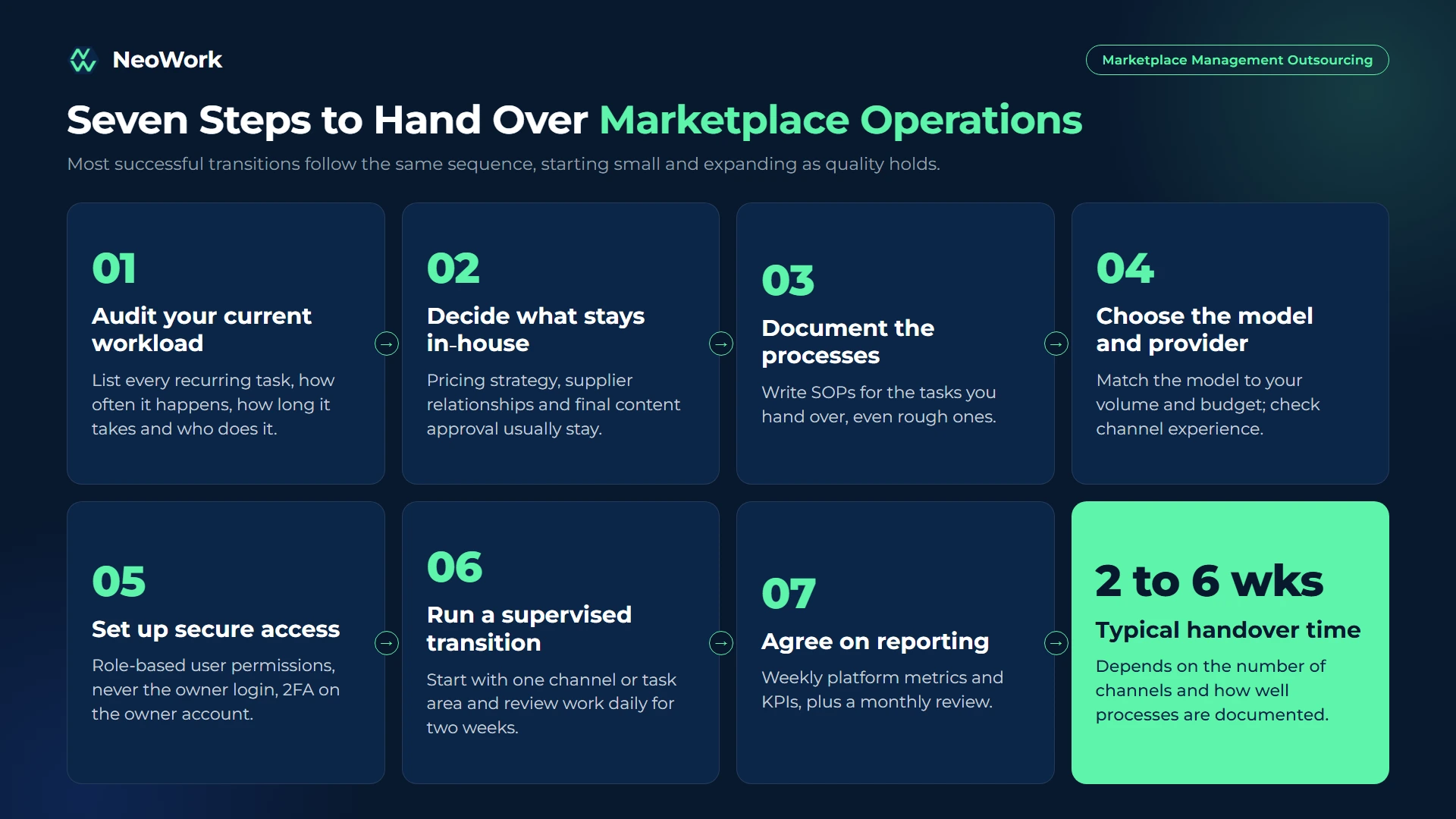
Seven-step process for outsourcing marketplace management, from workload audit and SOP documentation to secure seller account access, supervised transition, and reporting
  1. Audit your current workload. List every recurring marketplace task, how often it happens, how long it takes, and who does it now. This becomes your scope.
  2. Decide what stays in-house. Pricing strategy, supplier relationships, and final approval on brand content usually remain with your team.
  3. Document the processes. Write SOPs for the tasks you hand over, even rough ones. A good provider will help refine them, but they need a starting point.
  4. Choose the model and provider. Match the model to your volume and budget, then shortlist providers with experience on your specific channels.
  5. Set up secure access. Add the team as users with role-based permissions in Seller Central, Walmart Seller Center, and other tools. Never share the primary account owner login, and keep two-factor authentication on the owner account.
  6. Run a supervised transition. Start with one channel or task area, review work daily for the first two weeks, and expand scope as quality holds.
  7. Agree on reporting. Set a weekly report with platform metrics and operational KPIs, plus a monthly review of what to change.

Questions Worth Asking Any Provider

  • Which marketplaces and categories has your team managed, and can you share references from similar brands?
  • Will the people on our account be dedicated to us or shared with other clients?
  • What coverage do you provide on weekends, holidays, and during Q4?
  • How do you handle access, permissions, and data security?
  • What happens if a teammate leaves, and how is their knowledge transferred?
  • Which metrics will you report on, and how often?
  • What are the notice period and exit terms?

Common Marketplace Outsourcing Mistakes and How to Avoid Them

Outsourcing fails most often for reasons that have little to do with the provider's skill:

  • Handing over the primary login. Sharing owner credentials makes it impossible to track who changed what and creates real risk if the relationship ends. Use individual user accounts with limited permissions.
  • Outsourcing strategy along with execution. An external team can run operations well, but decisions about pricing, assortment, and positioning need an owner inside the business.
  • No written scope. "Manage our Amazon account" means different things to different people. List the tasks, response times, and metrics in writing.
  • Choosing on price alone. The cheapest option often means shared staff and high turnover, so you end up retraining new people every few months.
  • Skipping the review period. Daily checks in the first weeks catch misunderstandings before they turn into suppressed listings or policy warnings.

Final Thoughts

Marketplace management outsourcing works best when it is planned as an operations decision. Start by mapping the work that takes up most of your team's time, decide what has to stay in-house, and match the rest to the right model: an agency for hands-off growth, a dedicated team for consistent execution, or a mix of both.

Whichever route you choose, put the platform metrics in the agreement, set up proper user permissions instead of sharing logins, and review the work closely during the first weeks. Once that is in place, your team can spend its time on product and growth while the outsourced team handles daily marketplace work. If you want to see how a dedicated marketplace team would fit your channels, talk to our team at NeoWork and we will put together a plan around your catalog.

FAQ

What does marketplace management include?

Marketplace management covers everything needed to sell on third-party platforms like Amazon, Walmart, eBay, and TikTok Shop: creating and optimizing listings, managing inventory and pricing, processing orders and returns, answering buyer messages, monitoring account health, and often running advertising and promotions.

Is it safe to give an outsourced team access to my seller account?

Yes, if access is set up correctly. Amazon Seller Central and Walmart Seller Center both let you add individual users with specific permissions. Give each team member their own login, grant only the permissions their tasks require, keep the owner account under your control with two-factor authentication, and remove access promptly when someone leaves the account.

How much does it cost to outsource marketplace management?

Costs depend on the model. Full-service agencies commonly charge monthly retainers, a percentage of revenue, or both, while dedicated team providers usually charge a fixed monthly fee per teammate. Compare total cost at both your current and projected sales volume, since revenue-based fees grow as you scale.

Should I outsource to an agency or hire a dedicated team?

An agency suits brands that want an external partner to own strategy and growth. A dedicated team suits brands that want to keep strategy in-house but need reliable, scalable execution. Many multichannel sellers combine both: a dedicated team for daily operations and a specialist agency for advertising.

Can one team manage several marketplaces at once?

Yes. A dedicated team can cover Amazon, Walmart, eBay, TikTok Shop, and other channels from a shared set of SOPs, which also helps keep product data and pricing consistent across platforms. For larger catalogs, it is common to assign channel leads within the team.

How long does it take to hand over marketplace operations?

Plan for roughly two to six weeks, depending on the number of channels and how well your processes are documented. Starting with one channel or task area and expanding once quality is proven is the lowest-risk approach.

Which tasks should stay in-house?

Keep pricing strategy, product and assortment decisions, supplier relationships, brand guidelines, and final approval of major content changes in-house. These decisions shape the business and depend on context an external team does not fully have.

‍

Topics
No items found.

Marketplace Management Outsourcing Guide: How It Works in 2026

Paper
Calendar Icon
Oct 29, 2026
Ann

Quick Summary: Marketplace management outsourcing means handing the day-to-day work of selling on Amazon, Walmart, eBay, TikTok Shop, and similar platforms (listings, catalog upkeep, inventory, orders, buyer messages, account health, and often advertising) to an external team. Third-party sellers accounted for 60% of worldwide paid units on Amazon in Q1 2026, according to Marketplace Pulse, which shows how much of ecommerce now runs through seller accounts that someone has to operate every day. Most brands hand over listings, orders, and buyer messages first, keep pricing and assortment strategy in-house, and choose between a full-service agency, a dedicated team, freelancers, or a hybrid of these. The safest handovers use individual user permissions instead of shared logins and write platform metrics into the service agreement.

Every marketplace a brand adds comes with its own listing rules, category requirements, fee changes, performance thresholds, and message inbox, and none of it pauses for weekends or Q4. As channels multiply, the founder or ecommerce manager often ends up spending more time fixing suppressed listings and answering buyer questions than planning growth.

Outsourcing is a common answer, but "outsourcing marketplace management" can mean very different things. It can be a part-time virtual assistant who updates prices, a full-service agency that also runs your ads, or a dedicated team that works inside your Seller Central like in-house staff. The right choice depends on your catalog size, channel mix, and budget.

What Is Marketplace Management Outsourcing?

Marketplace management outsourcing is a form of ecommerce outsourcing in which a brand or retailer delegates the operation of its marketplace seller accounts to an external provider. The provider supplies trained people, documented processes, and usually reporting, and works inside the brand's existing accounts and tools rather than selling the products on its own behalf.

It differs from two things it is often confused with:

  • Not reselling or wholesale. Under a 1P or wholesale arrangement, someone else buys your stock and controls the listing. With outsourced management, you keep ownership of the account, the inventory, the pricing decisions, and the customer data.
  • Not just software. Multichannel listing and repricing tools automate parts of the job, but they still need someone to set rules, fix errors, handle exceptions, and talk to buyers. Outsourcing supplies the people who do that work.

Which Marketplace Tasks Can You Outsource?

Almost every recurring marketplace task can be outsourced. The question is which ones are worth handing over first. The table below groups the work into six areas, from the most commonly outsourced to the most strategic.

Area Typical Tasks Outsourcing Fit
Catalog and listings Creating and updating listings, flat-file uploads, variations, category and attribute mapping, image and A+ content uploads, fixing suppressed or stranded listings High: repetitive, rule-based, and easy to document
Inventory and pricing Stock syncs across channels, FBA/WFS replenishment requests, price updates, repricer rules, low-stock alerts High, with pricing rules set by the brand
Orders and fulfillment Order monitoring, shipping confirmations, tracking uploads, cancellations, returns and refunds, carrier issues High: time-sensitive and directly tied to performance metrics
Buyer communication Answering buyer messages, product questions, review and feedback follow-up, A-to-z and dispute responses High: needs fast response times, often across time zones
Account health and compliance Monitoring performance dashboards, policy warnings, listing compliance, appeals, reimbursement claims for lost or damaged FBA inventory Medium to high: needs experienced specialists and clear escalation rules
Growth and advertising Keyword research, listing SEO, sponsored ads, promotions and deals, channel expansion, reporting Medium: often split between a dedicated team and a specialist agency
Marketplace management outsourcing task map showing six areas of marketplace operations: catalog and listings, inventory and pricing, orders and fulfillment, buyer communication, account health, and growth and advertising

A practical rule: start with the work that is high-volume, time-sensitive, and already (or easily) written down as a process. Listings, orders, and buyer messages usually come first. Pricing strategy, assortment decisions, and brand positioning tend to stay in-house.

Keep Every Marketplace Running Without Building an In-House Team

At NeoWork, we build dedicated marketplace teams that take over your daily marketplace operations. Our teammates manage listings and catalog updates, keep inventory and orders moving, answer buyer messages, and watch account health, working directly inside your seller accounts, tools, and SOPs as an extension of your team.

We handle everything that comes with staffing that team: recruiting, onboarding, benefits, and ongoing teammate support. You get people who learn your catalog and stay on your account, without adding headcount or management overhead.

What we bring:

  • Dedicated marketplace specialists or full teams trained on your products and processes
  • A selective hiring process with a 3.2% candidate selectivity rate
  • Coverage across time zones, including nights, weekends, and peak seasons
  • Industry-leading 91% annualized teammate retention rate, so the knowledge of your account stays with your team

Contact us to tell us which marketplaces you sell on and where your team is stretched thin. We will map out the roles that can take that work over and how fast we can have them running.

Signs It Is Time to Outsource Marketplace Management

Brands rarely outsource because everything is going well. These are the most common triggers:

  • Listing work is backing up. New SKUs wait weeks to go live, or suppressed listings stay down for days because nobody had time to fix them.
  • Buyer messages are going unanswered. Amazon tracks whether buyer messages are answered within 24 hours, Walmart expects at least 95% of customer messages to be answered within 48 hours, and slow replies show up in both performance dashboards.
  • Performance metrics are drifting. Late shipments, cancellations, or invalid tracking numbers are creeping toward the platform thresholds.
  • You are adding a channel. Launching on Walmart, TikTok Shop, or a new Amazon region adds another catalog to maintain, another inventory feed, another inbox, and another set of performance metrics, while your team stays the same size.
  • Peak season is more than your team can handle. Q4 order volume overwhelms the people who handle everything the rest of the year.
  • Your senior people are doing junior work. The ecommerce lead spends most of the week uploading flat files instead of planning assortment and growth.

Marketplace Management Outsourcing Models Compared

There are four main ways to outsource marketplace work. They differ in who owns the strategy, who does the execution, and how much control you keep.

Model How It Works Best For Watch Out For
Full-service marketplace agency Agency owns strategy and execution, often including ads, usually billed as a retainer plus a share of revenue Brands that want a hands-off growth partner and have budget for it Shared account managers, less day-to-day control, costs that scale with your sales
Dedicated outsourced team Provider recruits specialists who work only on your accounts, inside your tools, following your SOPs Brands with steady operational volume that want in-house-style control without hiring You still need someone internally to set priorities and own strategy
Freelancers and virtual assistants Individual contractors handle specific tasks on an hourly or project basis Small catalogs, one-off projects, short-term gaps No backup when someone leaves, inconsistent quality, access security risks
Hybrid A dedicated team runs operations while a specialist agency handles advertising or a specific channel Multi-channel brands with meaningful ad spend Needs clear ownership lines so tasks do not fall between partners

A common setup for growing brands is the hybrid model: a dedicated operations team covering listings, orders, and buyer communication across every channel, plus an ads specialist where advertising spend justifies it. This keeps the high-volume work predictable in cost while letting a specialist optimize the part that directly drives revenue.

How Much Does Marketplace Management Outsourcing Cost?

Pricing depends heavily on the model, the number of channels and SKUs, and whether advertising is included. The most common structures are:

  • Flat monthly retainer: A fixed fee for a defined scope. The 2026 pricing guide from Amazon agency AMZDudes lists retainers from 1,500 to 3,000 US dollars per month at the entry level, 7,500 to 15,000 US dollars for full-service management, and 15,000 US dollars or more for enterprise and multi-marketplace accounts.
  • Percentage of revenue: Agencies often charge a share of marketplace sales. Agency pricing guides published in 2026, including those from AMZDudes and SupplyKick, put this model at roughly 3% to 10% of monthly revenue.
  • Retainer plus revenue share: A base fee plus a smaller percentage of sales, common with agencies that also run growth work.
  • Percentage of ad spend: For advertising management, the same guides list fees of around 10% to 20% of monthly ad spend.
  • Per-teammate (FTE) pricing: A fixed monthly cost per dedicated specialist, regardless of your sales volume. This is the usual structure for dedicated team providers and makes costs predictable as revenue grows.

Treat any published figure as a rough range: most of them come from agencies describing their own market. The more useful exercise is to compare total cost at your current revenue and at your target revenue a year out. A revenue-share deal that looks cheap at today's volume can become the most expensive option once sales double, while per-teammate pricing stays flat until you decide to add capacity.

Also ask about extras that are often billed separately: onboarding fees, creative and A+ content production, minimum contract terms, and surcharges for each additional marketplace.

Marketplace Metrics to Hold Your Partner To

The clearest way to judge an outsourced marketplace team is by the same metrics the platforms use to judge you. If these slip, listings can be suppressed or an account can be deactivated, so they belong in the service agreement from day one.

Metric Amazon Requirement Walmart Requirement Suggested Internal Target
Order defect rate Below 1% No ODR metric; negative feedback rate of 2% or less, with return and item-not-received rates also monitored Below 0.5%
Late shipment / on-time delivery Late shipment rate below 4% On-time delivery of at least 90% Late shipments below 2%; on-time delivery above 95%
Cancellation rate Pre-fulfillment cancel rate below 2.5% Seller cancellations of 2% or less Below 1%
Valid tracking rate Above 95% At least 99% 99% or higher on every channel
Buyer message response Within 24 hours At least 95% of messages answered within 48 hours Within 12 hours, 7 days a week

Platform thresholds above are based on Amazon Seller Central account health standards and Walmart Marketplace seller performance standards as of 2026. Platforms update these periodically (Walmart added negative feedback, return, and item-not-received rates to its standards in 2026), so confirm the current figures in your own dashboards.

Comparison of Amazon and Walmart seller performance thresholds for order defect rate, late shipments, cancellations, and valid tracking, with recommended internal targets for an outsourced marketplace team

Beyond platform metrics, add operational KPIs that show whether the team is reducing your workload: time to publish a new SKU, time to fix a suppressed listing, number of open account health issues, and FBA reimbursements recovered per month.

How to Outsource Marketplace Management Step by Step

A good handover usually takes several weeks. Most successful transitions follow the same sequence.

Seven-step process for outsourcing marketplace management, from workload audit and SOP documentation to secure seller account access, supervised transition, and reporting
  1. Audit your current workload. List every recurring marketplace task, how often it happens, how long it takes, and who does it now. This becomes your scope.
  2. Decide what stays in-house. Pricing strategy, supplier relationships, and final approval on brand content usually remain with your team.
  3. Document the processes. Write SOPs for the tasks you hand over, even rough ones. A good provider will help refine them, but they need a starting point.
  4. Choose the model and provider. Match the model to your volume and budget, then shortlist providers with experience on your specific channels.
  5. Set up secure access. Add the team as users with role-based permissions in Seller Central, Walmart Seller Center, and other tools. Never share the primary account owner login, and keep two-factor authentication on the owner account.
  6. Run a supervised transition. Start with one channel or task area, review work daily for the first two weeks, and expand scope as quality holds.
  7. Agree on reporting. Set a weekly report with platform metrics and operational KPIs, plus a monthly review of what to change.

Questions Worth Asking Any Provider

  • Which marketplaces and categories has your team managed, and can you share references from similar brands?
  • Will the people on our account be dedicated to us or shared with other clients?
  • What coverage do you provide on weekends, holidays, and during Q4?
  • How do you handle access, permissions, and data security?
  • What happens if a teammate leaves, and how is their knowledge transferred?
  • Which metrics will you report on, and how often?
  • What are the notice period and exit terms?

Common Marketplace Outsourcing Mistakes and How to Avoid Them

Outsourcing fails most often for reasons that have little to do with the provider's skill:

  • Handing over the primary login. Sharing owner credentials makes it impossible to track who changed what and creates real risk if the relationship ends. Use individual user accounts with limited permissions.
  • Outsourcing strategy along with execution. An external team can run operations well, but decisions about pricing, assortment, and positioning need an owner inside the business.
  • No written scope. "Manage our Amazon account" means different things to different people. List the tasks, response times, and metrics in writing.
  • Choosing on price alone. The cheapest option often means shared staff and high turnover, so you end up retraining new people every few months.
  • Skipping the review period. Daily checks in the first weeks catch misunderstandings before they turn into suppressed listings or policy warnings.

Final Thoughts

Marketplace management outsourcing works best when it is planned as an operations decision. Start by mapping the work that takes up most of your team's time, decide what has to stay in-house, and match the rest to the right model: an agency for hands-off growth, a dedicated team for consistent execution, or a mix of both.

Whichever route you choose, put the platform metrics in the agreement, set up proper user permissions instead of sharing logins, and review the work closely during the first weeks. Once that is in place, your team can spend its time on product and growth while the outsourced team handles daily marketplace work. If you want to see how a dedicated marketplace team would fit your channels, talk to our team at NeoWork and we will put together a plan around your catalog.

FAQ

What does marketplace management include?

Marketplace management covers everything needed to sell on third-party platforms like Amazon, Walmart, eBay, and TikTok Shop: creating and optimizing listings, managing inventory and pricing, processing orders and returns, answering buyer messages, monitoring account health, and often running advertising and promotions.

Is it safe to give an outsourced team access to my seller account?

Yes, if access is set up correctly. Amazon Seller Central and Walmart Seller Center both let you add individual users with specific permissions. Give each team member their own login, grant only the permissions their tasks require, keep the owner account under your control with two-factor authentication, and remove access promptly when someone leaves the account.

How much does it cost to outsource marketplace management?

Costs depend on the model. Full-service agencies commonly charge monthly retainers, a percentage of revenue, or both, while dedicated team providers usually charge a fixed monthly fee per teammate. Compare total cost at both your current and projected sales volume, since revenue-based fees grow as you scale.

Should I outsource to an agency or hire a dedicated team?

An agency suits brands that want an external partner to own strategy and growth. A dedicated team suits brands that want to keep strategy in-house but need reliable, scalable execution. Many multichannel sellers combine both: a dedicated team for daily operations and a specialist agency for advertising.

Can one team manage several marketplaces at once?

Yes. A dedicated team can cover Amazon, Walmart, eBay, TikTok Shop, and other channels from a shared set of SOPs, which also helps keep product data and pricing consistent across platforms. For larger catalogs, it is common to assign channel leads within the team.

How long does it take to hand over marketplace operations?

Plan for roughly two to six weeks, depending on the number of channels and how well your processes are documented. Starting with one channel or task area and expanding once quality is proven is the lowest-risk approach.

Which tasks should stay in-house?

Keep pricing strategy, product and assortment decisions, supplier relationships, brand guidelines, and final approval of major content changes in-house. These decisions shape the business and depend on context an external team does not fully have.

‍

Topics

No items found.
Blue gradient banner with rounded corners at the top.
CTA Hexagon LeftCTA Hexagon LeftCTA Hexagon RightCTA Hexagon Right Mobile

Navigate the shadows of tech leadership – all while enjoying the comfort food that binds us all.

CTA Hexagon LeftCTA Hexagon LeftCTA Hexagon RightCTA Hexagon Right Mobile

Book a consultation

Build your team with NeoWork

Talk to us about how we staff and manage high-performing remote teams for companies like yours.