
Green glowing circular pattern with concentric rings and faint hexagonal grid on the left side.
Blue abstract hexagonal pattern with glowing circular gradient edges on a black background.Glowing greenish-blue hexagonal pattern with concentric circular gradients on a black background.

NetSuite Team Augmentation Guide: How It Works in 2026

Calendar Icon
Published:
Oct 29
2026
,
Updated:
Oct 30
2026
Ann
Facebook IconInstagram Icon

Build your team with NeoWork

Talk to us about how we staff and manage high-performing remote teams for companies like yours.

Get a NetSuite Team Augmentation Quote

Quick Summary: NetSuite team augmentation is when a company adds external NetSuite administrators, developers, consultants, or analysts to its internal team to support, customize, and extend Oracle NetSuite. The augmented specialists work in your account, sandboxes, and processes under your direction. NetSuite is one of the most widely used cloud ERP systems for growing companies, with industry estimates putting its customer base above 40,000 organizations, and many of those companies outgrow the internal capacity they have to manage it. This guide covers the NetSuite roles you can add, when augmentation beats relying on an implementation partner, how to vet NetSuite talent, what it costs, and how to onboard augmented specialists into a live ERP safely.

NetSuite rarely stays the way it was on go-live day. New subsidiaries, new revenue models, acquisitions, integrations with ecommerce and CRM, custom approvals, and growing reporting needs all add pressure. Many companies run NetSuite with a single overloaded admin, while finance and operations teams wait weeks for fixes and reports. Implementation partners are great for projects, but expensive for the continuous stream of small changes a live ERP needs.

NetSuite team augmentation gives you dedicated capacity that knows your account and works on your priorities. This guide explains how to set it up.

What Is NetSuite Team Augmentation?

NetSuite team augmentation is an engagement model in which a provider supplies dedicated NetSuite professionals who join your finance systems, IT, or business applications team. They handle administration, customization, scripting, integrations, and reporting in your account, following your change management process. The provider handles recruiting, employment, and continuity.

You can add one specialist to support an existing admin, or a small team that combines functional and technical roles to run your NetSuite roadmap.
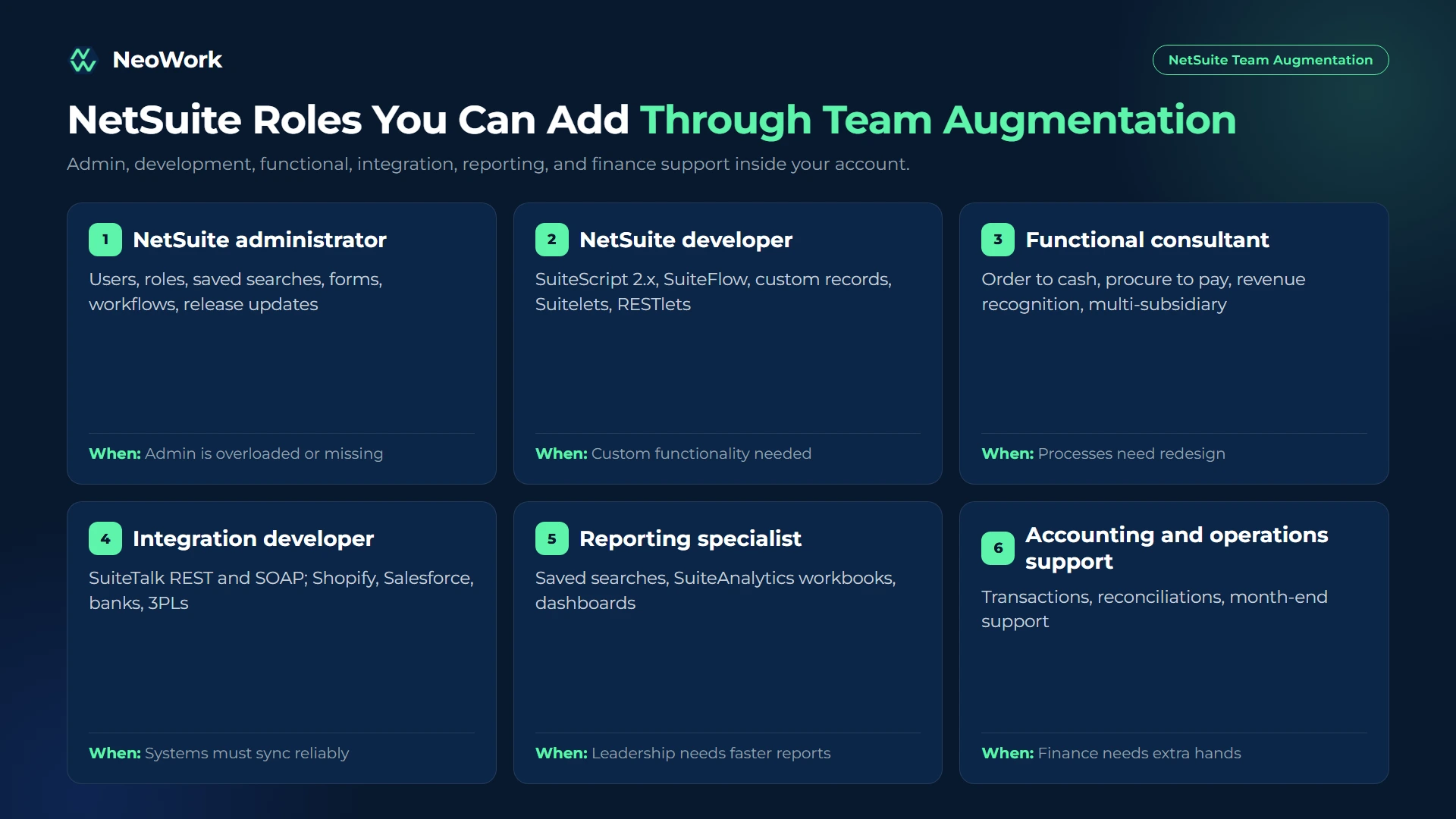
NetSuite Roles You Can Add

Role What They Do When You Need One
NetSuite administrator Users, roles and permissions, saved searches, forms, workflows, release updates Your admin is overloaded or you have none
NetSuite developer SuiteScript 2.x, SuiteFlow, custom records, Suitelets and RESTlets Custom functionality or automation is needed
Functional consultant Process design for order to cash, procure to pay, revenue recognition, inventory, and multi-subsidiary setups Business processes need redesign or optimization
Integration developer SuiteTalk REST and SOAP, integration platforms, connections with Shopify, Salesforce, banks, and 3PLs Systems need to talk to NetSuite reliably
Reporting and analytics specialist Saved searches, SuiteAnalytics workbooks, dashboards, financial reports Leadership needs better and faster reporting
Accounting and operations support Transaction processing, reconciliations, month-end support inside NetSuite Finance team needs extra hands in the system
NetSuite team augmentation roles including NetSuite administrator, SuiteScript developer, functional consultant, integration developer, reporting specialist, and accounting support

For transaction processing and month-end support, a dedicated bookkeeping team working inside NetSuite can free your accountants for review and analysis.

Add NetSuite Expertise to Your Team

At NeoWork, we help companies add dedicated NetSuite admins, developers, and finance specialists who work inside their account and processes as part of their team. We recruit for the NetSuite modules and skills you need, onboard specialists into your change process, and handle employment, benefits, and ongoing teammate support.

Our model includes:

  • Dedicated NetSuite specialists who work on your priorities in your account
  • A 3.2% candidate selectivity rate, with NetSuite-specific technical and functional screening
  • Industry-leading 91% annualized teammate retention rate, so knowledge of your ERP stays on the team
  • Capacity that scales with your ERP roadmap

Contact us to tell us how you use NetSuite and where you need help. We will suggest the right profiles and team setup.

When NetSuite Team Augmentation Makes Sense

The most common trigger is a bottlenecked administrator. When requests for new fields, workflows, saved searches, and reports wait for weeks, the business starts working around the system with spreadsheets and manual steps, which slowly erodes the value of having an ERP at all. Adding a dedicated admin or developer clears the queue and gives the internal admin room to think about bigger improvements.

Cost is the second trigger. Companies that rely on their implementation partner for every change often find that small tweaks, billed at partner rates, add up to a substantial monthly spend. A dedicated augmented specialist typically costs less for the same volume of work and gets faster over time because they learn the account.

Growth is the third. New subsidiaries, currencies, sales channels, and acquisitions all require configuration and integration work, and fragile integrations that fail to sync orders, inventory, or payments need someone with time to fix root causes rather than symptoms. Finally, painful month-end closes are often a sign that better configuration, automation, and extra hands inside the system could save the finance team days every month.

NetSuite Team Augmentation vs. Other Models

Model Who Manages Work Best For Trade-Offs
Team augmentation Your team Ongoing administration, optimization, and roadmap work Needs an internal owner for priorities
Implementation partner The partner New implementations and large projects Higher rates for small, ongoing changes
Managed services or support plans The provider, against a block of hours Occasional fixes and questions Shared consultants with less account knowledge
Freelancers Your team Small, defined tasks Availability and continuity risks
In-house hiring Your team Long-term core roles NetSuite talent is hard to find

How to Vet NetSuite Specialists

  • Certifications: Oracle NetSuite certifications such as Administrator, SuiteFoundation, ERP Consultant, or SuiteCloud Developer II are a useful baseline.
  • Module experience: Match experience to your use: OneWorld multi-subsidiary, advanced revenue management, inventory and WMS, manufacturing, or SuiteCommerce.
  • Scripting skills: For developers, check SuiteScript 2.x, governance limits, error handling, and deployment through SDF.
  • Accounting knowledge: Functional specialists should understand the accounting behind transactions, not just the screens.
  • Change management habits: Ask how they test in sandboxes, document changes, and deploy to production.
  • Practical exercise: Have candidates build a saved search, design a workflow, or review a script from a realistic scenario.

How Much Does NetSuite Team Augmentation Cost?

Rates depend on role, module expertise, certifications, and location. Senior functional consultants and SuiteScript developers cost more than administrators and finance support. Common pricing models:

  • Monthly rate per specialist: A fixed fee for each dedicated full-time professional.
  • Monthly team rate: One price for a combined functional and technical team.
  • Hourly or block-of-hours pricing: For part-time support.

For ongoing work, a dedicated specialist is often far cheaper than paying implementation partner rates for every change. See how we structure dedicated roles on our pricing page.
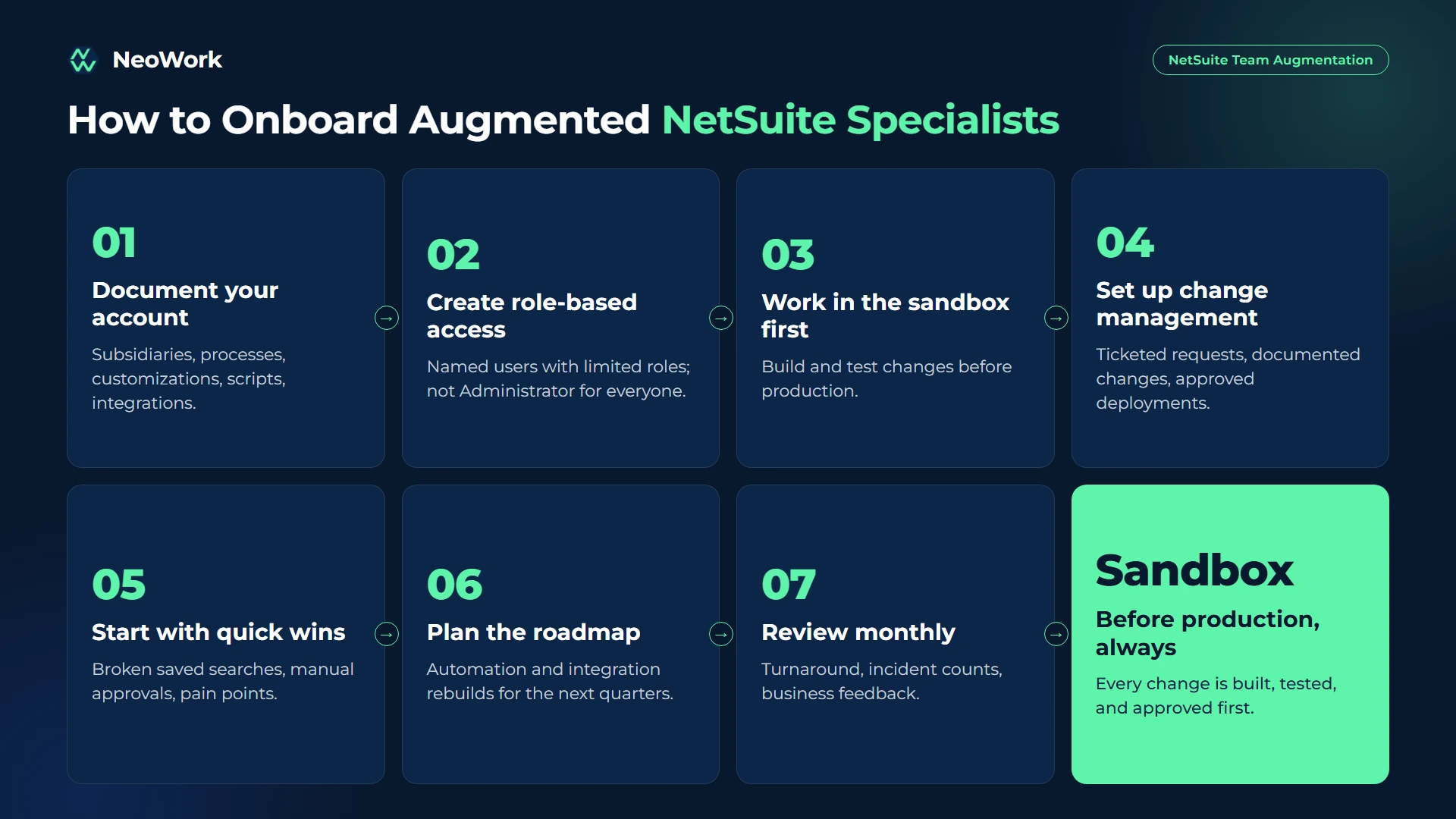
How to Onboard Augmented NetSuite Specialists

NetSuite team augmentation onboarding steps from account documentation and role-based access to sandbox work, change management, production deployment, and monthly review
  1. Document your account. Share subsidiaries, key processes, customizations, scripts, integrations, and known issues.
  2. Create role-based access. Give each specialist a named user with a role limited to what they need. Avoid using the Administrator role for everyone.
  3. Work in the sandbox first. Build and test changes in sandbox accounts before production.
  4. Set up change management. Track requests in a ticketing tool, document every change, and require approval for production deployments.
  5. Start with quick wins. Fix high-impact pain points such as broken saved searches or manual approvals.
  6. Plan the roadmap. Agree on larger improvements for the next quarters, such as automation or integration rebuilds.
  7. Review monthly. Track request turnaround, incident counts, and business feedback.

Questions Worth Asking Any Provider

  • Which NetSuite modules and industries have your specialists worked with?
  • Do they hold current NetSuite certifications?
  • How do they handle sandbox testing and production deployments?
  • Can they cover both functional and technical work?
  • How do you handle replacements and documentation?
  • What time zone overlap can we expect around month-end?

Common NetSuite Team Augmentation Mistakes

The most frequent mistake is giving every external specialist the Administrator role. It is convenient, but it removes the controls that protect financial data and makes it hard to trace who changed what. Custom roles with least privilege take a little longer to set up and prevent a whole category of problems.

The second mistake is changing production directly. In a live ERP, an untested workflow or script can block transactions, post entries incorrectly, or break reports that leadership relies on. Sandbox-first development is non-negotiable. Closely related is the lack of documentation: undocumented scripts and workflows become risky technical debt that nobody dares to touch.

Finally, two people-related mistakes are common. Hiring technical specialists without accounting knowledge leads to configuration that ignores accounting logic, and running augmentation without an internal owner leaves nobody to set priorities and approve changes. Someone in finance or IT must own the system, even when most of the hands-on work is done by augmented specialists.

Final Thoughts

NetSuite team augmentation gives growing companies the dedicated ERP expertise they need without long hiring cycles or partner rates for every small change. It works best with clear ownership, role-based access, sandbox-first change management, and specialists vetted on both NetSuite skills and business process knowledge.

If your NetSuite backlog keeps growing, see how we build dedicated teams at NeoWork.

FAQ

What is NetSuite team augmentation?

It is a model where an external provider supplies dedicated NetSuite specialists who join your team and work in your account under your direction, while the provider handles hiring and employment.

How is it different from using a NetSuite partner?

Implementation partners usually work on projects and bill for each engagement. Augmented specialists are dedicated to your account and handle ongoing work on your priorities.

Which NetSuite roles can be augmented?

Administrators, SuiteScript developers, functional consultants, integration developers, reporting specialists, and accounting support working inside NetSuite.

How much does NetSuite team augmentation cost?

Providers usually charge a monthly rate per specialist, a monthly team rate, or hourly pricing. Cost depends on role, module expertise, certifications, and location.

Is it safe to give external specialists access to our ERP?

Yes, with named users, custom least-privilege roles, two-factor authentication, sandbox-first development, documented change approvals, and audit trails.

Can augmented specialists help with month-end close?

Yes. Finance and accounting specialists can handle reconciliations and transaction processing, while admins and developers automate manual steps to shorten the close.

How quickly can a NetSuite specialist start?

Providers can often present candidates within days to a couple of weeks. Productive work usually begins after a short account walkthrough and access setup.

Topics
No items found.

NetSuite Team Augmentation Guide: How It Works in 2026

Paper
Calendar Icon
Oct 29, 2026
Ann

Quick Summary: NetSuite team augmentation is when a company adds external NetSuite administrators, developers, consultants, or analysts to its internal team to support, customize, and extend Oracle NetSuite. The augmented specialists work in your account, sandboxes, and processes under your direction. NetSuite is one of the most widely used cloud ERP systems for growing companies, with industry estimates putting its customer base above 40,000 organizations, and many of those companies outgrow the internal capacity they have to manage it. This guide covers the NetSuite roles you can add, when augmentation beats relying on an implementation partner, how to vet NetSuite talent, what it costs, and how to onboard augmented specialists into a live ERP safely.

NetSuite rarely stays the way it was on go-live day. New subsidiaries, new revenue models, acquisitions, integrations with ecommerce and CRM, custom approvals, and growing reporting needs all add pressure. Many companies run NetSuite with a single overloaded admin, while finance and operations teams wait weeks for fixes and reports. Implementation partners are great for projects, but expensive for the continuous stream of small changes a live ERP needs.

NetSuite team augmentation gives you dedicated capacity that knows your account and works on your priorities. This guide explains how to set it up.

What Is NetSuite Team Augmentation?

NetSuite team augmentation is an engagement model in which a provider supplies dedicated NetSuite professionals who join your finance systems, IT, or business applications team. They handle administration, customization, scripting, integrations, and reporting in your account, following your change management process. The provider handles recruiting, employment, and continuity.

You can add one specialist to support an existing admin, or a small team that combines functional and technical roles to run your NetSuite roadmap.

NetSuite Roles You Can Add

Role What They Do When You Need One
NetSuite administrator Users, roles and permissions, saved searches, forms, workflows, release updates Your admin is overloaded or you have none
NetSuite developer SuiteScript 2.x, SuiteFlow, custom records, Suitelets and RESTlets Custom functionality or automation is needed
Functional consultant Process design for order to cash, procure to pay, revenue recognition, inventory, and multi-subsidiary setups Business processes need redesign or optimization
Integration developer SuiteTalk REST and SOAP, integration platforms, connections with Shopify, Salesforce, banks, and 3PLs Systems need to talk to NetSuite reliably
Reporting and analytics specialist Saved searches, SuiteAnalytics workbooks, dashboards, financial reports Leadership needs better and faster reporting
Accounting and operations support Transaction processing, reconciliations, month-end support inside NetSuite Finance team needs extra hands in the system
NetSuite team augmentation roles including NetSuite administrator, SuiteScript developer, functional consultant, integration developer, reporting specialist, and accounting support

For transaction processing and month-end support, a dedicated bookkeeping team working inside NetSuite can free your accountants for review and analysis.

Add NetSuite Expertise to Your Team

At NeoWork, we help companies add dedicated NetSuite admins, developers, and finance specialists who work inside their account and processes as part of their team. We recruit for the NetSuite modules and skills you need, onboard specialists into your change process, and handle employment, benefits, and ongoing teammate support.

Our model includes:

  • Dedicated NetSuite specialists who work on your priorities in your account
  • A 3.2% candidate selectivity rate, with NetSuite-specific technical and functional screening
  • Industry-leading 91% annualized teammate retention rate, so knowledge of your ERP stays on the team
  • Capacity that scales with your ERP roadmap

Contact us to tell us how you use NetSuite and where you need help. We will suggest the right profiles and team setup.

When NetSuite Team Augmentation Makes Sense

The most common trigger is a bottlenecked administrator. When requests for new fields, workflows, saved searches, and reports wait for weeks, the business starts working around the system with spreadsheets and manual steps, which slowly erodes the value of having an ERP at all. Adding a dedicated admin or developer clears the queue and gives the internal admin room to think about bigger improvements.

Cost is the second trigger. Companies that rely on their implementation partner for every change often find that small tweaks, billed at partner rates, add up to a substantial monthly spend. A dedicated augmented specialist typically costs less for the same volume of work and gets faster over time because they learn the account.

Growth is the third. New subsidiaries, currencies, sales channels, and acquisitions all require configuration and integration work, and fragile integrations that fail to sync orders, inventory, or payments need someone with time to fix root causes rather than symptoms. Finally, painful month-end closes are often a sign that better configuration, automation, and extra hands inside the system could save the finance team days every month.

NetSuite Team Augmentation vs. Other Models

Model Who Manages Work Best For Trade-Offs
Team augmentation Your team Ongoing administration, optimization, and roadmap work Needs an internal owner for priorities
Implementation partner The partner New implementations and large projects Higher rates for small, ongoing changes
Managed services or support plans The provider, against a block of hours Occasional fixes and questions Shared consultants with less account knowledge
Freelancers Your team Small, defined tasks Availability and continuity risks
In-house hiring Your team Long-term core roles NetSuite talent is hard to find

How to Vet NetSuite Specialists

  • Certifications: Oracle NetSuite certifications such as Administrator, SuiteFoundation, ERP Consultant, or SuiteCloud Developer II are a useful baseline.
  • Module experience: Match experience to your use: OneWorld multi-subsidiary, advanced revenue management, inventory and WMS, manufacturing, or SuiteCommerce.
  • Scripting skills: For developers, check SuiteScript 2.x, governance limits, error handling, and deployment through SDF.
  • Accounting knowledge: Functional specialists should understand the accounting behind transactions, not just the screens.
  • Change management habits: Ask how they test in sandboxes, document changes, and deploy to production.
  • Practical exercise: Have candidates build a saved search, design a workflow, or review a script from a realistic scenario.

How Much Does NetSuite Team Augmentation Cost?

Rates depend on role, module expertise, certifications, and location. Senior functional consultants and SuiteScript developers cost more than administrators and finance support. Common pricing models:

  • Monthly rate per specialist: A fixed fee for each dedicated full-time professional.
  • Monthly team rate: One price for a combined functional and technical team.
  • Hourly or block-of-hours pricing: For part-time support.

For ongoing work, a dedicated specialist is often far cheaper than paying implementation partner rates for every change. See how we structure dedicated roles on our pricing page.

How to Onboard Augmented NetSuite Specialists

NetSuite team augmentation onboarding steps from account documentation and role-based access to sandbox work, change management, production deployment, and monthly review
  1. Document your account. Share subsidiaries, key processes, customizations, scripts, integrations, and known issues.
  2. Create role-based access. Give each specialist a named user with a role limited to what they need. Avoid using the Administrator role for everyone.
  3. Work in the sandbox first. Build and test changes in sandbox accounts before production.
  4. Set up change management. Track requests in a ticketing tool, document every change, and require approval for production deployments.
  5. Start with quick wins. Fix high-impact pain points such as broken saved searches or manual approvals.
  6. Plan the roadmap. Agree on larger improvements for the next quarters, such as automation or integration rebuilds.
  7. Review monthly. Track request turnaround, incident counts, and business feedback.

Questions Worth Asking Any Provider

  • Which NetSuite modules and industries have your specialists worked with?
  • Do they hold current NetSuite certifications?
  • How do they handle sandbox testing and production deployments?
  • Can they cover both functional and technical work?
  • How do you handle replacements and documentation?
  • What time zone overlap can we expect around month-end?

Common NetSuite Team Augmentation Mistakes

The most frequent mistake is giving every external specialist the Administrator role. It is convenient, but it removes the controls that protect financial data and makes it hard to trace who changed what. Custom roles with least privilege take a little longer to set up and prevent a whole category of problems.

The second mistake is changing production directly. In a live ERP, an untested workflow or script can block transactions, post entries incorrectly, or break reports that leadership relies on. Sandbox-first development is non-negotiable. Closely related is the lack of documentation: undocumented scripts and workflows become risky technical debt that nobody dares to touch.

Finally, two people-related mistakes are common. Hiring technical specialists without accounting knowledge leads to configuration that ignores accounting logic, and running augmentation without an internal owner leaves nobody to set priorities and approve changes. Someone in finance or IT must own the system, even when most of the hands-on work is done by augmented specialists.

Final Thoughts

NetSuite team augmentation gives growing companies the dedicated ERP expertise they need without long hiring cycles or partner rates for every small change. It works best with clear ownership, role-based access, sandbox-first change management, and specialists vetted on both NetSuite skills and business process knowledge.

If your NetSuite backlog keeps growing, see how we build dedicated teams at NeoWork.

FAQ

What is NetSuite team augmentation?

It is a model where an external provider supplies dedicated NetSuite specialists who join your team and work in your account under your direction, while the provider handles hiring and employment.

How is it different from using a NetSuite partner?

Implementation partners usually work on projects and bill for each engagement. Augmented specialists are dedicated to your account and handle ongoing work on your priorities.

Which NetSuite roles can be augmented?

Administrators, SuiteScript developers, functional consultants, integration developers, reporting specialists, and accounting support working inside NetSuite.

How much does NetSuite team augmentation cost?

Providers usually charge a monthly rate per specialist, a monthly team rate, or hourly pricing. Cost depends on role, module expertise, certifications, and location.

Is it safe to give external specialists access to our ERP?

Yes, with named users, custom least-privilege roles, two-factor authentication, sandbox-first development, documented change approvals, and audit trails.

Can augmented specialists help with month-end close?

Yes. Finance and accounting specialists can handle reconciliations and transaction processing, while admins and developers automate manual steps to shorten the close.

How quickly can a NetSuite specialist start?

Providers can often present candidates within days to a couple of weeks. Productive work usually begins after a short account walkthrough and access setup.

Topics

No items found.
Blue gradient banner with rounded corners at the top.
CTA Hexagon LeftCTA Hexagon LeftCTA Hexagon RightCTA Hexagon Right Mobile

Navigate the shadows of tech leadership – all while enjoying the comfort food that binds us all.

CTA Hexagon LeftCTA Hexagon LeftCTA Hexagon RightCTA Hexagon Right Mobile

Book a consultation

Build your team with NeoWork

Talk to us about how we staff and manage high-performing remote teams for companies like yours.