
Green glowing circular pattern with concentric rings and faint hexagonal grid on the left side.
Blue abstract hexagonal pattern with glowing circular gradient edges on a black background.Glowing greenish-blue hexagonal pattern with concentric circular gradients on a black background.

PHP Team Augmentation Guide: How It Works in 2026

Calendar Icon
Published:
Oct 29
2026
,
Updated:
Oct 30
2026
Ann
Facebook IconInstagram Icon

Build your team with NeoWork

Talk to us about how we staff and manage high-performing remote teams for companies like yours.

Get a PHP Team Augmentation Quote

Quick Summary: PHP team augmentation is when a company adds external PHP developers, or a full PHP pod, to its existing team to build features, modernize legacy code, or support growing platforms built on Laravel, Symfony, or custom PHP. The augmented developers work in your codebase and processes and report to your engineering leads. PHP is still the backbone of the web: W3Techs data shows it as the server-side language behind roughly 70% of websites whose server-side language can be identified. Modern PHP 8.x releases brought major performance gains, strong typing features, and a much better developer experience, so there is plenty of reason to invest in PHP codebases rather than rewrite them. This guide covers PHP roles you can add, when augmentation makes sense, how to vet PHP developers, what it costs, and how to onboard them.

Many businesses run on PHP applications that have grown for a decade or more: SaaS platforms, marketplaces, booking systems, internal tools, and ecommerce backends. Some are built on Laravel or Symfony, others on older frameworks or custom code. Common problems include outdated PHP versions, missing tests, slow pages, and a backlog that the current team cannot clear.

PHP team augmentation lets you add experienced developers who can modernize the code, ship new features, and stabilize the platform without months of recruiting. This guide explains how to do it well.

What Is PHP Team Augmentation?

PHP team augmentation is an engagement model in which a provider supplies dedicated PHP developers who join your engineering team. They take work from your backlog, follow your coding standards, participate in code reviews and sprints, and use your repositories, CI/CD, and hosting. The provider handles recruiting, employment, and continuity.

You can add individuals to fill gaps or a pod with a senior lead, developers, and QA to own a workstream such as a framework upgrade, an API rebuild, or a new module.
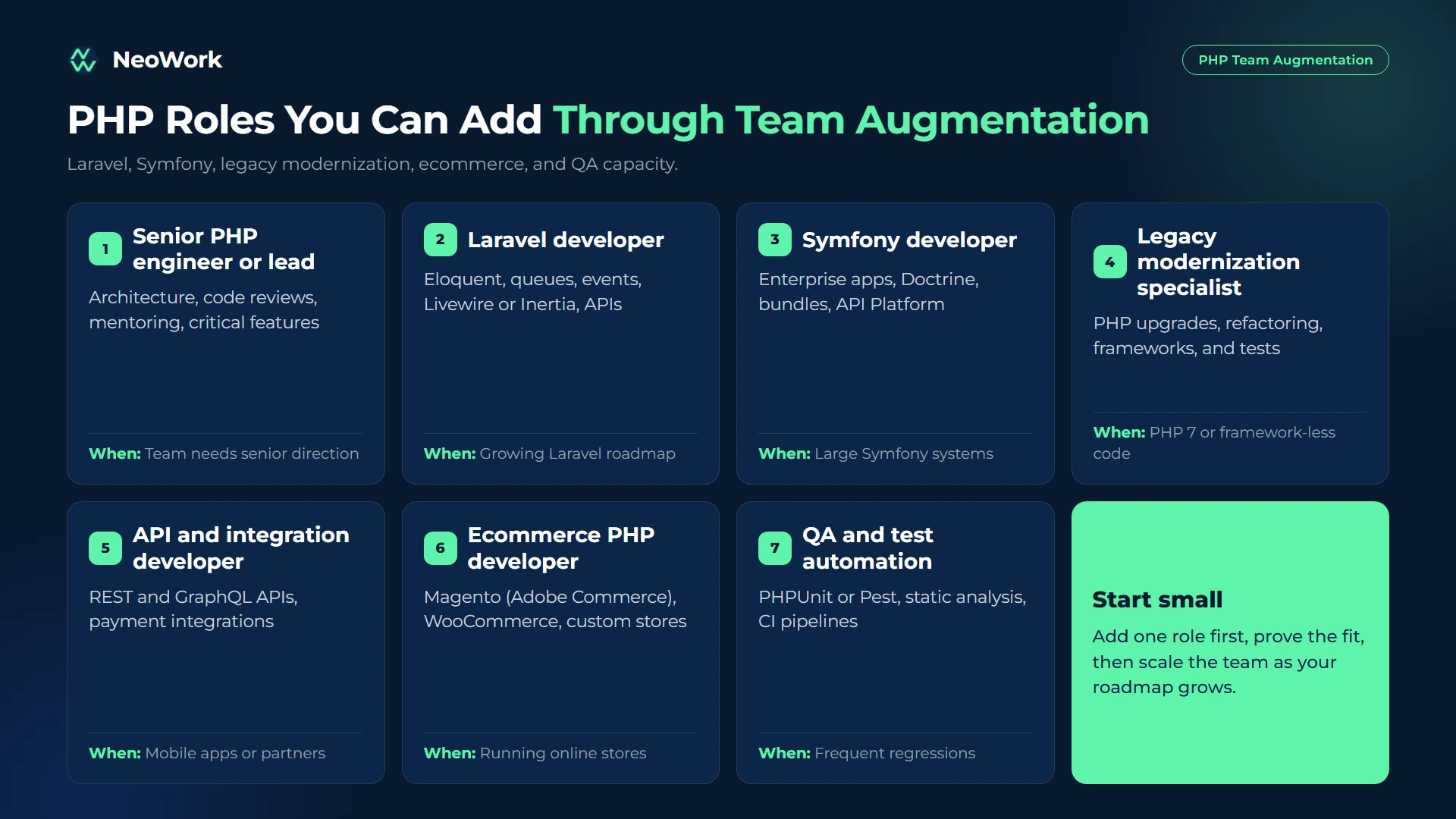
PHP Roles You Can Add

Role What They Do When You Need One
Senior PHP engineer or tech lead Architecture, code reviews, mentoring, critical features Your team needs senior direction
Laravel developer Features with Eloquent, queues, events, Livewire or Inertia, APIs Laravel applications with growing roadmaps
Symfony developer Enterprise applications, Doctrine, bundles, API Platform Large or long-lived Symfony systems
Legacy modernization specialist Upgrading PHP versions, refactoring, introducing frameworks and tests Running PHP 7 or older, or framework-less legacy code
API and integration developer REST and GraphQL APIs, payment and third-party integrations Mobile apps, partners, or new services
Ecommerce PHP developer Magento (Adobe Commerce), WooCommerce, or custom store backends Running or scaling online stores
QA and test automation engineer PHPUnit or Pest tests, static analysis, CI pipelines Low coverage or frequent regressions
PHP team augmentation roles including senior PHP engineer, Laravel developer, Symfony developer, legacy modernization specialist, API developer, ecommerce PHP developer, and QA automation engineer

Add Experienced PHP Developers to Your Team

At NeoWork, we help companies add dedicated PHP developers and complete PHP teams that work inside their codebase and engineering process. We recruit for your framework and seniority needs, onboard developers into your workflows, and handle employment, benefits, and ongoing teammate support.

Our model includes:

  • Dedicated PHP developers or pods that join your sprints and code reviews
  • A 3.2% candidate selectivity rate, with hands-on PHP and framework assessments
  • Industry-leading 91% annualized teammate retention rate, so knowledge of your platform stays on the team
  • Team size that scales with your roadmap

Contact us to share your PHP stack and priorities. We will suggest developer profiles and a team setup.

When PHP Team Augmentation Makes Sense

An outdated PHP version is one of the clearest signals. Unsupported versions stop receiving security patches, block updates to frameworks and libraries, and miss the substantial performance improvements of PHP 8.x. Upgrading a large application is careful, methodical work that internal teams tend to postpone, and augmented developers who have done it before can move it forward without stalling the roadmap.

Augmentation is also worth considering before any decision to rewrite. Rewrites are attractive because they promise a clean start, but they are expensive, slow, and risky, and they freeze feature development for months. Experienced PHP developers can often modernize incrementally instead: adding tests around critical flows, upgrading PHP, introducing a framework module by module, and refactoring the worst areas first. The business keeps moving while the code improves.

More routinely, augmentation fits whenever the roadmap outpaces the team, when you need framework expertise such as Laravel, Symfony, or Magento that your team lacks, or when rising bugs and regressions show that the codebase needs tests and refactoring before it can safely grow further.

PHP Team Augmentation vs. Other Models

Model Who Manages Delivery Best For Trade-Offs
Team augmentation Your engineering leads Ongoing development and modernization Needs internal technical ownership
Project outsourcing The vendor Fixed-scope builds Knowledge often leaves after delivery
Freelancers Your team Small, isolated tasks Continuity and security risks
Full rewrite in another stack Varies Rare cases where PHP truly limits the business High cost, long timelines, and high risk

For a closer look at providers, see our overviews of PHP team augmentation companies and PHP development team augmentation companies.

How to Vet PHP Developers

  • Modern PHP: Typed properties, enums, readonly properties, attributes, and match expressions from PHP 8.x.
  • Framework depth: Laravel or Symfony internals, service containers, queues, events, and ORM pitfalls.
  • Composer and dependencies: Managing packages, autoloading, and safe upgrades.
  • Testing and static analysis: PHPUnit or Pest, plus tools such as PHPStan or Psalm.
  • Security basics: SQL injection prevention, XSS, CSRF, authentication, and secure file handling.
  • Performance: OPcache, query optimization, caching with Redis, and queue processing.
  • Practical task: A small feature with tests, or a refactoring exercise on legacy code, shows how candidates handle real codebases.

How Much Does PHP Team Augmentation Cost?

PHP developer rates depend on seniority, framework specialization, and location. Senior Laravel, Symfony, and Magento developers cost more than generalists. Common pricing models:

  • Monthly rate per developer: A fixed fee for each dedicated full-time developer.
  • Monthly team rate: One price for a full pod.
  • Hourly rate: For part-time or short engagements.

PHP has a large global talent pool, so experienced developers are available in many nearshore and offshore markets at competitive rates. See how we structure dedicated teams on our pricing page.
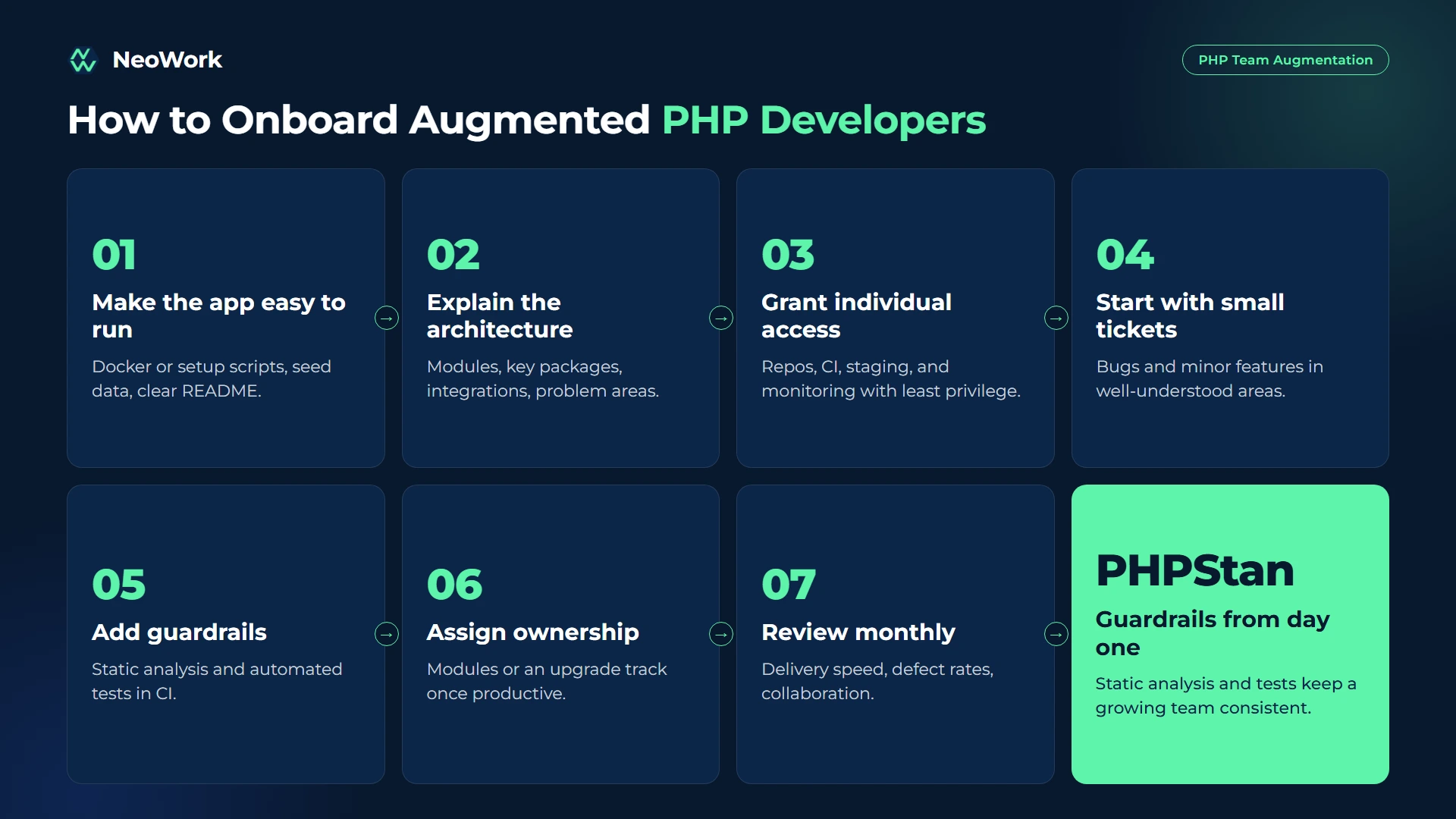
How to Onboard Augmented PHP Developers

PHP team augmentation onboarding steps from local setup and codebase walkthrough to first tickets, code review, static analysis, and module ownership
  1. Make the app easy to run. Provide Docker or setup scripts, seed data, and clear README instructions.
  2. Explain the architecture. Walk through modules, key packages, integrations, and known problem areas.
  3. Grant individual access. Repositories, CI, staging, and monitoring tools with least-privilege permissions.
  4. Start with small tickets. Bugs and minor features in well-understood areas.
  5. Add guardrails. Introduce static analysis and automated tests in CI if they are not already there.
  6. Assign ownership. Give developers responsibility for modules or an upgrade track once they are productive.
  7. Review monthly. Track delivery speed, defect rates, and collaboration.

Questions Worth Asking Any Provider

  • Which PHP frameworks and versions do your developers work with?
  • Have they modernized legacy PHP applications?
  • Can we interview developers before they start?
  • How much time zone overlap will we have?
  • How do you handle replacements and knowledge transfer?
  • Who owns the code and intellectual property?

Common PHP Team Augmentation Mistakes

The most costly mistake is choosing a rewrite when modernization would do. Full rewrites routinely take longer and cost more than planned, and they leave the business without new features for months. Incremental improvement with experienced developers is almost always the safer path.

When modernizing, the most common mistake is refactoring without tests. Changing legacy code that has no automated tests is how regressions reach production. Adding tests around critical flows first is slower at the start and much faster overall. Ignoring PHP version upgrades has a similar long-term cost, because every month on an old version adds security risk and slows everyone down.

Weak code review allows inconsistent patterns to spread quickly in large PHP codebases, and choosing developers purely on rate tends to add technical debt that costs more than the savings. Both problems are easier to prevent than to fix.

Final Thoughts

PHP team augmentation is a practical way to add capacity, modernize legacy applications, and bring in framework expertise without a long hiring process or a risky rewrite. It works best when you vet developers on modern PHP practices, make onboarding easy, add tests and static analysis, and keep ownership clear.

If your PHP platform needs more hands, explore our software development teams at NeoWork.

FAQ

What is PHP team augmentation?

It is a model where an external provider supplies dedicated PHP developers who join your engineering team, work in your codebase, and follow your processes.

Is PHP still worth investing in?

Yes. PHP powers a large majority of websites with a known server-side language, and modern PHP 8.x is fast, well typed, and supported by mature frameworks such as Laravel and Symfony.

Should we rewrite our legacy PHP app?

Usually not as a first step. Incremental modernization, adding tests, upgrading PHP, and introducing a framework step by step is typically lower risk and faster than a full rewrite.

Which PHP frameworks can augmented developers support?

Most commonly Laravel and Symfony, plus ecommerce platforms such as Magento and WooCommerce, and custom or legacy frameworks.

How much does PHP team augmentation cost?

Providers usually charge a monthly rate per developer, a monthly team rate, or an hourly rate. Cost depends on seniority, framework expertise, and location.

How quickly can augmented PHP developers start?

Candidates can often be presented within days, and developers typically start contributing within their first sprint with good onboarding.

What is the difference between PHP and WordPress team augmentation?

WordPress augmentation focuses on themes, blocks, plugins, and WooCommerce. PHP augmentation covers broader application development, including Laravel, Symfony, custom platforms, and APIs.

Topics
No items found.

PHP Team Augmentation Guide: How It Works in 2026

Paper
Calendar Icon
Oct 29, 2026
Ann

Quick Summary: PHP team augmentation is when a company adds external PHP developers, or a full PHP pod, to its existing team to build features, modernize legacy code, or support growing platforms built on Laravel, Symfony, or custom PHP. The augmented developers work in your codebase and processes and report to your engineering leads. PHP is still the backbone of the web: W3Techs data shows it as the server-side language behind roughly 70% of websites whose server-side language can be identified. Modern PHP 8.x releases brought major performance gains, strong typing features, and a much better developer experience, so there is plenty of reason to invest in PHP codebases rather than rewrite them. This guide covers PHP roles you can add, when augmentation makes sense, how to vet PHP developers, what it costs, and how to onboard them.

Many businesses run on PHP applications that have grown for a decade or more: SaaS platforms, marketplaces, booking systems, internal tools, and ecommerce backends. Some are built on Laravel or Symfony, others on older frameworks or custom code. Common problems include outdated PHP versions, missing tests, slow pages, and a backlog that the current team cannot clear.

PHP team augmentation lets you add experienced developers who can modernize the code, ship new features, and stabilize the platform without months of recruiting. This guide explains how to do it well.

What Is PHP Team Augmentation?

PHP team augmentation is an engagement model in which a provider supplies dedicated PHP developers who join your engineering team. They take work from your backlog, follow your coding standards, participate in code reviews and sprints, and use your repositories, CI/CD, and hosting. The provider handles recruiting, employment, and continuity.

You can add individuals to fill gaps or a pod with a senior lead, developers, and QA to own a workstream such as a framework upgrade, an API rebuild, or a new module.

PHP Roles You Can Add

Role What They Do When You Need One
Senior PHP engineer or tech lead Architecture, code reviews, mentoring, critical features Your team needs senior direction
Laravel developer Features with Eloquent, queues, events, Livewire or Inertia, APIs Laravel applications with growing roadmaps
Symfony developer Enterprise applications, Doctrine, bundles, API Platform Large or long-lived Symfony systems
Legacy modernization specialist Upgrading PHP versions, refactoring, introducing frameworks and tests Running PHP 7 or older, or framework-less legacy code
API and integration developer REST and GraphQL APIs, payment and third-party integrations Mobile apps, partners, or new services
Ecommerce PHP developer Magento (Adobe Commerce), WooCommerce, or custom store backends Running or scaling online stores
QA and test automation engineer PHPUnit or Pest tests, static analysis, CI pipelines Low coverage or frequent regressions
PHP team augmentation roles including senior PHP engineer, Laravel developer, Symfony developer, legacy modernization specialist, API developer, ecommerce PHP developer, and QA automation engineer

Add Experienced PHP Developers to Your Team

At NeoWork, we help companies add dedicated PHP developers and complete PHP teams that work inside their codebase and engineering process. We recruit for your framework and seniority needs, onboard developers into your workflows, and handle employment, benefits, and ongoing teammate support.

Our model includes:

  • Dedicated PHP developers or pods that join your sprints and code reviews
  • A 3.2% candidate selectivity rate, with hands-on PHP and framework assessments
  • Industry-leading 91% annualized teammate retention rate, so knowledge of your platform stays on the team
  • Team size that scales with your roadmap

Contact us to share your PHP stack and priorities. We will suggest developer profiles and a team setup.

When PHP Team Augmentation Makes Sense

An outdated PHP version is one of the clearest signals. Unsupported versions stop receiving security patches, block updates to frameworks and libraries, and miss the substantial performance improvements of PHP 8.x. Upgrading a large application is careful, methodical work that internal teams tend to postpone, and augmented developers who have done it before can move it forward without stalling the roadmap.

Augmentation is also worth considering before any decision to rewrite. Rewrites are attractive because they promise a clean start, but they are expensive, slow, and risky, and they freeze feature development for months. Experienced PHP developers can often modernize incrementally instead: adding tests around critical flows, upgrading PHP, introducing a framework module by module, and refactoring the worst areas first. The business keeps moving while the code improves.

More routinely, augmentation fits whenever the roadmap outpaces the team, when you need framework expertise such as Laravel, Symfony, or Magento that your team lacks, or when rising bugs and regressions show that the codebase needs tests and refactoring before it can safely grow further.

PHP Team Augmentation vs. Other Models

Model Who Manages Delivery Best For Trade-Offs
Team augmentation Your engineering leads Ongoing development and modernization Needs internal technical ownership
Project outsourcing The vendor Fixed-scope builds Knowledge often leaves after delivery
Freelancers Your team Small, isolated tasks Continuity and security risks
Full rewrite in another stack Varies Rare cases where PHP truly limits the business High cost, long timelines, and high risk

For a closer look at providers, see our overviews of PHP team augmentation companies and PHP development team augmentation companies.

How to Vet PHP Developers

  • Modern PHP: Typed properties, enums, readonly properties, attributes, and match expressions from PHP 8.x.
  • Framework depth: Laravel or Symfony internals, service containers, queues, events, and ORM pitfalls.
  • Composer and dependencies: Managing packages, autoloading, and safe upgrades.
  • Testing and static analysis: PHPUnit or Pest, plus tools such as PHPStan or Psalm.
  • Security basics: SQL injection prevention, XSS, CSRF, authentication, and secure file handling.
  • Performance: OPcache, query optimization, caching with Redis, and queue processing.
  • Practical task: A small feature with tests, or a refactoring exercise on legacy code, shows how candidates handle real codebases.

How Much Does PHP Team Augmentation Cost?

PHP developer rates depend on seniority, framework specialization, and location. Senior Laravel, Symfony, and Magento developers cost more than generalists. Common pricing models:

  • Monthly rate per developer: A fixed fee for each dedicated full-time developer.
  • Monthly team rate: One price for a full pod.
  • Hourly rate: For part-time or short engagements.

PHP has a large global talent pool, so experienced developers are available in many nearshore and offshore markets at competitive rates. See how we structure dedicated teams on our pricing page.

How to Onboard Augmented PHP Developers

PHP team augmentation onboarding steps from local setup and codebase walkthrough to first tickets, code review, static analysis, and module ownership
  1. Make the app easy to run. Provide Docker or setup scripts, seed data, and clear README instructions.
  2. Explain the architecture. Walk through modules, key packages, integrations, and known problem areas.
  3. Grant individual access. Repositories, CI, staging, and monitoring tools with least-privilege permissions.
  4. Start with small tickets. Bugs and minor features in well-understood areas.
  5. Add guardrails. Introduce static analysis and automated tests in CI if they are not already there.
  6. Assign ownership. Give developers responsibility for modules or an upgrade track once they are productive.
  7. Review monthly. Track delivery speed, defect rates, and collaboration.

Questions Worth Asking Any Provider

  • Which PHP frameworks and versions do your developers work with?
  • Have they modernized legacy PHP applications?
  • Can we interview developers before they start?
  • How much time zone overlap will we have?
  • How do you handle replacements and knowledge transfer?
  • Who owns the code and intellectual property?

Common PHP Team Augmentation Mistakes

The most costly mistake is choosing a rewrite when modernization would do. Full rewrites routinely take longer and cost more than planned, and they leave the business without new features for months. Incremental improvement with experienced developers is almost always the safer path.

When modernizing, the most common mistake is refactoring without tests. Changing legacy code that has no automated tests is how regressions reach production. Adding tests around critical flows first is slower at the start and much faster overall. Ignoring PHP version upgrades has a similar long-term cost, because every month on an old version adds security risk and slows everyone down.

Weak code review allows inconsistent patterns to spread quickly in large PHP codebases, and choosing developers purely on rate tends to add technical debt that costs more than the savings. Both problems are easier to prevent than to fix.

Final Thoughts

PHP team augmentation is a practical way to add capacity, modernize legacy applications, and bring in framework expertise without a long hiring process or a risky rewrite. It works best when you vet developers on modern PHP practices, make onboarding easy, add tests and static analysis, and keep ownership clear.

If your PHP platform needs more hands, explore our software development teams at NeoWork.

FAQ

What is PHP team augmentation?

It is a model where an external provider supplies dedicated PHP developers who join your engineering team, work in your codebase, and follow your processes.

Is PHP still worth investing in?

Yes. PHP powers a large majority of websites with a known server-side language, and modern PHP 8.x is fast, well typed, and supported by mature frameworks such as Laravel and Symfony.

Should we rewrite our legacy PHP app?

Usually not as a first step. Incremental modernization, adding tests, upgrading PHP, and introducing a framework step by step is typically lower risk and faster than a full rewrite.

Which PHP frameworks can augmented developers support?

Most commonly Laravel and Symfony, plus ecommerce platforms such as Magento and WooCommerce, and custom or legacy frameworks.

How much does PHP team augmentation cost?

Providers usually charge a monthly rate per developer, a monthly team rate, or an hourly rate. Cost depends on seniority, framework expertise, and location.

How quickly can augmented PHP developers start?

Candidates can often be presented within days, and developers typically start contributing within their first sprint with good onboarding.

What is the difference between PHP and WordPress team augmentation?

WordPress augmentation focuses on themes, blocks, plugins, and WooCommerce. PHP augmentation covers broader application development, including Laravel, Symfony, custom platforms, and APIs.

Topics

No items found.
Blue gradient banner with rounded corners at the top.
CTA Hexagon LeftCTA Hexagon LeftCTA Hexagon RightCTA Hexagon Right Mobile

Navigate the shadows of tech leadership – all while enjoying the comfort food that binds us all.

CTA Hexagon LeftCTA Hexagon LeftCTA Hexagon RightCTA Hexagon Right Mobile

Book a consultation

Build your team with NeoWork

Talk to us about how we staff and manage high-performing remote teams for companies like yours.