

.avif)
.avif)

QA Team Augmentation Guide: Scale Testing Without the Hiring Grind


.svg)

Quick Summary: QA team augmentation means adding external QA engineers or test automation specialists directly into an existing engineering team, under its own processes and tools, to close skill or capacity gaps fast. It works best when a company already has a QA lead or engineering manager who can direct the augmented staff, and it typically costs less and moves faster than a full outsourced QA project or a new full-time hire. This guide walks through when it makes sense, how pricing and engagement models compare, and how to onboard augmented QA testers without breaking sprint rhythm.
Most engineering teams hit the same wall eventually: the backlog of untested features grows faster than the QA headcount. A big release is looming, automation coverage is thin, and the hiring pipeline for a senior QA engineer is going to take two or three months minimum. That gap is exactly where QA team augmentation earns its keep.
Unlike outsourcing an entire test cycle to a third-party agency, augmentation slots individual testers or small pods directly into an existing team. They join daily standups, use the same test management tools, and report to the same QA lead. The company keeps control of process and priorities; the augmentation partner supplies the people.
What QA Team Augmentation Actually Means
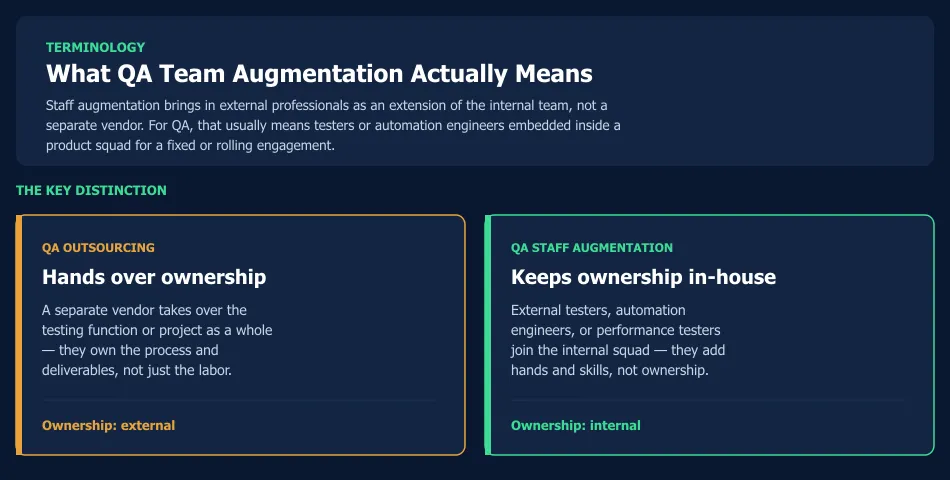
Staff augmentation, in general, is a hiring model where a company brings in external professionals to work as an extension of its internal team, rather than handing a project to a separate vendor. Applied to quality assurance specifically, it usually looks like one or more manual testers, automation engineers, or performance testers embedded inside a product squad for a fixed or rolling engagement.
The distinction matters because "QA outsourcing" and "QA staff augmentation" get used interchangeably online, but they're not the same thing. Outsourcing hands over ownership of a testing function or project. Augmentation keeps ownership in-house and simply adds hands and skills.
When QA Augmentation Makes Sense (and When It Doesn't)
It tends to work well in a handful of recurring scenarios: a release deadline that can't move, a sudden spike in regression testing after a major feature launch, a temporary need for a niche skill like performance or security testing, or a hiring freeze that still leaves quality goals in place.
It's a weaker fit when the real problem is process, not headcount. Adding three more manual testers to a team with no test strategy, no defined "done" criteria, and no automation framework just adds more people typing into the same broken system faster. Fix the process gaps first, or bring in augmented staff who can help fix them as part of the engagement.
QA Augmentation vs. Dedicated Teams vs. Full Outsourcing
These three models get confused constantly, and picking the wrong one is expensive. Here's the short version: augmentation adds people to an existing team; a dedicated team is a self-contained unit built for one client but managed with more vendor involvement; full outsourcing hands over an entire testing function, including strategy and reporting, to an external company.
Note there's no universally "best" option here. A startup with zero QA headcount might actually want a dedicated team over augmentation, since there's no internal lead to manage augmented staff. A mature engineering org with a strong QA manager but a temporary crunch is the classic augmentation candidate.

Expand QA Capacity with NeoWork
QA team augmentation helps companies add testing and quality support without expanding every role internally. NeoWork provides remote teammates who can support quality assurance, test execution, issue tracking, documentation, and related technical workflows. NeoWork handles recruitment, benefits, training, and ongoing engagement, while teammates integrate into the client’s systems, tools, and development processes. Its 91% annualized teammate retention rate and 3.2% candidate selectivity rate reflect a focus on selective hiring and longer-term team stability.
NeoWork's QA team augmentation model offers:
- QA and testing professionals
- integration with the client’s tools and processes
- recruitment and ongoing teammate support
Contact NeoWork to add QA capacity that fits your existing product and development workflows.
How the Engagement Actually Works
A typical QA augmentation engagement runs through a handful of predictable stages. Skipping steps here — especially the knowledge-transfer step — is the single biggest reason these engagements underperform.
- Scoping: defining the skill gap, expected duration, and whether manual, automation, or specialized testing (performance, security, accessibility) is needed.
- Sourcing and vetting: the augmentation partner proposes candidates, usually with a technical screen and a short interview with the hiring team.
- Onboarding: access provisioning, tool setup, and a knowledge-transfer session covering the product, test cases, and existing automation suite.
- Integration: augmented testers join standups, sprint planning, and retros just like internal staff.
- Review and scaling: after 2-4 weeks, most teams reassess whether to extend, scale up, or wind down the engagement.
Cost Considerations
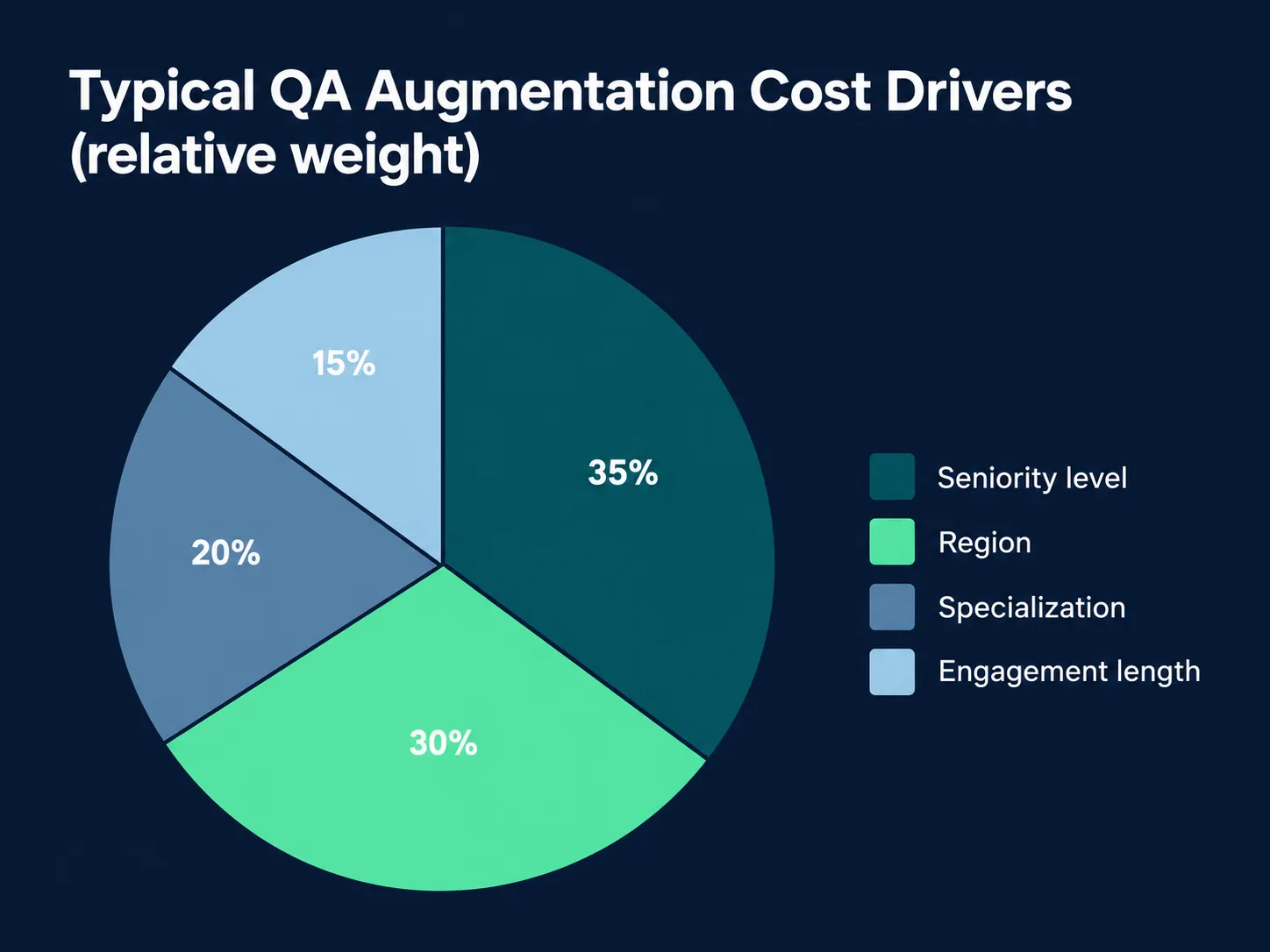
Pricing varies a lot by region, seniority, and whether the tester works onshore, nearshore, or offshore. Rather than quoting specific numbers here — which shift with currency, market demand, and location — it's worth understanding the variables that actually move the price:
- Seniority level (junior manual tester vs. senior automation/SDET)
- Region (rates in Eastern Europe, Latin America, and South Asia differ meaningfully from Western Europe or North America)
- Engagement length (short-term engagements often carry a premium over multi-month contracts)
- Specialization (performance, security, and accessibility testing typically command higher rates than functional/manual testing)
Check a prospective partner's current rate card directly, since published "guide" pricing on most vendor sites goes stale within a year.
Managing Augmented QA Testers Without Losing Sprint Rhythm
The teams that get this right treat augmented testers as full sprint participants from day one, not as a separate offshore appendage. A few practices come up again and again in engagements that work smoothly:
- Give augmented staff the same access to test management, bug tracking, and CI/CD tools as internal engineers — delayed access is the single most common early friction point.
- Assign a single internal point of contact for questions, rather than routing everything through a vendor account manager.
- Set explicit definitions of "done" and test coverage expectations before the first sprint, not after.
- Include augmented testers in retros. Their outside perspective on process gaps is often more useful than expected.
One risk worth flagging: knowledge concentration. If an augmented tester builds critical automation scripts alone with no internal engineer pairing on them, that knowledge walks out the door when the contract ends. Pair augmented specialists with at least one internal engineer on anything meant to outlast the engagement.
Signs a Vendor Is Worth Trusting
Not every staffing vendor that claims "QA expertise" actually has deep testing experience — plenty are generalist IT staffing shops that added "QA" to a services list. A few filters help separate the two:
- Can they show a portfolio of testers with relevant domain experience (fintech, healthcare, e-commerce, etc.) rather than generic resumes?
- Do they offer a trial period or replacement guarantee if a placed tester isn't a fit?
- Is there a technical screening process beyond a basic HR interview?
- Do they support both manual and automation testing, or just one?
Getting Started
QA team augmentation isn't a magic fix for a broken testing process, but it's a genuinely effective way to close a real capacity or skill gap without the multi-month grind of a full-time hiring cycle. The model works best paired with clear internal ownership, solid onboarding, and a deliberate plan for knowledge transfer.
Start small: bring in one augmented tester or a small pod for a defined sprint cycle, measure how the integration goes, and scale from there. Reach out to a vendor with a strong QA-specific track record, ask for a trial period, and get current, region-specific pricing directly rather than relying on generic published rates.
Frequently Asked Questions
Topics
QA Team Augmentation Guide: Scale Testing Without the Hiring Grind

Quick Summary: QA team augmentation means adding external QA engineers or test automation specialists directly into an existing engineering team, under its own processes and tools, to close skill or capacity gaps fast. It works best when a company already has a QA lead or engineering manager who can direct the augmented staff, and it typically costs less and moves faster than a full outsourced QA project or a new full-time hire. This guide walks through when it makes sense, how pricing and engagement models compare, and how to onboard augmented QA testers without breaking sprint rhythm.
Most engineering teams hit the same wall eventually: the backlog of untested features grows faster than the QA headcount. A big release is looming, automation coverage is thin, and the hiring pipeline for a senior QA engineer is going to take two or three months minimum. That gap is exactly where QA team augmentation earns its keep.
Unlike outsourcing an entire test cycle to a third-party agency, augmentation slots individual testers or small pods directly into an existing team. They join daily standups, use the same test management tools, and report to the same QA lead. The company keeps control of process and priorities; the augmentation partner supplies the people.
What QA Team Augmentation Actually Means
Staff augmentation, in general, is a hiring model where a company brings in external professionals to work as an extension of its internal team, rather than handing a project to a separate vendor. Applied to quality assurance specifically, it usually looks like one or more manual testers, automation engineers, or performance testers embedded inside a product squad for a fixed or rolling engagement.
The distinction matters because "QA outsourcing" and "QA staff augmentation" get used interchangeably online, but they're not the same thing. Outsourcing hands over ownership of a testing function or project. Augmentation keeps ownership in-house and simply adds hands and skills.
When QA Augmentation Makes Sense (and When It Doesn't)
It tends to work well in a handful of recurring scenarios: a release deadline that can't move, a sudden spike in regression testing after a major feature launch, a temporary need for a niche skill like performance or security testing, or a hiring freeze that still leaves quality goals in place.
It's a weaker fit when the real problem is process, not headcount. Adding three more manual testers to a team with no test strategy, no defined "done" criteria, and no automation framework just adds more people typing into the same broken system faster. Fix the process gaps first, or bring in augmented staff who can help fix them as part of the engagement.
QA Augmentation vs. Dedicated Teams vs. Full Outsourcing
These three models get confused constantly, and picking the wrong one is expensive. Here's the short version: augmentation adds people to an existing team; a dedicated team is a self-contained unit built for one client but managed with more vendor involvement; full outsourcing hands over an entire testing function, including strategy and reporting, to an external company.
Note there's no universally "best" option here. A startup with zero QA headcount might actually want a dedicated team over augmentation, since there's no internal lead to manage augmented staff. A mature engineering org with a strong QA manager but a temporary crunch is the classic augmentation candidate.
Expand QA Capacity with NeoWork
QA team augmentation helps companies add testing and quality support without expanding every role internally. NeoWork provides remote teammates who can support quality assurance, test execution, issue tracking, documentation, and related technical workflows. NeoWork handles recruitment, benefits, training, and ongoing engagement, while teammates integrate into the client’s systems, tools, and development processes. Its 91% annualized teammate retention rate and 3.2% candidate selectivity rate reflect a focus on selective hiring and longer-term team stability.
NeoWork's QA team augmentation model offers:
- QA and testing professionals
- integration with the client’s tools and processes
- recruitment and ongoing teammate support
Contact NeoWork to add QA capacity that fits your existing product and development workflows.
How the Engagement Actually Works
A typical QA augmentation engagement runs through a handful of predictable stages. Skipping steps here — especially the knowledge-transfer step — is the single biggest reason these engagements underperform.
- Scoping: defining the skill gap, expected duration, and whether manual, automation, or specialized testing (performance, security, accessibility) is needed.
- Sourcing and vetting: the augmentation partner proposes candidates, usually with a technical screen and a short interview with the hiring team.
- Onboarding: access provisioning, tool setup, and a knowledge-transfer session covering the product, test cases, and existing automation suite.
- Integration: augmented testers join standups, sprint planning, and retros just like internal staff.
- Review and scaling: after 2-4 weeks, most teams reassess whether to extend, scale up, or wind down the engagement.
Cost Considerations
Pricing varies a lot by region, seniority, and whether the tester works onshore, nearshore, or offshore. Rather than quoting specific numbers here — which shift with currency, market demand, and location — it's worth understanding the variables that actually move the price:
- Seniority level (junior manual tester vs. senior automation/SDET)
- Region (rates in Eastern Europe, Latin America, and South Asia differ meaningfully from Western Europe or North America)
- Engagement length (short-term engagements often carry a premium over multi-month contracts)
- Specialization (performance, security, and accessibility testing typically command higher rates than functional/manual testing)
Check a prospective partner's current rate card directly, since published "guide" pricing on most vendor sites goes stale within a year.
Managing Augmented QA Testers Without Losing Sprint Rhythm
The teams that get this right treat augmented testers as full sprint participants from day one, not as a separate offshore appendage. A few practices come up again and again in engagements that work smoothly:
- Give augmented staff the same access to test management, bug tracking, and CI/CD tools as internal engineers — delayed access is the single most common early friction point.
- Assign a single internal point of contact for questions, rather than routing everything through a vendor account manager.
- Set explicit definitions of "done" and test coverage expectations before the first sprint, not after.
- Include augmented testers in retros. Their outside perspective on process gaps is often more useful than expected.
One risk worth flagging: knowledge concentration. If an augmented tester builds critical automation scripts alone with no internal engineer pairing on them, that knowledge walks out the door when the contract ends. Pair augmented specialists with at least one internal engineer on anything meant to outlast the engagement.
Signs a Vendor Is Worth Trusting
Not every staffing vendor that claims "QA expertise" actually has deep testing experience — plenty are generalist IT staffing shops that added "QA" to a services list. A few filters help separate the two:
- Can they show a portfolio of testers with relevant domain experience (fintech, healthcare, e-commerce, etc.) rather than generic resumes?
- Do they offer a trial period or replacement guarantee if a placed tester isn't a fit?
- Is there a technical screening process beyond a basic HR interview?
- Do they support both manual and automation testing, or just one?
Getting Started
QA team augmentation isn't a magic fix for a broken testing process, but it's a genuinely effective way to close a real capacity or skill gap without the multi-month grind of a full-time hiring cycle. The model works best paired with clear internal ownership, solid onboarding, and a deliberate plan for knowledge transfer.
Start small: bring in one augmented tester or a small pod for a defined sprint cycle, measure how the integration goes, and scale from there. Reach out to a vendor with a strong QA-specific track record, ask for a trial period, and get current, region-specific pricing directly rather than relying on generic published rates.
Frequently Asked Questions
Topics
Related Blogs
Related Podcasts


.webp)

.webp)
.webp)



