
.avif)
.avif)

Recruitment Process Outsourcing Guide: How RPO Works in 2026


.svg)

Quick Summary: Recruitment process outsourcing (RPO) is when a company hands over all or part of its hiring function to an outside provider that supplies recruiters, technology, and process expertise. The global RPO market is valued at roughly $9.5 billion in 2026 and growing at a double-digit rate, according to The Business Research Company, as more organizations look to cut cost-per-hire and fix inconsistent hiring results. This guide breaks down how RPO works, what it costs, the main engagement models, and how to pick a provider that actually fits your hiring volume and goals.
Hiring has gotten messier. Talent shortages in some markets, hiring freezes followed by sudden hiring sprees in others, and recruiters stretched across too many open roles — it's a lot. That's the backdrop driving more companies toward recruitment process outsourcing instead of building out bigger internal talent acquisition teams.
But RPO isn't one thing. It can mean a single recruiter embedded with HR for three months, or a provider running the entire hiring function for a 10,000-person company across six countries. This guide walks through what RPO actually is, how the process works day to day, what it costs, and how to tell if it's the right move before signing a contract.
What Is Recruitment Process Outsourcing (RPO)?
Recruitment process outsourcing is a form of business process outsourcing where an employer transfers some or all of its recruiting function to a third-party provider. The RPO provider typically supplies recruiters, sourcing technology, employer branding support, and a defined process — acting as an extension of the internal HR or talent acquisition team rather than a transactional staffing agency.
The key distinction from a staffing agency: RPO providers usually own an entire process or significant chunk of it (sourcing, screening, interview coordination, offer management) rather than just submitting candidate resumes for a fee. They're measured on outcomes like time-to-fill, quality of hire, and cost-per-hire, not just placements.
How Does the RPO Process Work?
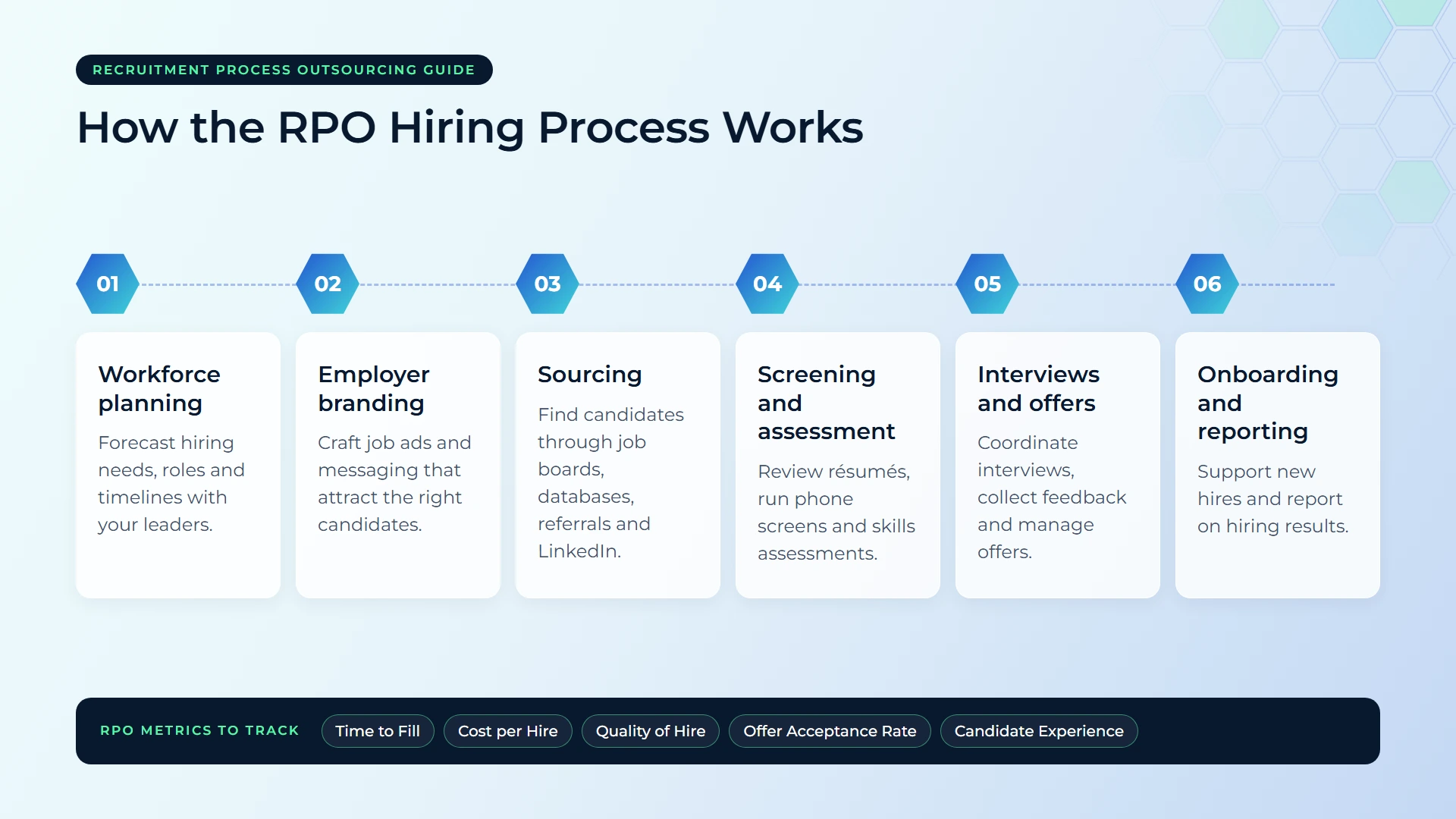
Most RPO engagements follow a similar sequence, even when the scope differs. It starts with understanding what "good" looks like for the client, then builds a repeatable hiring machine around that definition.
Needs assessment covers volume, role types, locations, and compliance requirements. Solution design turns that into a staffing plan, technology stack, and SLAs. From there, the provider's recruiters take over sourcing and screening, loop in hiring managers for interviews, manage offers and negotiations, and often stay involved through the first weeks of onboarding. Reporting closes the loop — dashboards tracking time-to-fill, cost-per-hire, and pipeline health feed back into the next hiring cycle.

Build Your Team Without Running the Hiring Process
At NeoWork, we help companies recruit individual specialists and dedicated teams while handling the employment support that comes with hiring. We take care of recruitment, onboarding, benefits, and ongoing teammate support, so your team can stay focused on day-to-day operations.
Our model includes:
- Recruitment for individual roles and dedicated teams
- A selective hiring process with a 3.2% candidate selectivity rate
- Onboarding, benefits, and ongoing teammate support
- 91% annualized teammate retention
Contact us to discuss the roles you need to fill and the type of team you want to build.
Types of RPO Engagements
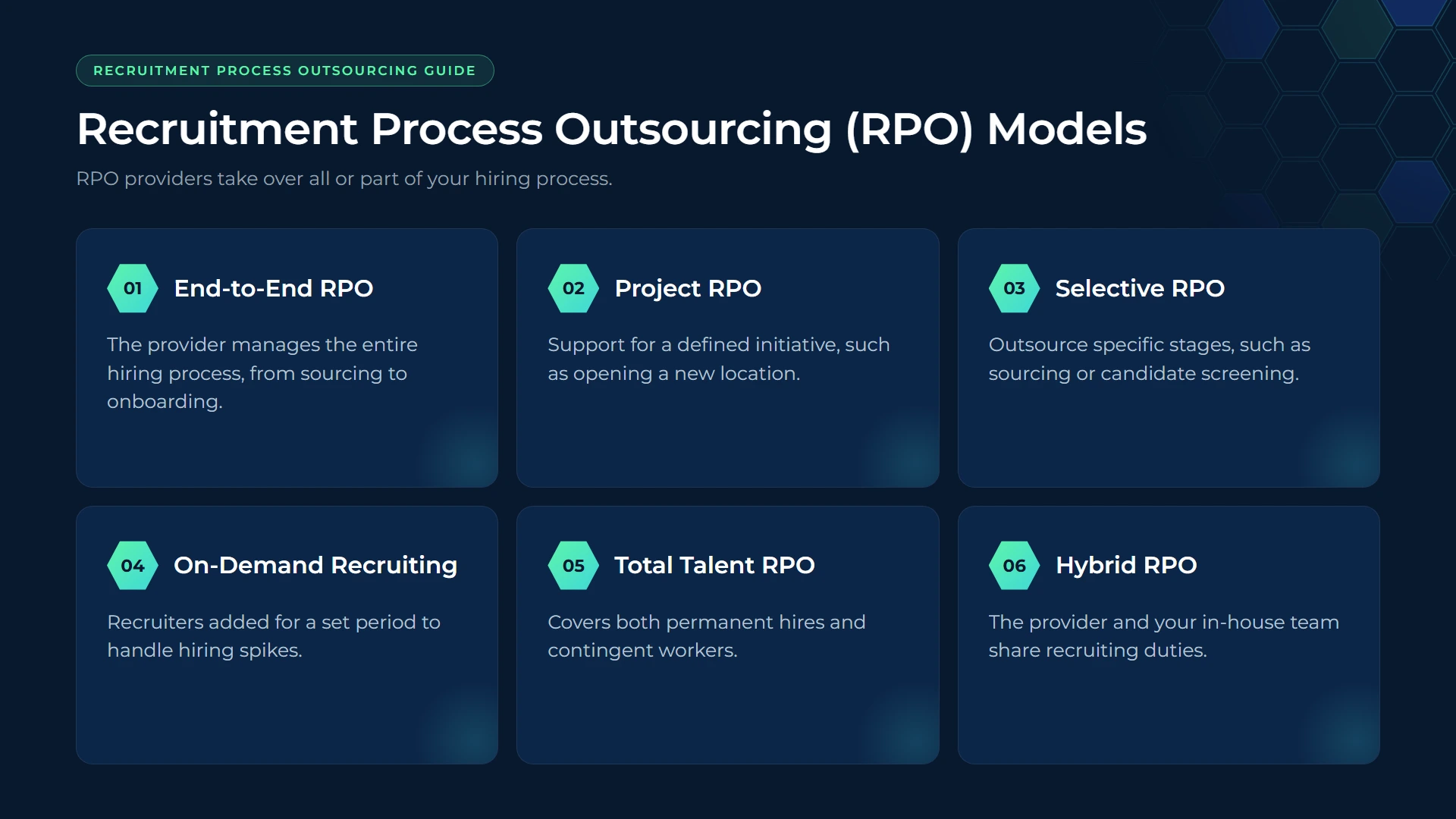
Not every company needs the same depth of outsourcing. Providers generally offer a few standard models, and picking the wrong one is one of the more common reasons RPO relationships underdeliver.
On-demand RPO has become one of the fastest-growing segments as companies try to avoid the cost of maintaining a large internal recruiting bench year-round, scaling capacity up only when hiring actually spikes.
RPO Market Size and Growth in 2026
Market sizing for RPO varies quite a bit depending on how analysts define its scope — some bundle in managed service provider (MSP) and workforce solutions, others don't. The Business Research Company puts the global RPO market at roughly $9.53 billion in 2026, up from $8.18 billion in 2025, growing at a 16.5% compound annual growth rate. Other analysts place the figure higher when adjacent services are included, with some projections showing the broader market exceeding $18 billion this year.
Regional distribution tends to skew heavily toward mature outsourcing markets. According to Global Growth Insights, North America holds around 38% of global RPO market share, with Europe, Asia-Pacific, and the Middle East/Africa splitting the remainder.
Whatever the exact dollar figure, the direction is consistent across sources: double-digit growth, driven largely by persistent talent shortages, rising hiring complexity, and employers wanting measurable, scalable hiring infrastructure without the fixed cost of a huge internal team.
Benefits of Recruitment Process Outsourcing
The appeal of RPO usually comes down to three things: cost, speed, and consistency. Organizations struggling with any of those tend to see the biggest gains from outsourcing part of their hiring function:
- Lower cost-per-hire: Industry estimates suggest RPO clients can see cost-per-hire reductions in the range of 50-75% compared to relying heavily on staffing agencies, largely because RPO avoids per-placement agency fees at scale.
- Faster time-to-fill: Dedicated recruiters working a defined process tend to close roles faster — estimates put the reduction in time-to-fill at roughly 20-50% versus unmanaged internal hiring.
- Scalability: Recruiting capacity flexes with hiring demand instead of staying fixed, which matters a lot for companies with seasonal or project-based hiring spikes.
- Access to technology and data: Most providers bring their own applicant tracking integrations, sourcing tools, and reporting dashboards — things smaller internal teams rarely build on their own.
- Compliance support: For multi-country hiring, an established RPO partner typically has existing knowledge of local labor law and documentation requirements.
RPO Pricing Models: What It Actually Costs
Pricing structures vary by provider and by how much of the process is being handed over, but a few common models show up across the industry:
- Cost-per-hire: A flat or tiered fee charged for each successful hire, often used for project-based or on-demand engagements.
- Management fee + cost-per-hire hybrid: A base retainer covering dedicated recruiter time plus a smaller per-hire fee, common in enterprise engagements.
- Full-time equivalent (FTE) pricing: A flat monthly or annual fee per dedicated recruiter, regardless of how many hires they make in a given period.
- Blended/performance-based: A base fee tied to SLA performance metrics like time-to-fill or candidate satisfaction scores.
There's no universal number to quote here — actual pricing depends on hiring volume, role seniority, geography, and the provider's overhead. It's worth asking any shortlisted provider for a breakdown by model rather than a single bundled rate, so the real cost drivers are visible before signing.
RPO vs. Staffing Agencies vs. In-House Recruiting
These three options get confused often, but they solve different problems.
How to Choose the Right RPO Provider
Picking a provider shouldn't start with a pricing conversation. It should start with a clear picture of what's actually broken in the current hiring process — too slow, too expensive, inconsistent quality, or simply not enough recruiter bandwidth.
Once the scope is clear, a few things are worth checking before signing anything: industry experience with similar roles, technology compatibility with the existing ATS, references from current clients of comparable size, and clearly defined SLAs around time-to-fill and quality of hire. Vague promises of "white-glove service" without measurable commitments are a red flag.
Questions Worth Asking Any Provider
- What's the average time-to-fill for roles similar to ours?
- How is quality of hire measured and reported?
- What happens if hiring volume drops mid-contract?
- Which parts of the process stay with our internal team?
- What's the exit process if the engagement doesn't work out?
Common RPO Challenges and How to Avoid Them
RPO isn't a guaranteed fix. It works brilliantly for the right volume and scope, and it can be a costly mistake when mismatched to the actual problem. A few recurring pitfalls:
- Mismatched scope: Hiring a full life-cycle provider for sporadic, low-volume hiring often costs more than it saves.
- Weak internal alignment: If hiring managers aren't looped into the process design, the provider ends up guessing at requirements.
- Underdefined SLAs: Without clear metrics upfront, it's hard to tell whether the engagement is actually working after six months.
- Culture mismatch: An RPO team unfamiliar with the company's employer brand can send mixed signals to candidates during interviews.
Final Thoughts
Recruitment process outsourcing isn't a single product — it's a spectrum of engagement models that can flex from a single embedded recruiter to a full hiring department run by someone else. The companies that get the most out of it are the ones that start with a clear diagnosis of what's actually broken in their hiring, match that to the right RPO model, and hold providers to measurable SLAs rather than vague promises.
Before signing with any provider, get specific: ask for current client references, request a pricing breakdown by model, and define what success looks like at the 90-day, 6-month, and 1-year marks. That clarity upfront is what separates RPO partnerships that actually move the needle from ones that just shuffle the same hiring problems to a different team.
Topics
Recruitment Process Outsourcing Guide: How RPO Works in 2026

Quick Summary: Recruitment process outsourcing (RPO) is when a company hands over all or part of its hiring function to an outside provider that supplies recruiters, technology, and process expertise. The global RPO market is valued at roughly $9.5 billion in 2026 and growing at a double-digit rate, according to The Business Research Company, as more organizations look to cut cost-per-hire and fix inconsistent hiring results. This guide breaks down how RPO works, what it costs, the main engagement models, and how to pick a provider that actually fits your hiring volume and goals.
Hiring has gotten messier. Talent shortages in some markets, hiring freezes followed by sudden hiring sprees in others, and recruiters stretched across too many open roles — it's a lot. That's the backdrop driving more companies toward recruitment process outsourcing instead of building out bigger internal talent acquisition teams.
But RPO isn't one thing. It can mean a single recruiter embedded with HR for three months, or a provider running the entire hiring function for a 10,000-person company across six countries. This guide walks through what RPO actually is, how the process works day to day, what it costs, and how to tell if it's the right move before signing a contract.
What Is Recruitment Process Outsourcing (RPO)?
Recruitment process outsourcing is a form of business process outsourcing where an employer transfers some or all of its recruiting function to a third-party provider. The RPO provider typically supplies recruiters, sourcing technology, employer branding support, and a defined process — acting as an extension of the internal HR or talent acquisition team rather than a transactional staffing agency.
The key distinction from a staffing agency: RPO providers usually own an entire process or significant chunk of it (sourcing, screening, interview coordination, offer management) rather than just submitting candidate resumes for a fee. They're measured on outcomes like time-to-fill, quality of hire, and cost-per-hire, not just placements.
How Does the RPO Process Work?
Most RPO engagements follow a similar sequence, even when the scope differs. It starts with understanding what "good" looks like for the client, then builds a repeatable hiring machine around that definition.
Needs assessment covers volume, role types, locations, and compliance requirements. Solution design turns that into a staffing plan, technology stack, and SLAs. From there, the provider's recruiters take over sourcing and screening, loop in hiring managers for interviews, manage offers and negotiations, and often stay involved through the first weeks of onboarding. Reporting closes the loop — dashboards tracking time-to-fill, cost-per-hire, and pipeline health feed back into the next hiring cycle.
Build Your Team Without Running the Hiring Process
At NeoWork, we help companies recruit individual specialists and dedicated teams while handling the employment support that comes with hiring. We take care of recruitment, onboarding, benefits, and ongoing teammate support, so your team can stay focused on day-to-day operations.
Our model includes:
- Recruitment for individual roles and dedicated teams
- A selective hiring process with a 3.2% candidate selectivity rate
- Onboarding, benefits, and ongoing teammate support
- 91% annualized teammate retention
Contact us to discuss the roles you need to fill and the type of team you want to build.
Types of RPO Engagements
Not every company needs the same depth of outsourcing. Providers generally offer a few standard models, and picking the wrong one is one of the more common reasons RPO relationships underdeliver.
On-demand RPO has become one of the fastest-growing segments as companies try to avoid the cost of maintaining a large internal recruiting bench year-round, scaling capacity up only when hiring actually spikes.
RPO Market Size and Growth in 2026
Market sizing for RPO varies quite a bit depending on how analysts define its scope — some bundle in managed service provider (MSP) and workforce solutions, others don't. The Business Research Company puts the global RPO market at roughly $9.53 billion in 2026, up from $8.18 billion in 2025, growing at a 16.5% compound annual growth rate. Other analysts place the figure higher when adjacent services are included, with some projections showing the broader market exceeding $18 billion this year.
Regional distribution tends to skew heavily toward mature outsourcing markets. According to Global Growth Insights, North America holds around 38% of global RPO market share, with Europe, Asia-Pacific, and the Middle East/Africa splitting the remainder.
Whatever the exact dollar figure, the direction is consistent across sources: double-digit growth, driven largely by persistent talent shortages, rising hiring complexity, and employers wanting measurable, scalable hiring infrastructure without the fixed cost of a huge internal team.
Benefits of Recruitment Process Outsourcing
The appeal of RPO usually comes down to three things: cost, speed, and consistency. Organizations struggling with any of those tend to see the biggest gains from outsourcing part of their hiring function:
- Lower cost-per-hire: Industry estimates suggest RPO clients can see cost-per-hire reductions in the range of 50-75% compared to relying heavily on staffing agencies, largely because RPO avoids per-placement agency fees at scale.
- Faster time-to-fill: Dedicated recruiters working a defined process tend to close roles faster — estimates put the reduction in time-to-fill at roughly 20-50% versus unmanaged internal hiring.
- Scalability: Recruiting capacity flexes with hiring demand instead of staying fixed, which matters a lot for companies with seasonal or project-based hiring spikes.
- Access to technology and data: Most providers bring their own applicant tracking integrations, sourcing tools, and reporting dashboards — things smaller internal teams rarely build on their own.
- Compliance support: For multi-country hiring, an established RPO partner typically has existing knowledge of local labor law and documentation requirements.
RPO Pricing Models: What It Actually Costs
Pricing structures vary by provider and by how much of the process is being handed over, but a few common models show up across the industry:
- Cost-per-hire: A flat or tiered fee charged for each successful hire, often used for project-based or on-demand engagements.
- Management fee + cost-per-hire hybrid: A base retainer covering dedicated recruiter time plus a smaller per-hire fee, common in enterprise engagements.
- Full-time equivalent (FTE) pricing: A flat monthly or annual fee per dedicated recruiter, regardless of how many hires they make in a given period.
- Blended/performance-based: A base fee tied to SLA performance metrics like time-to-fill or candidate satisfaction scores.
There's no universal number to quote here — actual pricing depends on hiring volume, role seniority, geography, and the provider's overhead. It's worth asking any shortlisted provider for a breakdown by model rather than a single bundled rate, so the real cost drivers are visible before signing.
RPO vs. Staffing Agencies vs. In-House Recruiting
These three options get confused often, but they solve different problems.
How to Choose the Right RPO Provider
Picking a provider shouldn't start with a pricing conversation. It should start with a clear picture of what's actually broken in the current hiring process — too slow, too expensive, inconsistent quality, or simply not enough recruiter bandwidth.
Once the scope is clear, a few things are worth checking before signing anything: industry experience with similar roles, technology compatibility with the existing ATS, references from current clients of comparable size, and clearly defined SLAs around time-to-fill and quality of hire. Vague promises of "white-glove service" without measurable commitments are a red flag.
Questions Worth Asking Any Provider
- What's the average time-to-fill for roles similar to ours?
- How is quality of hire measured and reported?
- What happens if hiring volume drops mid-contract?
- Which parts of the process stay with our internal team?
- What's the exit process if the engagement doesn't work out?
Common RPO Challenges and How to Avoid Them
RPO isn't a guaranteed fix. It works brilliantly for the right volume and scope, and it can be a costly mistake when mismatched to the actual problem. A few recurring pitfalls:
- Mismatched scope: Hiring a full life-cycle provider for sporadic, low-volume hiring often costs more than it saves.
- Weak internal alignment: If hiring managers aren't looped into the process design, the provider ends up guessing at requirements.
- Underdefined SLAs: Without clear metrics upfront, it's hard to tell whether the engagement is actually working after six months.
- Culture mismatch: An RPO team unfamiliar with the company's employer brand can send mixed signals to candidates during interviews.
Final Thoughts
Recruitment process outsourcing isn't a single product — it's a spectrum of engagement models that can flex from a single embedded recruiter to a full hiring department run by someone else. The companies that get the most out of it are the ones that start with a clear diagnosis of what's actually broken in their hiring, match that to the right RPO model, and hold providers to measurable SLAs rather than vague promises.
Before signing with any provider, get specific: ask for current client references, request a pricing breakdown by model, and define what success looks like at the 90-day, 6-month, and 1-year marks. That clarity upfront is what separates RPO partnerships that actually move the needle from ones that just shuffle the same hiring problems to a different team.
Topics
Related Blogs
Related Podcasts