
Green glowing circular pattern with concentric rings and faint hexagonal grid on the left side.
Blue abstract hexagonal pattern with glowing circular gradient edges on a black background.Glowing greenish-blue hexagonal pattern with concentric circular gradients on a black background.

Ruby on Rails Team Augmentation Guide: How It Works in 2026

Calendar Icon
Published:
Oct 29
2026
,
Updated:
Oct 30
2026
Ann
Facebook IconInstagram Icon

Build your team with NeoWork

Talk to us about how we staff and manage high-performing remote teams for companies like yours.

Get a Ruby on Rails Team Augmentation Quote

Quick Summary: Ruby on Rails team augmentation is when a company adds external Rails developers, or a full Rails pod, to its existing engineering team to ship features faster, upgrade legacy applications, or reduce a growing backlog. The augmented developers work in your codebase, follow your workflows, and report to your engineering leads. Rails continues to power major products such as Shopify, GitHub, and Basecamp, and Rails 8 added built-in tools like Solid Queue, Solid Cache, Kamal 2 deployments, and an authentication generator that make lean teams even more productive. The challenge is finding experienced Rails developers. This guide covers the roles you can add, when augmentation makes sense, how to vet Rails talent, what it costs, and how to onboard an augmented team into a Rails codebase.

Many companies built their product on Rails years ago because it let a small team move fast. Today, those same companies often face a different problem: a large, mature monolith, an aging Ruby or Rails version, test suites that take too long, and a roadmap that keeps growing. At the same time, the pool of senior Rails developers is smaller than for some newer stacks, which makes hiring slow.

Team augmentation helps you add proven Rails experience quickly, without restructuring your engineering organization. This guide explains how to make it work.

What Is Ruby on Rails Team Augmentation?

Ruby on Rails team augmentation is an engagement model in which a provider supplies dedicated Rails engineers who join your team for a defined period or on an ongoing basis. They work in your repositories, take tickets from your backlog, join your code reviews and standups, and follow your engineering standards. The provider handles recruiting, employment, and continuity.

You can augment with individual developers to fill specific gaps, or with a small pod (for example, a senior Rails engineer, two developers, and QA) that takes ownership of a workstream such as an upgrade or a new product area.
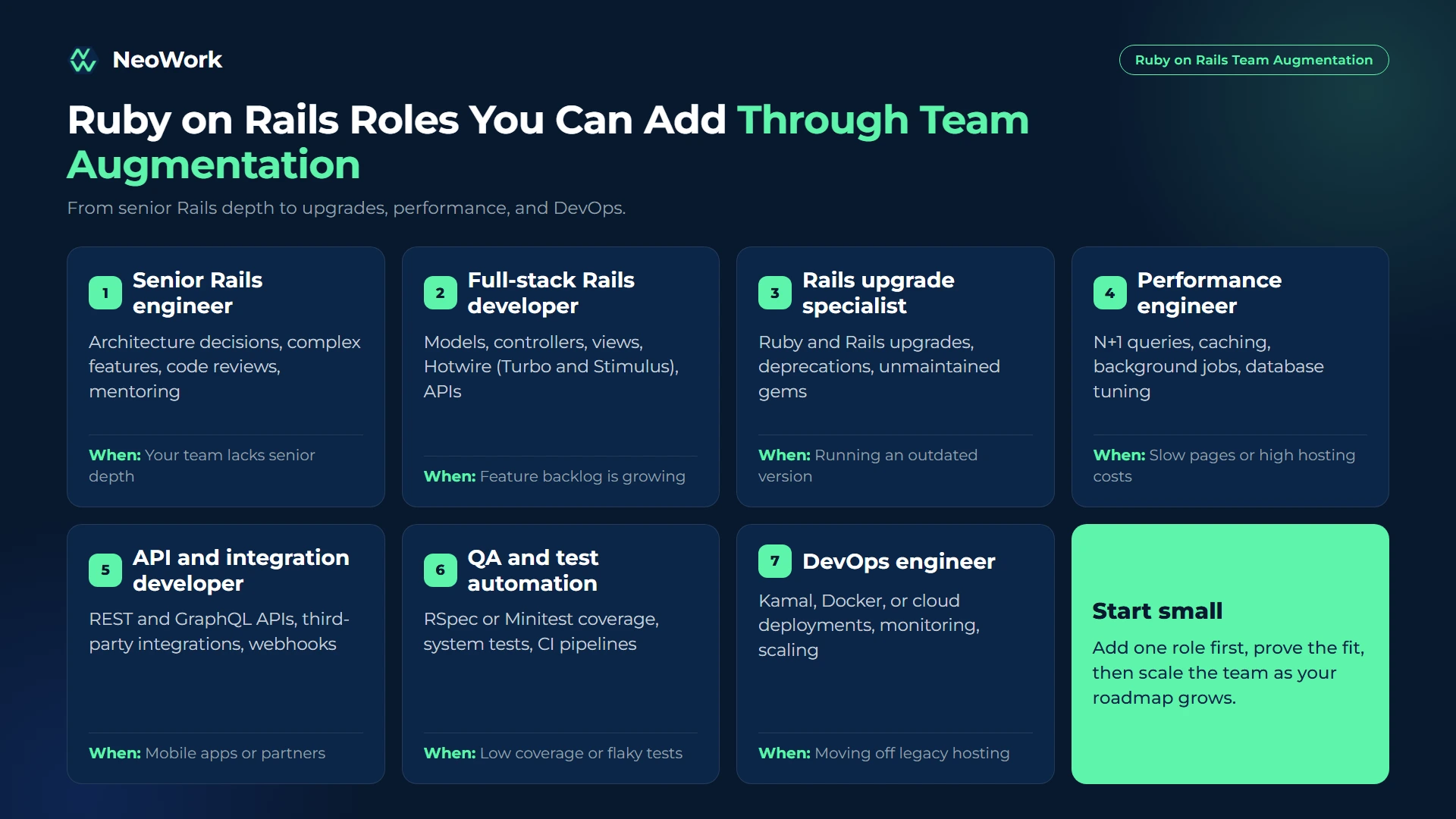
Rails Roles You Can Add

Role What They Do When You Need One
Senior Rails engineer Architecture decisions, complex features, code reviews, mentoring Your team lacks senior Rails depth
Full-stack Rails developer Features across models, controllers, views, Hotwire (Turbo and Stimulus), and APIs Backlog of product features
Rails upgrade specialist Upgrading Ruby and Rails versions, removing deprecations, replacing unmaintained gems Running an outdated or unsupported version
Performance engineer Fixing N+1 queries, caching, background job tuning, database optimization Slow pages, timeouts, high hosting costs
API and integration developer REST and GraphQL APIs, third-party integrations, webhooks Mobile apps, partners, or new integrations
QA and test automation engineer RSpec or Minitest coverage, system tests, CI pipeline improvements Low test coverage or flaky test suites
DevOps engineer Deployments with Kamal, Docker, or cloud platforms, monitoring, scaling Moving off a legacy hosting setup
Ruby on Rails team augmentation roles including senior Rails engineer, full-stack Rails developer, upgrade specialist, performance engineer, API developer, QA engineer, and DevOps engineer

Add Experienced Rails Developers to Your Team

At NeoWork, we help companies add dedicated Ruby on Rails developers and full Rails teams that work inside their codebase and engineering process. We recruit for the Rails experience you need, onboard developers into your workflows, and handle employment, benefits, and ongoing teammate support.

Our model includes:

  • Dedicated Rails engineers or pods that join your standups, code reviews, and sprints
  • A 3.2% candidate selectivity rate, with hands-on Rails technical screening
  • Industry-leading 91% annualized teammate retention rate, so knowledge of your codebase stays on the team
  • Flexible team size that follows your roadmap

Contact us to tell us about your Rails application and goals. We will propose the right developer profiles and team setup.

When Rails Team Augmentation Makes Sense

The most common trigger is an application that has fallen behind on versions. Old Ruby and Rails releases stop receiving security patches, block gem updates, and make every new feature a little harder to build. Upgrading is rarely glamorous work, and internal teams busy with the roadmap tend to postpone it year after year. Bringing in developers who have done several major upgrades before, and who can focus on it without being pulled into feature work, is often the only way it actually gets done.

The second trigger is a backlog that grows faster than the team can ship. This is especially common in companies whose Rails application has become the core of the business: product, sales, and operations all want changes, and the engineering team becomes a bottleneck. Augmented developers add capacity without the months of recruiting that senior Rails hires usually require.

Augmentation also makes sense when you need senior judgment rather than more hands. Teams made up mostly of junior or mid-level developers benefit enormously from one or two experienced engineers who can set patterns, review code, and steer the architecture. And when performance problems start costing money in hosting bills or lost conversions, a specialist who knows Active Record, caching, and background jobs deeply can often deliver results in weeks.

Rails Team Augmentation vs. Other Models

Model Who Manages Delivery Best For Trade-Offs
Team augmentation Your engineering leads Ongoing development, upgrades, scaling capacity Needs internal technical leadership
Project outsourcing The vendor Fixed-scope builds with clear requirements Less control, knowledge leaves after delivery
Freelancers Your team Small, isolated tasks Availability, continuity, and security risks
In-house hiring Your team Long-term core roles Slow and expensive recruiting

If you are comparing providers, our overview of Ruby on Rails team augmentation companies lists options and what to look for.

How to Vet Ruby on Rails Developers

  • Rails conventions: Strong candidates follow Rails conventions and explain when to break them.
  • Active Record depth: Ask about N+1 queries, eager loading, indexes, transactions, and migrations on large tables.
  • Testing culture: Look for real experience with RSpec or Minitest, factories, system tests, and keeping test suites fast.
  • Background jobs: Experience with Sidekiq, Solid Queue, or similar tools, including idempotency and retries.
  • Modern Rails: Familiarity with Hotwire, Turbo, Stimulus, and Rails 8 features such as Solid Cache and Kamal.
  • Upgrade experience: Ask for examples of major version upgrades and how they handled deprecated gems.
  • Code review exercise: Have candidates review a pull request from a realistic Rails codebase. It shows judgment better than a coding puzzle.

How Much Does Rails Team Augmentation Cost?

Rails developer rates depend on seniority, location, and specialization. Industry rate guides commonly put senior developers in the US and Western Europe at the top of the market, with Latin America and Eastern Europe in the middle and parts of Asia at the lower end. Common pricing models:

  • Monthly rate per developer: A fixed monthly fee for each full-time dedicated engineer. Predictable and the most common model.
  • Monthly team rate: A single price for a full pod.
  • Hourly rate: For part-time or short-term work.

Because senior Rails talent is scarce, the best value often comes from experienced developers in nearshore or offshore markets who have worked on production Rails applications. See how we structure dedicated teams on our pricing page.
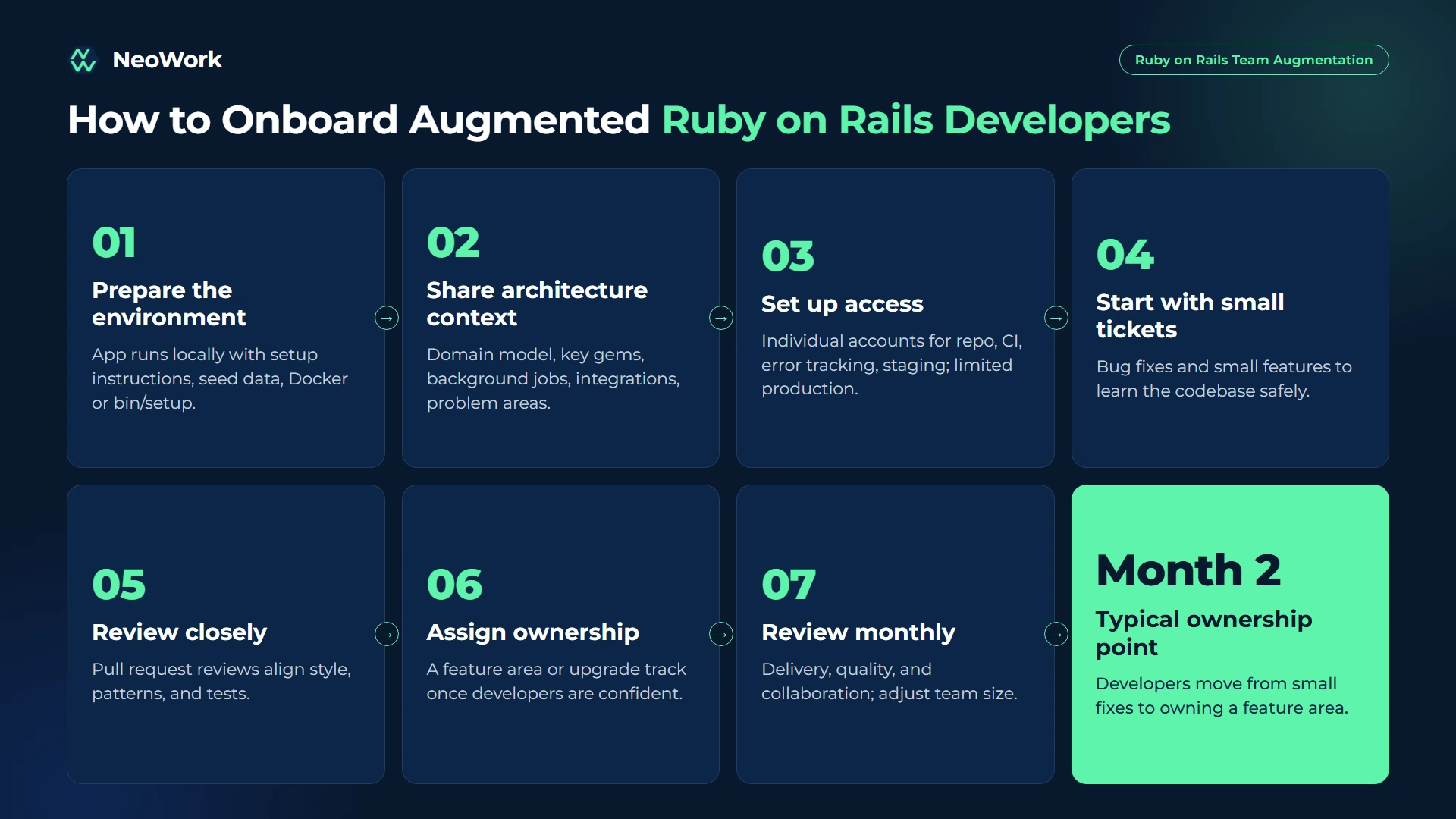
How to Onboard Augmented Rails Developers

Ruby on Rails team augmentation onboarding steps from local environment setup and codebase walkthrough to first pull request, code review, and full sprint ownership
  1. Prepare the environment. Make sure the app runs locally with clear setup instructions, seed data, and Docker or bin/setup scripts.
  2. Share architecture context. Walk through the domain model, key gems, background jobs, integrations, and known problem areas.
  3. Set up access. Grant repository, CI, error tracking, and staging access with individual accounts. Limit production access until needed.
  4. Start with small tickets. Bug fixes and small features help new developers learn the codebase safely.
  5. Review closely. Use pull request reviews to align on style, patterns, and test expectations.
  6. Assign ownership. Once confident, give the augmented developers or pod ownership of a feature area or upgrade track.
  7. Review monthly. Track delivery, quality, and collaboration, and adjust team size if needed.

Questions Worth Asking Any Provider

  • How do you test Rails skills during hiring?
  • Have your developers done major Rails upgrades on production apps?
  • Can we interview and approve developers before they start?
  • How much working-hour overlap will we have?
  • What happens if a developer leaves the project?
  • Who owns the code and intellectual property?

Common Rails Team Augmentation Mistakes

The simplest mistake to avoid is starting without local setup documentation. It seems minor, but it wastes days of expensive developer time and signals disorganization from the start. Fixing setup scripts before augmented developers arrive is one of the highest-return tasks an engineering lead can do.

A more costly mistake is postponing upgrades indefinitely while adding developers. Every new feature built on an outdated Rails version increases the cost of upgrading later, so growing the team without an upgrade plan compounds the problem. Skipping code review has a similar compounding effect: inconsistent patterns spread quickly through a Rails monolith, and cleaning them up later is much harder than preventing them.

Finally, treating augmented developers as ticket takers wastes much of their value. Developers who understand the business make better design decisions, catch requirement gaps, and suggest simpler solutions. Choosing on rate alone works against this too, because inexperienced Rails developers can create technical debt that costs more than they save.

Final Thoughts

Ruby on Rails team augmentation is a practical way to add senior Rails experience, ship features faster, and finally tackle upgrades and performance work. It works best with good onboarding, clear ownership, strong code review, and developers vetted on real Rails experience rather than general web skills.

If your Rails roadmap is bigger than your team, explore our software development teams at NeoWork.

FAQ

What is Ruby on Rails team augmentation?

It is a model where an external provider supplies dedicated Rails developers who join your engineering team, work in your codebase, and follow your processes, while the provider handles hiring and employment.

Is Ruby on Rails still relevant in 2026?

Yes. Rails powers major products such as Shopify, GitHub, and Basecamp, and Rails 8 added built-in tools for background jobs, caching, deployment, and authentication that make small teams highly productive.

Can augmented developers upgrade our Rails application?

Yes. Upgrades are one of the most common reasons to augment. Experienced developers can plan the upgrade path, fix deprecations, replace unmaintained gems, and improve test coverage along the way.

How do I vet Rails developers?

Focus on Active Record knowledge, testing practices, background jobs, modern Rails features, and upgrade experience. A code review exercise on a realistic codebase works better than abstract coding puzzles.

How much does Rails team augmentation cost?

Most providers charge a monthly rate per developer or a monthly team rate. Cost depends on seniority, location, and specialization.

How quickly can augmented Rails developers start?

Candidates can often be presented within days to a couple of weeks, and developers typically start contributing within their first sprint if onboarding is well prepared.

Should I augment individuals or a full team?

Add individuals to fill specific gaps in an existing team. Add a pod when you want a group to own a workstream, such as an upgrade or a new product area.

Topics
No items found.

Ruby on Rails Team Augmentation Guide: How It Works in 2026

Paper
Calendar Icon
Oct 29, 2026
Ann

Quick Summary: Ruby on Rails team augmentation is when a company adds external Rails developers, or a full Rails pod, to its existing engineering team to ship features faster, upgrade legacy applications, or reduce a growing backlog. The augmented developers work in your codebase, follow your workflows, and report to your engineering leads. Rails continues to power major products such as Shopify, GitHub, and Basecamp, and Rails 8 added built-in tools like Solid Queue, Solid Cache, Kamal 2 deployments, and an authentication generator that make lean teams even more productive. The challenge is finding experienced Rails developers. This guide covers the roles you can add, when augmentation makes sense, how to vet Rails talent, what it costs, and how to onboard an augmented team into a Rails codebase.

Many companies built their product on Rails years ago because it let a small team move fast. Today, those same companies often face a different problem: a large, mature monolith, an aging Ruby or Rails version, test suites that take too long, and a roadmap that keeps growing. At the same time, the pool of senior Rails developers is smaller than for some newer stacks, which makes hiring slow.

Team augmentation helps you add proven Rails experience quickly, without restructuring your engineering organization. This guide explains how to make it work.

What Is Ruby on Rails Team Augmentation?

Ruby on Rails team augmentation is an engagement model in which a provider supplies dedicated Rails engineers who join your team for a defined period or on an ongoing basis. They work in your repositories, take tickets from your backlog, join your code reviews and standups, and follow your engineering standards. The provider handles recruiting, employment, and continuity.

You can augment with individual developers to fill specific gaps, or with a small pod (for example, a senior Rails engineer, two developers, and QA) that takes ownership of a workstream such as an upgrade or a new product area.

Rails Roles You Can Add

Role What They Do When You Need One
Senior Rails engineer Architecture decisions, complex features, code reviews, mentoring Your team lacks senior Rails depth
Full-stack Rails developer Features across models, controllers, views, Hotwire (Turbo and Stimulus), and APIs Backlog of product features
Rails upgrade specialist Upgrading Ruby and Rails versions, removing deprecations, replacing unmaintained gems Running an outdated or unsupported version
Performance engineer Fixing N+1 queries, caching, background job tuning, database optimization Slow pages, timeouts, high hosting costs
API and integration developer REST and GraphQL APIs, third-party integrations, webhooks Mobile apps, partners, or new integrations
QA and test automation engineer RSpec or Minitest coverage, system tests, CI pipeline improvements Low test coverage or flaky test suites
DevOps engineer Deployments with Kamal, Docker, or cloud platforms, monitoring, scaling Moving off a legacy hosting setup
Ruby on Rails team augmentation roles including senior Rails engineer, full-stack Rails developer, upgrade specialist, performance engineer, API developer, QA engineer, and DevOps engineer

Add Experienced Rails Developers to Your Team

At NeoWork, we help companies add dedicated Ruby on Rails developers and full Rails teams that work inside their codebase and engineering process. We recruit for the Rails experience you need, onboard developers into your workflows, and handle employment, benefits, and ongoing teammate support.

Our model includes:

  • Dedicated Rails engineers or pods that join your standups, code reviews, and sprints
  • A 3.2% candidate selectivity rate, with hands-on Rails technical screening
  • Industry-leading 91% annualized teammate retention rate, so knowledge of your codebase stays on the team
  • Flexible team size that follows your roadmap

Contact us to tell us about your Rails application and goals. We will propose the right developer profiles and team setup.

When Rails Team Augmentation Makes Sense

The most common trigger is an application that has fallen behind on versions. Old Ruby and Rails releases stop receiving security patches, block gem updates, and make every new feature a little harder to build. Upgrading is rarely glamorous work, and internal teams busy with the roadmap tend to postpone it year after year. Bringing in developers who have done several major upgrades before, and who can focus on it without being pulled into feature work, is often the only way it actually gets done.

The second trigger is a backlog that grows faster than the team can ship. This is especially common in companies whose Rails application has become the core of the business: product, sales, and operations all want changes, and the engineering team becomes a bottleneck. Augmented developers add capacity without the months of recruiting that senior Rails hires usually require.

Augmentation also makes sense when you need senior judgment rather than more hands. Teams made up mostly of junior or mid-level developers benefit enormously from one or two experienced engineers who can set patterns, review code, and steer the architecture. And when performance problems start costing money in hosting bills or lost conversions, a specialist who knows Active Record, caching, and background jobs deeply can often deliver results in weeks.

Rails Team Augmentation vs. Other Models

Model Who Manages Delivery Best For Trade-Offs
Team augmentation Your engineering leads Ongoing development, upgrades, scaling capacity Needs internal technical leadership
Project outsourcing The vendor Fixed-scope builds with clear requirements Less control, knowledge leaves after delivery
Freelancers Your team Small, isolated tasks Availability, continuity, and security risks
In-house hiring Your team Long-term core roles Slow and expensive recruiting

If you are comparing providers, our overview of Ruby on Rails team augmentation companies lists options and what to look for.

How to Vet Ruby on Rails Developers

  • Rails conventions: Strong candidates follow Rails conventions and explain when to break them.
  • Active Record depth: Ask about N+1 queries, eager loading, indexes, transactions, and migrations on large tables.
  • Testing culture: Look for real experience with RSpec or Minitest, factories, system tests, and keeping test suites fast.
  • Background jobs: Experience with Sidekiq, Solid Queue, or similar tools, including idempotency and retries.
  • Modern Rails: Familiarity with Hotwire, Turbo, Stimulus, and Rails 8 features such as Solid Cache and Kamal.
  • Upgrade experience: Ask for examples of major version upgrades and how they handled deprecated gems.
  • Code review exercise: Have candidates review a pull request from a realistic Rails codebase. It shows judgment better than a coding puzzle.

How Much Does Rails Team Augmentation Cost?

Rails developer rates depend on seniority, location, and specialization. Industry rate guides commonly put senior developers in the US and Western Europe at the top of the market, with Latin America and Eastern Europe in the middle and parts of Asia at the lower end. Common pricing models:

  • Monthly rate per developer: A fixed monthly fee for each full-time dedicated engineer. Predictable and the most common model.
  • Monthly team rate: A single price for a full pod.
  • Hourly rate: For part-time or short-term work.

Because senior Rails talent is scarce, the best value often comes from experienced developers in nearshore or offshore markets who have worked on production Rails applications. See how we structure dedicated teams on our pricing page.

How to Onboard Augmented Rails Developers

Ruby on Rails team augmentation onboarding steps from local environment setup and codebase walkthrough to first pull request, code review, and full sprint ownership
  1. Prepare the environment. Make sure the app runs locally with clear setup instructions, seed data, and Docker or bin/setup scripts.
  2. Share architecture context. Walk through the domain model, key gems, background jobs, integrations, and known problem areas.
  3. Set up access. Grant repository, CI, error tracking, and staging access with individual accounts. Limit production access until needed.
  4. Start with small tickets. Bug fixes and small features help new developers learn the codebase safely.
  5. Review closely. Use pull request reviews to align on style, patterns, and test expectations.
  6. Assign ownership. Once confident, give the augmented developers or pod ownership of a feature area or upgrade track.
  7. Review monthly. Track delivery, quality, and collaboration, and adjust team size if needed.

Questions Worth Asking Any Provider

  • How do you test Rails skills during hiring?
  • Have your developers done major Rails upgrades on production apps?
  • Can we interview and approve developers before they start?
  • How much working-hour overlap will we have?
  • What happens if a developer leaves the project?
  • Who owns the code and intellectual property?

Common Rails Team Augmentation Mistakes

The simplest mistake to avoid is starting without local setup documentation. It seems minor, but it wastes days of expensive developer time and signals disorganization from the start. Fixing setup scripts before augmented developers arrive is one of the highest-return tasks an engineering lead can do.

A more costly mistake is postponing upgrades indefinitely while adding developers. Every new feature built on an outdated Rails version increases the cost of upgrading later, so growing the team without an upgrade plan compounds the problem. Skipping code review has a similar compounding effect: inconsistent patterns spread quickly through a Rails monolith, and cleaning them up later is much harder than preventing them.

Finally, treating augmented developers as ticket takers wastes much of their value. Developers who understand the business make better design decisions, catch requirement gaps, and suggest simpler solutions. Choosing on rate alone works against this too, because inexperienced Rails developers can create technical debt that costs more than they save.

Final Thoughts

Ruby on Rails team augmentation is a practical way to add senior Rails experience, ship features faster, and finally tackle upgrades and performance work. It works best with good onboarding, clear ownership, strong code review, and developers vetted on real Rails experience rather than general web skills.

If your Rails roadmap is bigger than your team, explore our software development teams at NeoWork.

FAQ

What is Ruby on Rails team augmentation?

It is a model where an external provider supplies dedicated Rails developers who join your engineering team, work in your codebase, and follow your processes, while the provider handles hiring and employment.

Is Ruby on Rails still relevant in 2026?

Yes. Rails powers major products such as Shopify, GitHub, and Basecamp, and Rails 8 added built-in tools for background jobs, caching, deployment, and authentication that make small teams highly productive.

Can augmented developers upgrade our Rails application?

Yes. Upgrades are one of the most common reasons to augment. Experienced developers can plan the upgrade path, fix deprecations, replace unmaintained gems, and improve test coverage along the way.

How do I vet Rails developers?

Focus on Active Record knowledge, testing practices, background jobs, modern Rails features, and upgrade experience. A code review exercise on a realistic codebase works better than abstract coding puzzles.

How much does Rails team augmentation cost?

Most providers charge a monthly rate per developer or a monthly team rate. Cost depends on seniority, location, and specialization.

How quickly can augmented Rails developers start?

Candidates can often be presented within days to a couple of weeks, and developers typically start contributing within their first sprint if onboarding is well prepared.

Should I augment individuals or a full team?

Add individuals to fill specific gaps in an existing team. Add a pod when you want a group to own a workstream, such as an upgrade or a new product area.

Topics

No items found.
Blue gradient banner with rounded corners at the top.
CTA Hexagon LeftCTA Hexagon LeftCTA Hexagon RightCTA Hexagon Right Mobile

Navigate the shadows of tech leadership – all while enjoying the comfort food that binds us all.

CTA Hexagon LeftCTA Hexagon LeftCTA Hexagon RightCTA Hexagon Right Mobile

Book a consultation

Build your team with NeoWork

Talk to us about how we staff and manage high-performing remote teams for companies like yours.