

Updated:
Oct 5
2026
.avif)
.avif)


.svg)

Quick Summary: Sales outsourcing means hiring an external team or agency to run part or all of your sales process — typically prospecting, qualification, appointment setting, or full-cycle closing — instead of building that function with in-house hires. Done well, it can cut sales development costs by roughly 30-50% compared to a fully loaded in-house team and get a pipeline moving in weeks rather than months. The right model depends on budget, sales complexity, and how much control the business wants to retain, so this guide breaks down the models, real costs, and a practical framework for picking a partner.
Hiring and ramping a single SDR can take three to six months before that rep is anywhere near productive. Multiply that by a full team, add recruiting costs, management overhead, and tooling, and the math gets ugly fast. That's the gap sales outsourcing is built to close.
This guide walks through what sales outsourcing actually looks like in practice, the different models businesses use, what it realistically costs in 2026, and how to tell a strong partner from one that'll waste a quarter of pipeline and budget. No fluff, just the stuff that matters before signing a contract.
Sales outsourcing is the practice of hiring an external company or contractor to handle part or all of the sales function on a business's behalf. That can mean outbound prospecting and lead generation, inbound qualification, appointment setting, demo delivery, or full-cycle closing. Some companies outsource a single stage of the funnel; others hand over the entire sales operation, from first touch to signed contract.
It's different from a staffing agency placing a single contractor. Sales outsourcing providers typically bring a trained team, existing tooling (CRM integrations, dialers, enrichment data), and a playbook they've already run for other clients in similar industries. The business supplies the product knowledge, ideal customer profile, and pricing; the outsourced team supplies the people, process, and execution.
Companies turn to this model for a few common reasons: scaling pipeline without a long hiring cycle, testing a new market or vertical before committing headcount, or simply lacking the internal expertise to run outbound at a high standard. Early-stage startups and mid-market companies both use it, just for different stages of growth.
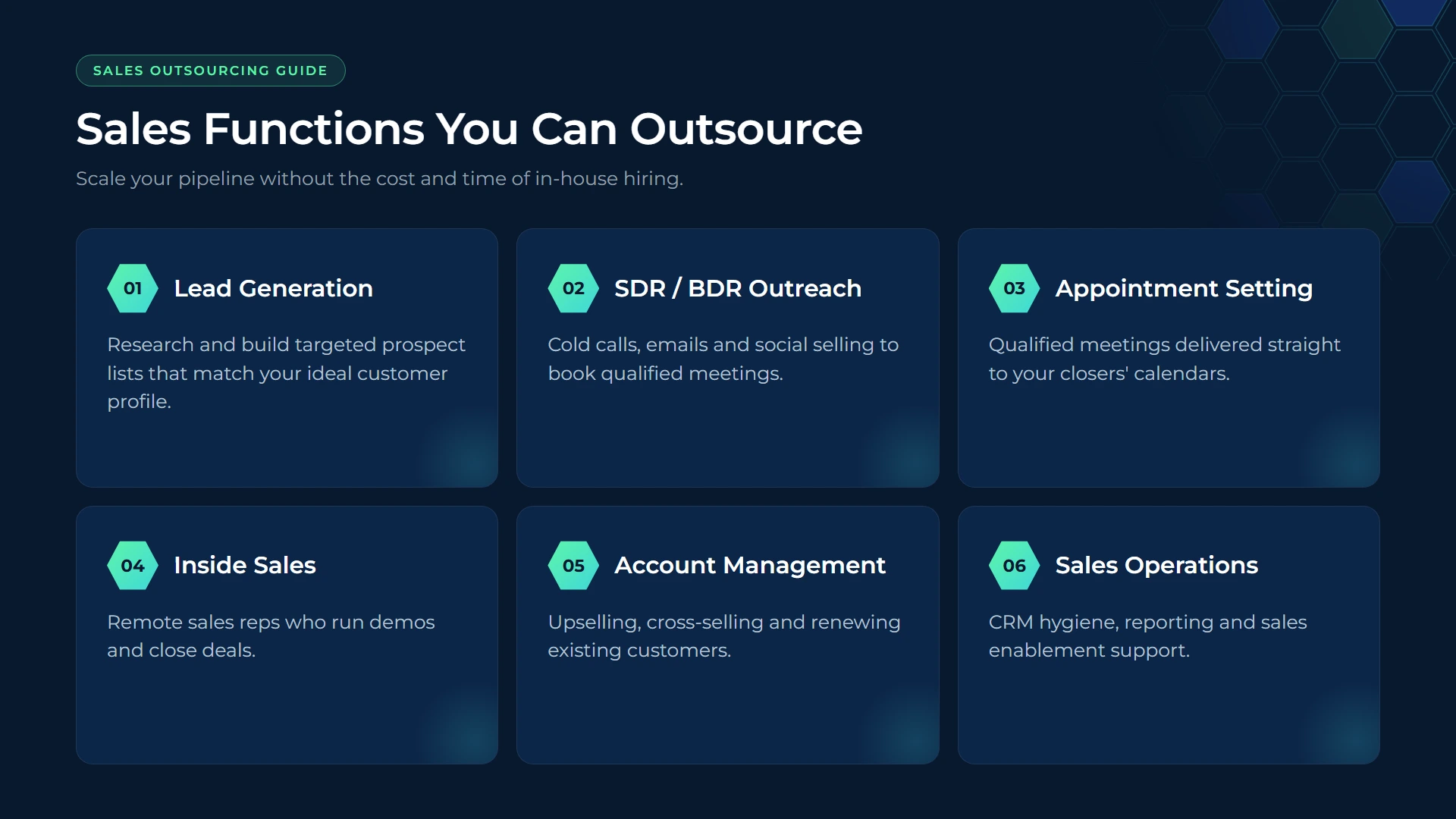
Most engagements follow a similar arc, even though the specifics vary by provider and contract length.
Onboarding usually takes two to four weeks. That's when the provider learns the product, builds target lists, defines the ideal customer profile, and sets up messaging sequences across channels such as email, phone, and LinkedIn.
Expect a ramp period of around 30–60 days before meeting volume becomes more predictable. Early performance is often uneven while the team tests messaging, refines targeting, and learns which objections come up most often. Providers promising instant results from day one are usually setting unrealistic expectations.
After launch, most reputable providers report weekly or biweekly on both activity and outcomes. That may include calls made, emails sent, conversations started, meetings booked, opportunities created, and deals influenced or closed.
This is where a lot of partnerships succeed or fail. Businesses that ignore the reporting and simply "let the agency handle it" often get weaker results, while teams that stay involved in regular syncs can help sharpen targeting, messaging, and qualification criteria over time.
Not all outsourcing arrangements look alike. Picking the wrong model for the business's stage is one of the most common reasons engagements underperform.
A lot of businesses start with lead generation outsourcing because it's the easiest to measure and the lowest-risk entry point. Full-cycle outsourcing demands more trust since the outsourced team is also closing revenue, but it can be the fastest way to validate a new market before investing in permanent headcount.

Sales outsourcing helps companies add capacity for prospecting, lead follow-up, customer communication, and recurring sales support without expanding every role internally. At NeoWork, we provide remote teammates who can support sales operations within your existing systems and processes. We handle recruitment, benefits, training, and ongoing engagement, while our teammates follow your tools, workflows, and daily priorities. Our 91% annualized teammate retention rate and 3.2% candidate selectivity rate reflect our focus on selective hiring and longer-term team stability.
Our sales outsourcing model offers:
Contact NeoWork to add sales support that fits your existing revenue operations.
Pricing varies a lot depending on model, geography of the outsourced team, and seniority of the reps involved. Still, a few patterns hold up across the market.
According to industry benchmarking from outsourced sales providers, businesses commonly report cost savings in the 30-50% range compared to a fully loaded in-house SDR when factoring in salary, benefits, tooling, management time, and ramp-up costs. Figures vary by provider and region, so treat any specific percentage as directional — check a shortlisted vendor's current pricing and case studies directly before budgeting against it.
The appeal isn't just cost. A handful of advantages come up again and again when businesses talk about why they went this route.
Outsourcing isn't free of downsides, and pretending otherwise does nobody favors.
None of these are dealbreakers on their own. They're just things to ask about before signing anything, not after the first disappointing month.
This is really the central question behind the whole guide, and there's no universal answer. It depends on stage, budget, and how core sales motion is to the business's competitive advantage.
Companies selling highly technical, long-cycle enterprise deals often keep closing in-house while outsourcing top-of-funnel prospecting — the complexity of the close benefits from deep internal product knowledge. Simpler, higher-volume sales motions (SMB software, services, certain consumer products) tend to tolerate full outsourcing much better.
AI-powered SDR tools have become a real part of the conversation around sales outsourcing. Some providers now blend human reps with AI tools for research, list building, and first-draft messaging, which can speed up prospecting without fully replacing the judgment a human rep brings to objection handling and tone. The honest take: AI handles volume and repetitive research well, but qualifying nuanced buying signals and building trust in a call still benefits from experienced humans, at least for now. Businesses evaluating vendors should ask directly how much of the "team" is AI-assisted versus fully automated, since that materially changes both pricing and quality expectations.
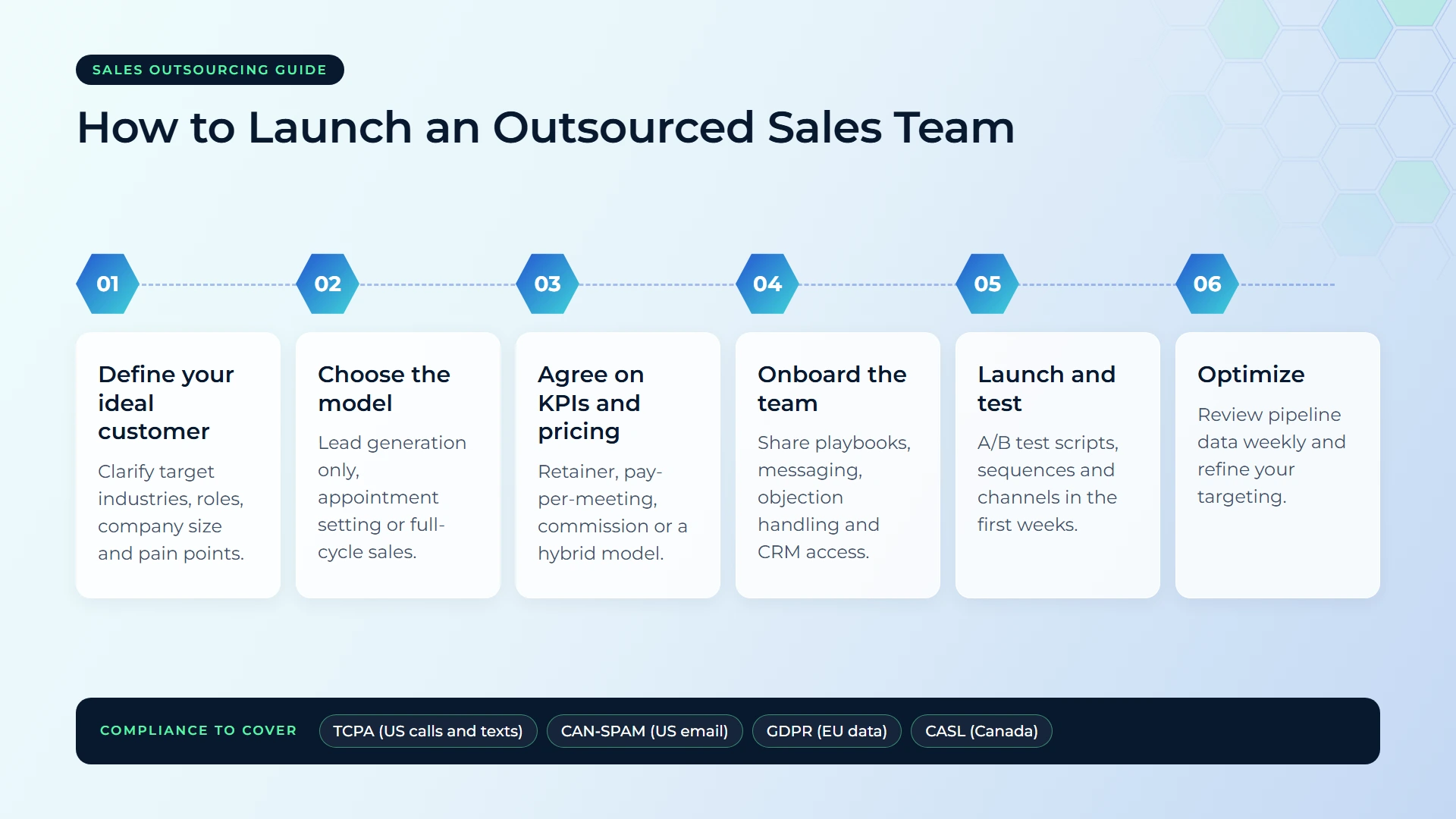
A few questions separate strong vendors from weak ones, regardless of which model is being considered.
Running a 90-day pilot before committing to a longer contract is one of the more reliable ways to de-risk the decision. It's long enough to see past the ramp period but short enough to limit downside if the fit isn't right.
Sales outsourcing isn't a shortcut around building a good product or a solid go-to-market strategy — it's a way to execute that strategy faster, with less upfront risk than hiring a full internal team. The businesses that get the most out of it tend to treat it as a partnership, not a hands-off vendor relationship: clear goals, regular reporting, and a pilot period before long-term commitment.
Start by defining which part of the sales process actually needs help, shortlist two or three providers with relevant case studies, and run a focused 90-day pilot before scaling spend. That's the version of this that actually moves pipeline instead of just moving budget.

Quick Summary: Sales outsourcing means hiring an external team or agency to run part or all of your sales process — typically prospecting, qualification, appointment setting, or full-cycle closing — instead of building that function with in-house hires. Done well, it can cut sales development costs by roughly 30-50% compared to a fully loaded in-house team and get a pipeline moving in weeks rather than months. The right model depends on budget, sales complexity, and how much control the business wants to retain, so this guide breaks down the models, real costs, and a practical framework for picking a partner.
Hiring and ramping a single SDR can take three to six months before that rep is anywhere near productive. Multiply that by a full team, add recruiting costs, management overhead, and tooling, and the math gets ugly fast. That's the gap sales outsourcing is built to close.
This guide walks through what sales outsourcing actually looks like in practice, the different models businesses use, what it realistically costs in 2026, and how to tell a strong partner from one that'll waste a quarter of pipeline and budget. No fluff, just the stuff that matters before signing a contract.
Sales outsourcing is the practice of hiring an external company or contractor to handle part or all of the sales function on a business's behalf. That can mean outbound prospecting and lead generation, inbound qualification, appointment setting, demo delivery, or full-cycle closing. Some companies outsource a single stage of the funnel; others hand over the entire sales operation, from first touch to signed contract.
It's different from a staffing agency placing a single contractor. Sales outsourcing providers typically bring a trained team, existing tooling (CRM integrations, dialers, enrichment data), and a playbook they've already run for other clients in similar industries. The business supplies the product knowledge, ideal customer profile, and pricing; the outsourced team supplies the people, process, and execution.
Companies turn to this model for a few common reasons: scaling pipeline without a long hiring cycle, testing a new market or vertical before committing headcount, or simply lacking the internal expertise to run outbound at a high standard. Early-stage startups and mid-market companies both use it, just for different stages of growth.
Most engagements follow a similar arc, even though the specifics vary by provider and contract length.
Onboarding usually takes two to four weeks. That's when the provider learns the product, builds target lists, defines the ideal customer profile, and sets up messaging sequences across channels such as email, phone, and LinkedIn.
Expect a ramp period of around 30–60 days before meeting volume becomes more predictable. Early performance is often uneven while the team tests messaging, refines targeting, and learns which objections come up most often. Providers promising instant results from day one are usually setting unrealistic expectations.
After launch, most reputable providers report weekly or biweekly on both activity and outcomes. That may include calls made, emails sent, conversations started, meetings booked, opportunities created, and deals influenced or closed.
This is where a lot of partnerships succeed or fail. Businesses that ignore the reporting and simply "let the agency handle it" often get weaker results, while teams that stay involved in regular syncs can help sharpen targeting, messaging, and qualification criteria over time.
Not all outsourcing arrangements look alike. Picking the wrong model for the business's stage is one of the most common reasons engagements underperform.
A lot of businesses start with lead generation outsourcing because it's the easiest to measure and the lowest-risk entry point. Full-cycle outsourcing demands more trust since the outsourced team is also closing revenue, but it can be the fastest way to validate a new market before investing in permanent headcount.
Sales outsourcing helps companies add capacity for prospecting, lead follow-up, customer communication, and recurring sales support without expanding every role internally. At NeoWork, we provide remote teammates who can support sales operations within your existing systems and processes. We handle recruitment, benefits, training, and ongoing engagement, while our teammates follow your tools, workflows, and daily priorities. Our 91% annualized teammate retention rate and 3.2% candidate selectivity rate reflect our focus on selective hiring and longer-term team stability.
Our sales outsourcing model offers:
Contact NeoWork to add sales support that fits your existing revenue operations.
Pricing varies a lot depending on model, geography of the outsourced team, and seniority of the reps involved. Still, a few patterns hold up across the market.
According to industry benchmarking from outsourced sales providers, businesses commonly report cost savings in the 30-50% range compared to a fully loaded in-house SDR when factoring in salary, benefits, tooling, management time, and ramp-up costs. Figures vary by provider and region, so treat any specific percentage as directional — check a shortlisted vendor's current pricing and case studies directly before budgeting against it.
The appeal isn't just cost. A handful of advantages come up again and again when businesses talk about why they went this route.
Outsourcing isn't free of downsides, and pretending otherwise does nobody favors.
None of these are dealbreakers on their own. They're just things to ask about before signing anything, not after the first disappointing month.
This is really the central question behind the whole guide, and there's no universal answer. It depends on stage, budget, and how core sales motion is to the business's competitive advantage.
Companies selling highly technical, long-cycle enterprise deals often keep closing in-house while outsourcing top-of-funnel prospecting — the complexity of the close benefits from deep internal product knowledge. Simpler, higher-volume sales motions (SMB software, services, certain consumer products) tend to tolerate full outsourcing much better.
AI-powered SDR tools have become a real part of the conversation around sales outsourcing. Some providers now blend human reps with AI tools for research, list building, and first-draft messaging, which can speed up prospecting without fully replacing the judgment a human rep brings to objection handling and tone. The honest take: AI handles volume and repetitive research well, but qualifying nuanced buying signals and building trust in a call still benefits from experienced humans, at least for now. Businesses evaluating vendors should ask directly how much of the "team" is AI-assisted versus fully automated, since that materially changes both pricing and quality expectations.
A few questions separate strong vendors from weak ones, regardless of which model is being considered.
Running a 90-day pilot before committing to a longer contract is one of the more reliable ways to de-risk the decision. It's long enough to see past the ramp period but short enough to limit downside if the fit isn't right.
Sales outsourcing isn't a shortcut around building a good product or a solid go-to-market strategy — it's a way to execute that strategy faster, with less upfront risk than hiring a full internal team. The businesses that get the most out of it tend to treat it as a partnership, not a hands-off vendor relationship: clear goals, regular reporting, and a pilot period before long-term commitment.
Start by defining which part of the sales process actually needs help, shortlist two or three providers with relevant case studies, and run a focused 90-day pilot before scaling spend. That's the version of this that actually moves pipeline instead of just moving budget.