

.avif)
.avif)

Sales Team Augmentation Guide: Scale Revenue Fast in 2026


.svg)

Quick Summary: Sales team augmentation means bringing in outside sales professionals — SDRs, AEs, closers, or sales ops specialists — to work alongside an existing in-house team without the overhead of full-time hiring. It's a fast way to fill pipeline gaps, test new markets, or hit a revenue target on a deadline. Done right, it blends external talent with internal strategy so the company keeps control while adding capacity. Done wrong, it becomes an expensive outsourcing mess with none of the accountability.
Hiring a full sales team takes months. Recruiting, onboarding, ramping — by the time a new rep is actually closing deals, the quarter that needed them is long gone. That's the gap sales team augmentation is built to close.
Instead of building a department from scratch, companies plug experienced sales professionals directly into their existing structure. They report into the same pipeline, use the same CRM, and follow the same playbook — just without the six-month hiring cycle attached. This guide breaks down what sales team augmentation actually looks like in practice, when it makes sense, what it costs, and how to avoid the traps that trip up first-time buyers.
What Is Sales Team Augmentation?
Sales team augmentation is a staffing model where a business adds external sales talent — SDRs, account executives, sales engineers, or revenue operations specialists — to an existing internal team on a temporary or ongoing basis. The augmented reps typically work inside the company's own systems and processes, rather than operating as a separate outsourced unit.
This is different from a traditional outsourced sales agency, where an outside firm runs an entire campaign independently and hands back leads or closed deals. With augmentation, the company keeps the strategy, the brand voice, and the management layer. The augmented talent just adds hands on deck.
Think of it less like outsourcing and more like flexible headcount. The rep might be a contractor or come through a staffing partner, but day to day, they function as part of the team.
How It Differs From Related Models
A lot of buyers confuse augmentation with outsourcing, managed services, or freelance hiring. They're related, but not the same thing.
Why Companies Turn to Sales Team Augmentation
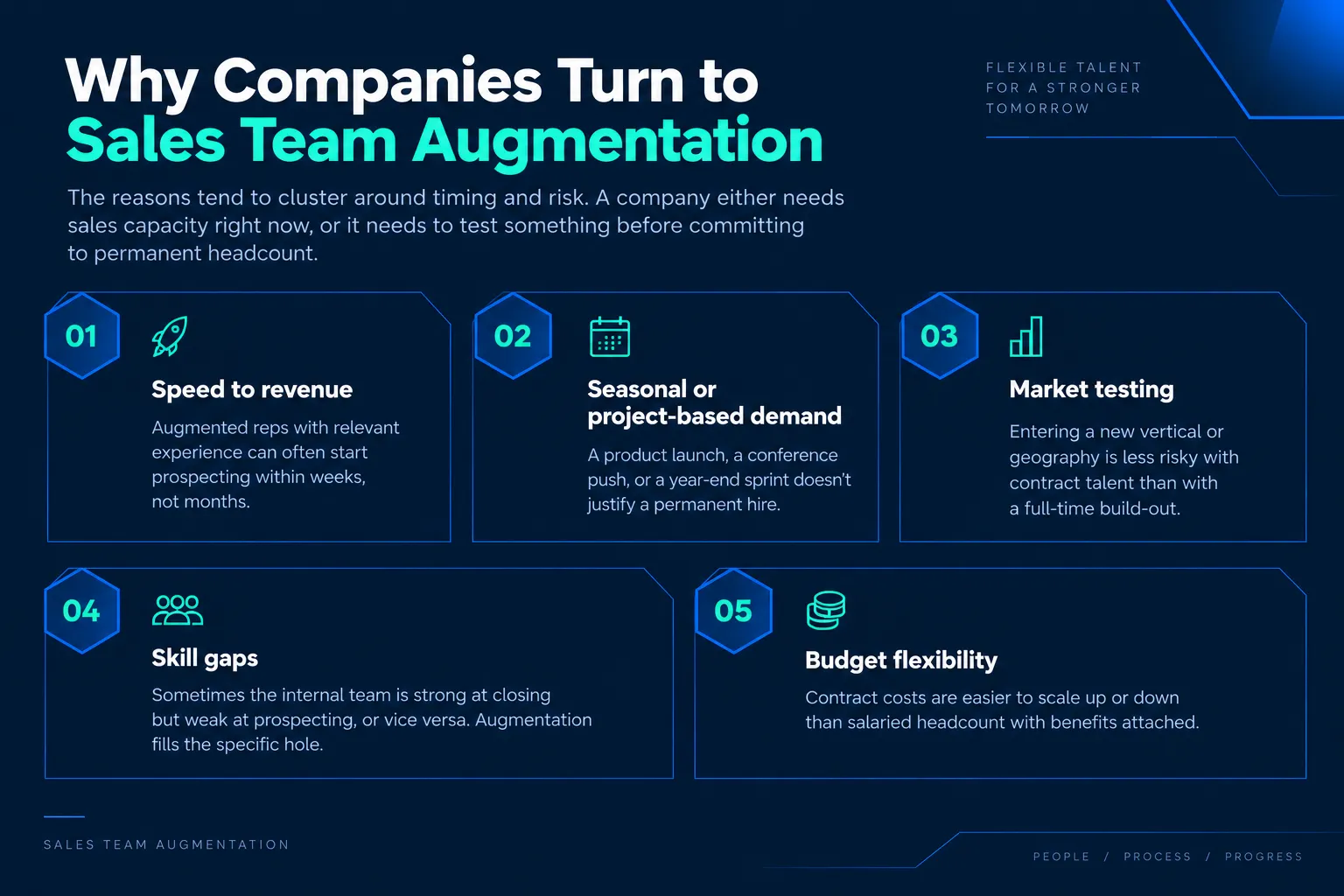
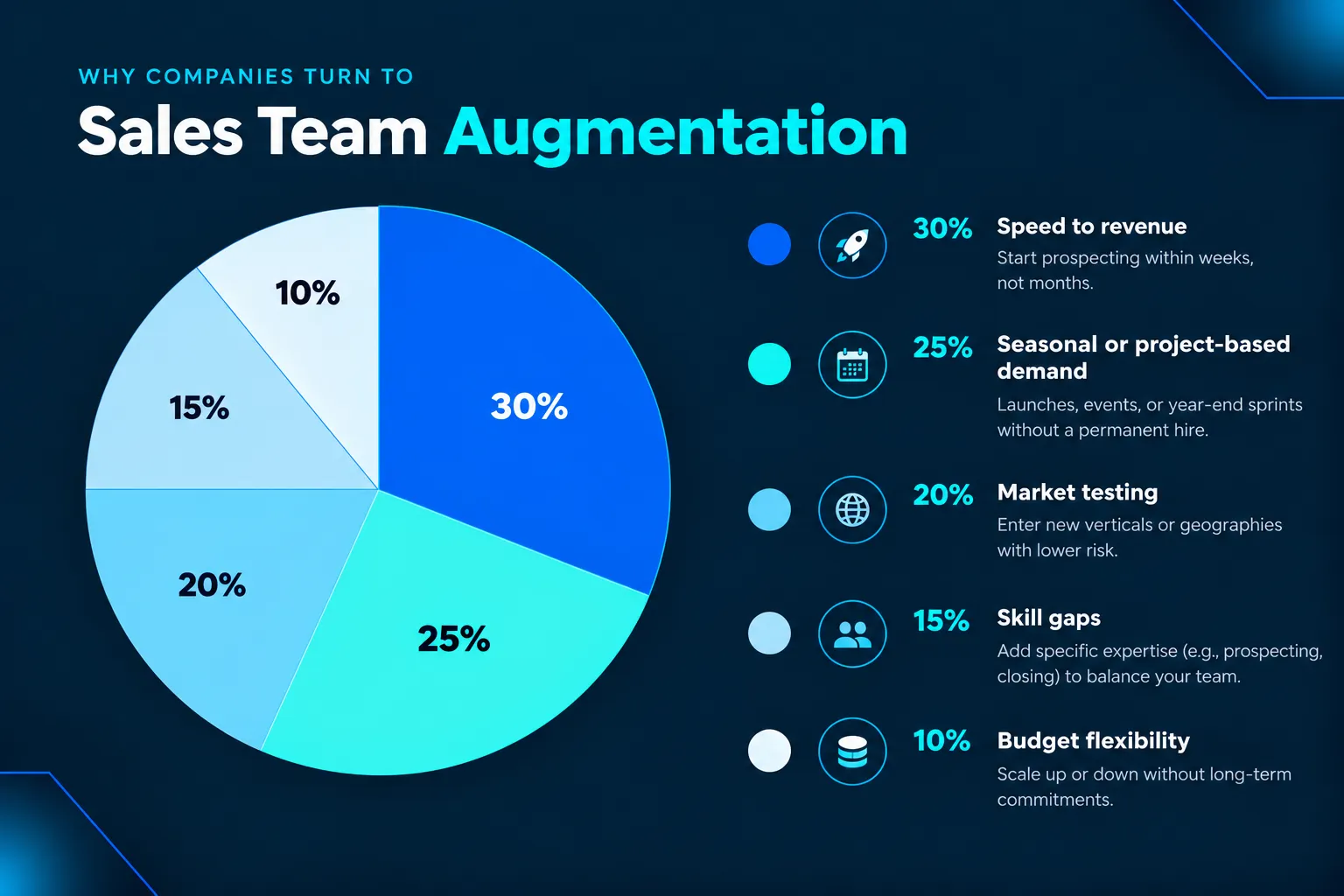
The reasons tend to cluster around timing and risk. A company either needs sales capacity right now, or it needs to test something before committing to permanent headcount.
- Speed to revenue: Augmented reps with relevant experience can often start prospecting within weeks, not months.
- Seasonal or project-based demand: A product launch, a conference push, or a year-end sprint doesn't justify a permanent hire.
- Market testing: Entering a new vertical or geography is less risky with contract talent than with a full-time build-out.
- Skill gaps: Sometimes the internal team is strong at closing but weak at prospecting, or vice versa. Augmentation fills the specific hole.
- Budget flexibility: Contract costs are easier to scale up or down than salaried headcount with benefits attached.
Here's the thing though — augmentation isn't a fix for a broken sales process. If the pipeline is leaking because of a weak offer or unclear ideal customer profile, adding more reps just means more people chasing the same bad leads.

Add Sales Team Support with NeoWork
Sales team augmentation helps companies add remote capacity for prospecting support, CRM updates, administrative work, and recurring sales operations. NeoWork provides remote teammates who can support existing commercial teams through virtual assistant and operational roles. NeoWork handles recruitment, benefits, training, and ongoing engagement, while teammates integrate into the client’s systems and daily workflows. Its 91% annualized teammate retention rate and 3.2% candidate selectivity rate reflect a focus on selective hiring and longer-term team stability.
NeoWork's sales team augmentation model offers:
- sales operations and administrative support
- integration with the client’s tools and processes
- recruitment and ongoing teammate support
Contact NeoWork to add sales support capacity that fits your existing team and processes.
Common Sales Roles Companies Augment
Not every sales role is equally suited to augmentation. Roles that are process-driven and measurable tend to work best, while roles that require deep, long-tenured relationship history are harder to hand off to a contractor.
Sales Development Representatives (SDRs)
Outbound prospecting is probably the single most commonly augmented sales function. It's repeatable, measurable by activity and conversion, and doesn't require years of institutional knowledge to execute well.
Account Executives (AEs)
Bringing in an experienced closer to run demos and negotiate deals works well when the internal pipeline is bigger than the internal team can handle — a good problem to have, but a real bottleneck.
Sales Engineers and Technical Specialists
For complex or technical products, augmented sales engineers can support demos and RFPs without needing a full-time hire dedicated to a niche technical need.
Revenue Operations (RevOps)
CRM cleanup, territory mapping, forecasting models — these are often project-based needs that don't require a permanent RevOps hire, making them a natural fit for augmentation.
Engagement Models: Picking the Right Fit
There isn't one single way to structure a sales augmentation arrangement. The right model depends on how long the need lasts and how much control the company wants to retain.
Most companies that use augmentation more than once eventually settle into a rolling or try-before-you-hire arrangement. It tends to strike the best balance between flexibility and the ramp-up cost that comes with any new hire, contract or not.
Costs: What Sales Team Augmentation Actually Runs
Pricing varies a lot based on seniority, location, and whether the talent comes through a staffing agency, a freelance platform, or a specialized sales-as-a-service firm. Rather than quoting a specific number that will be outdated within a year, it's worth understanding the variables that actually move the price.
- Experience level: A junior SDR costs meaningfully less than a senior AE with a track record closing enterprise deals.
- Geography: Augmented talent based in lower-cost regions can reduce spend significantly, though time zone and market fit matter too.
- Engagement length: Short-term contracts often carry a premium rate; longer commitments typically bring the effective rate down.
- Industry complexity: Technical or regulated industries (healthcare, fintech, enterprise SaaS) command higher rates than general B2C sales.
For current benchmark pricing, checking directly with a few staffing or sales-augmentation vendors is the most reliable approach — rates shift with market demand and vendor pricing pages tend to be more current than any single guide.
Pros and Cons of Sales Team Augmentation
Like any staffing model, augmentation trades certain advantages for certain risks. Weighing both honestly before signing a contract saves a lot of frustration later.
Best Practices for Getting It Right
Augmentation works best when it's treated as an extension of the team, not a bolt-on. A few practices separate the companies that get strong results from the ones that end up disappointed.
Define the Role Precisely Before Hiring
Vague requests like "we need more sales help" lead to mismatched hires. Specify the quota, the target segment, and the exact stage of the funnel the person will own.
Give Full Access to Tools and Data
An augmented rep working without CRM access, playbooks, or historical deal data is set up to underperform. Treat onboarding the same way it would happen for a full-time hire.
Set Ramp Expectations Early
Even a senior AE needs time to learn the product and the market. Building a realistic 30/60/90-day ramp plan avoids premature judgments about performance.
Keep Management Close
Weekly check-ins, shared pipeline reviews, and clear escalation paths matter more with augmented talent than with long-tenured employees who already know the unwritten rules.
Measure the Right Metrics
Activity metrics (calls, emails, meetings booked) matter early on, but pipeline generated and revenue closed are what ultimately justify the investment.
Choosing a Vendor or Partner
Not all staffing partners specialize in sales. Some are generalist IT staffing firms that happen to place sales roles occasionally; others build their entire business around revenue talent. The second type usually has better vetting for sales-specific skills like objection handling and pipeline discipline.
Before signing with a partner, it's worth asking a few direct questions: How do they vet for quota attainment history? What happens if a placed rep underperforms — is there a replacement guarantee? How much visibility does the company get into candidate sourcing? Vendors that dodge these questions are usually not worth the risk.
Final Thoughts
Sales team augmentation isn't a shortcut around building a real sales strategy — it's a way to execute that strategy faster when internal capacity runs short. The companies that get the most out of it treat augmented reps like real team members: proper onboarding, clear metrics, and management attention included.
Before reaching out to a staffing partner, get specific about the role, the timeline, and what success actually looks like in numbers. That clarity is what turns augmentation from a stopgap into a genuine growth lever.
FAQ
Topics
Sales Team Augmentation Guide: Scale Revenue Fast in 2026

Quick Summary: Sales team augmentation means bringing in outside sales professionals — SDRs, AEs, closers, or sales ops specialists — to work alongside an existing in-house team without the overhead of full-time hiring. It's a fast way to fill pipeline gaps, test new markets, or hit a revenue target on a deadline. Done right, it blends external talent with internal strategy so the company keeps control while adding capacity. Done wrong, it becomes an expensive outsourcing mess with none of the accountability.
Hiring a full sales team takes months. Recruiting, onboarding, ramping — by the time a new rep is actually closing deals, the quarter that needed them is long gone. That's the gap sales team augmentation is built to close.
Instead of building a department from scratch, companies plug experienced sales professionals directly into their existing structure. They report into the same pipeline, use the same CRM, and follow the same playbook — just without the six-month hiring cycle attached. This guide breaks down what sales team augmentation actually looks like in practice, when it makes sense, what it costs, and how to avoid the traps that trip up first-time buyers.
What Is Sales Team Augmentation?
Sales team augmentation is a staffing model where a business adds external sales talent — SDRs, account executives, sales engineers, or revenue operations specialists — to an existing internal team on a temporary or ongoing basis. The augmented reps typically work inside the company's own systems and processes, rather than operating as a separate outsourced unit.
This is different from a traditional outsourced sales agency, where an outside firm runs an entire campaign independently and hands back leads or closed deals. With augmentation, the company keeps the strategy, the brand voice, and the management layer. The augmented talent just adds hands on deck.
Think of it less like outsourcing and more like flexible headcount. The rep might be a contractor or come through a staffing partner, but day to day, they function as part of the team.
How It Differs From Related Models
A lot of buyers confuse augmentation with outsourcing, managed services, or freelance hiring. They're related, but not the same thing.
Why Companies Turn to Sales Team Augmentation
The reasons tend to cluster around timing and risk. A company either needs sales capacity right now, or it needs to test something before committing to permanent headcount.
- Speed to revenue: Augmented reps with relevant experience can often start prospecting within weeks, not months.
- Seasonal or project-based demand: A product launch, a conference push, or a year-end sprint doesn't justify a permanent hire.
- Market testing: Entering a new vertical or geography is less risky with contract talent than with a full-time build-out.
- Skill gaps: Sometimes the internal team is strong at closing but weak at prospecting, or vice versa. Augmentation fills the specific hole.
- Budget flexibility: Contract costs are easier to scale up or down than salaried headcount with benefits attached.
Here's the thing though — augmentation isn't a fix for a broken sales process. If the pipeline is leaking because of a weak offer or unclear ideal customer profile, adding more reps just means more people chasing the same bad leads.
Add Sales Team Support with NeoWork
Sales team augmentation helps companies add remote capacity for prospecting support, CRM updates, administrative work, and recurring sales operations. NeoWork provides remote teammates who can support existing commercial teams through virtual assistant and operational roles. NeoWork handles recruitment, benefits, training, and ongoing engagement, while teammates integrate into the client’s systems and daily workflows. Its 91% annualized teammate retention rate and 3.2% candidate selectivity rate reflect a focus on selective hiring and longer-term team stability.
NeoWork's sales team augmentation model offers:
- sales operations and administrative support
- integration with the client’s tools and processes
- recruitment and ongoing teammate support
Contact NeoWork to add sales support capacity that fits your existing team and processes.
Common Sales Roles Companies Augment
Not every sales role is equally suited to augmentation. Roles that are process-driven and measurable tend to work best, while roles that require deep, long-tenured relationship history are harder to hand off to a contractor.
Sales Development Representatives (SDRs)
Outbound prospecting is probably the single most commonly augmented sales function. It's repeatable, measurable by activity and conversion, and doesn't require years of institutional knowledge to execute well.
Account Executives (AEs)
Bringing in an experienced closer to run demos and negotiate deals works well when the internal pipeline is bigger than the internal team can handle — a good problem to have, but a real bottleneck.
Sales Engineers and Technical Specialists
For complex or technical products, augmented sales engineers can support demos and RFPs without needing a full-time hire dedicated to a niche technical need.
Revenue Operations (RevOps)
CRM cleanup, territory mapping, forecasting models — these are often project-based needs that don't require a permanent RevOps hire, making them a natural fit for augmentation.
Engagement Models: Picking the Right Fit
There isn't one single way to structure a sales augmentation arrangement. The right model depends on how long the need lasts and how much control the company wants to retain.
Most companies that use augmentation more than once eventually settle into a rolling or try-before-you-hire arrangement. It tends to strike the best balance between flexibility and the ramp-up cost that comes with any new hire, contract or not.
Costs: What Sales Team Augmentation Actually Runs
Pricing varies a lot based on seniority, location, and whether the talent comes through a staffing agency, a freelance platform, or a specialized sales-as-a-service firm. Rather than quoting a specific number that will be outdated within a year, it's worth understanding the variables that actually move the price.
- Experience level: A junior SDR costs meaningfully less than a senior AE with a track record closing enterprise deals.
- Geography: Augmented talent based in lower-cost regions can reduce spend significantly, though time zone and market fit matter too.
- Engagement length: Short-term contracts often carry a premium rate; longer commitments typically bring the effective rate down.
- Industry complexity: Technical or regulated industries (healthcare, fintech, enterprise SaaS) command higher rates than general B2C sales.
For current benchmark pricing, checking directly with a few staffing or sales-augmentation vendors is the most reliable approach — rates shift with market demand and vendor pricing pages tend to be more current than any single guide.
Pros and Cons of Sales Team Augmentation
Like any staffing model, augmentation trades certain advantages for certain risks. Weighing both honestly before signing a contract saves a lot of frustration later.
Best Practices for Getting It Right
Augmentation works best when it's treated as an extension of the team, not a bolt-on. A few practices separate the companies that get strong results from the ones that end up disappointed.
Define the Role Precisely Before Hiring
Vague requests like "we need more sales help" lead to mismatched hires. Specify the quota, the target segment, and the exact stage of the funnel the person will own.
Give Full Access to Tools and Data
An augmented rep working without CRM access, playbooks, or historical deal data is set up to underperform. Treat onboarding the same way it would happen for a full-time hire.
Set Ramp Expectations Early
Even a senior AE needs time to learn the product and the market. Building a realistic 30/60/90-day ramp plan avoids premature judgments about performance.
Keep Management Close
Weekly check-ins, shared pipeline reviews, and clear escalation paths matter more with augmented talent than with long-tenured employees who already know the unwritten rules.
Measure the Right Metrics
Activity metrics (calls, emails, meetings booked) matter early on, but pipeline generated and revenue closed are what ultimately justify the investment.
Choosing a Vendor or Partner
Not all staffing partners specialize in sales. Some are generalist IT staffing firms that happen to place sales roles occasionally; others build their entire business around revenue talent. The second type usually has better vetting for sales-specific skills like objection handling and pipeline discipline.
Before signing with a partner, it's worth asking a few direct questions: How do they vet for quota attainment history? What happens if a placed rep underperforms — is there a replacement guarantee? How much visibility does the company get into candidate sourcing? Vendors that dodge these questions are usually not worth the risk.
Final Thoughts
Sales team augmentation isn't a shortcut around building a real sales strategy — it's a way to execute that strategy faster when internal capacity runs short. The companies that get the most out of it treat augmented reps like real team members: proper onboarding, clear metrics, and management attention included.
Before reaching out to a staffing partner, get specific about the role, the timeline, and what success actually looks like in numbers. That clarity is what turns augmentation from a stopgap into a genuine growth lever.
FAQ
Topics
Related Blogs
Related Podcasts


.webp)

.webp)
.webp)



