

.avif)
.avif)

Technology Team Augmentation Guide: Scale Fast Without the Guesswork


.svg)

Quick Summary: Technology team augmentation lets companies plug experienced developers, QA engineers, or DevOps specialists directly into an existing team while keeping full control over the roadmap and process. It's faster than hiring and more flexible than outsourcing a whole project, but it only pays off when the intake, onboarding, and management steps are done right. This guide breaks down how the model works, what it costs in 2026, and the exact steps to run it well.
Every engineering leader eventually hits the same wall: the roadmap is full, the backlog is growing, and hiring takes months nobody has. That's the moment technology team augmentation starts sounding less like a buzzword and more like the only realistic option.
Unlike traditional outsourcing, where a vendor takes an entire project off someone's plate, team augmentation adds individual specialists directly into an in-house team. They join daily standups, use the same tools, and report to the same lead. The company keeps the architecture decisions, the product vision, and the say over who does what. So what changes? Mostly the org chart's payroll line, not the reporting structure.
This guide covers what the model actually looks like in practice, how it differs from outsourcing and managed services, what it costs by region in 2026, and the steps that separate a smooth engagement from a frustrating one.

What Is Technology Team Augmentation?
Technology team augmentation is a staffing approach where a company brings in external engineers, designers, or specialists to work alongside its existing staff on a temporary or ongoing basis. The augmented staff typically works under the client's management, follows the client's processes, and gets folded into existing sprints rather than running a separate workstream.
It's a middle ground between two extremes. On one end, there's full in-house hiring — slow, expensive, but total control. On the other, there's project outsourcing — fast, hands-off, but limited visibility. Team augmentation borrows speed from outsourcing and control from hiring.
Who Actually Uses This Model?
Startups use it to add senior expertise without diluting equity through a full-time hire. Mid-size companies use it to smooth out hiring cycles during a product push. Enterprises use it constantly — often as a permanent part of workforce planning, blending contractors and full-time staff on nearly every large initiative.
Team Augmentation vs. Outsourcing vs. Managed Services
These three terms get used interchangeably far too often, and that's where a lot of buying mistakes start. Here's how they actually differ.
Notice the pattern: as control shifts from client to vendor, speed of delegation goes up but day-to-day visibility goes down. Team augmentation sits at the end of the spectrum that favors control — which is exactly why product-focused companies tend to prefer it over full outsourcing.

Scale Technology Teams with NeoWork
Technology team augmentation helps companies add technical capacity across software, data, cloud, IT, and related functions. NeoWork provides remote professionals who can work as part of existing technology teams or within dedicated team structures. NeoWork handles recruitment, benefits, training, and ongoing engagement, while teammates integrate into the client’s systems and workflows. Its 91% annualized teammate retention rate and 3.2% candidate selectivity rate reflect a focus on selective hiring and longer-term team stability.
NeoWork's technology team augmentation model offers:
- technical professionals across multiple functions
- integration with the client’s tools and processes
- recruitment and ongoing teammate support
Contact NeoWork to expand your technology team around current delivery and operational needs.
When Team Augmentation Makes Sense (and When It Doesn't)
It's not always the right call. A few scenarios where it genuinely helps:
- A specific skill (say, a Kubernetes specialist or a mobile developer) is needed for months, not years.
- Hiring is frozen or slow, but the roadmap isn't.
- A short-term spike in workload needs extra hands without a long-term headcount commitment.
- Internal teams need mentorship from a senior engineer without a full-time salary.
And a few where it usually backfires:
- The internal team has no capacity to manage or onboard anyone new — augmentation adds coordination overhead, it doesn't remove it.
- The work is a single, isolated deliverable with a clear finish line — outsourcing is probably simpler.
- Core product knowledge needs to stay entirely in-house for IP or compliance reasons.
Costs by Region in 2026
Rates vary widely depending on where the talent is based and how senior the role is. As a general guide (actual figures shift with demand, so check current vendor quotes before budgeting):
For exact numbers tied to a specific role and region, it's worth getting quotes from two or three vendors rather than trusting a single published rate card — pricing moves faster than most guides get updated.
How to Find and Vet Augmented Talent
Sourcing is where most of the risk in this model actually lives. A resume looks fine; the real test is whether the person can plug into an existing codebase and existing team dynamics without months of ramp-up.
Screening Beyond the Resume
Technical screens matter, but so does communication style, timezone overlap, and how someone handles ambiguity. A strong technical test paired with a live pairing session tends to surface more red flags than either alone.
Vendor vs. Freelance Marketplace vs. Direct Contract
Staffing vendors handle vetting, replacement guarantees, and payroll compliance — useful when hiring at volume or across borders. Freelance marketplaces work for short, well-scoped tasks. Direct contracts make sense when a specific individual is already known and trusted.
Onboarding and Managing Augmented Engineers
This is the part competitors gloss over, and it's usually the difference between augmentation that works and augmentation that quietly drains a team's velocity.
Step 1: Set Expectations Before Day One
Access to repos, documentation, and communication channels should be ready before the engineer's first standup — not requested on it.
Step 2: Assign a Real Onboarding Buddy
Not a Slack channel. An actual person responsible for answering questions in the first two weeks.
Step 3: Integrate Into Existing Rituals
Standups, retros, sprint planning — augmented staff should be in all of it. Treating them as outsiders defeats the purpose of the model.
Step 4: Review Performance Like Any Other Team Member
Regular 1:1s and code review feedback apply just as much to contractors as to full-time staff. Skipping this is how underperformance goes unnoticed for months.
Step 5: Plan the Transition Out
Whether the engagement ends in a month or two years, knowledge transfer shouldn't be an afterthought scrambled together in the final week.
Where Companies Typically Allocate Augmented Roles
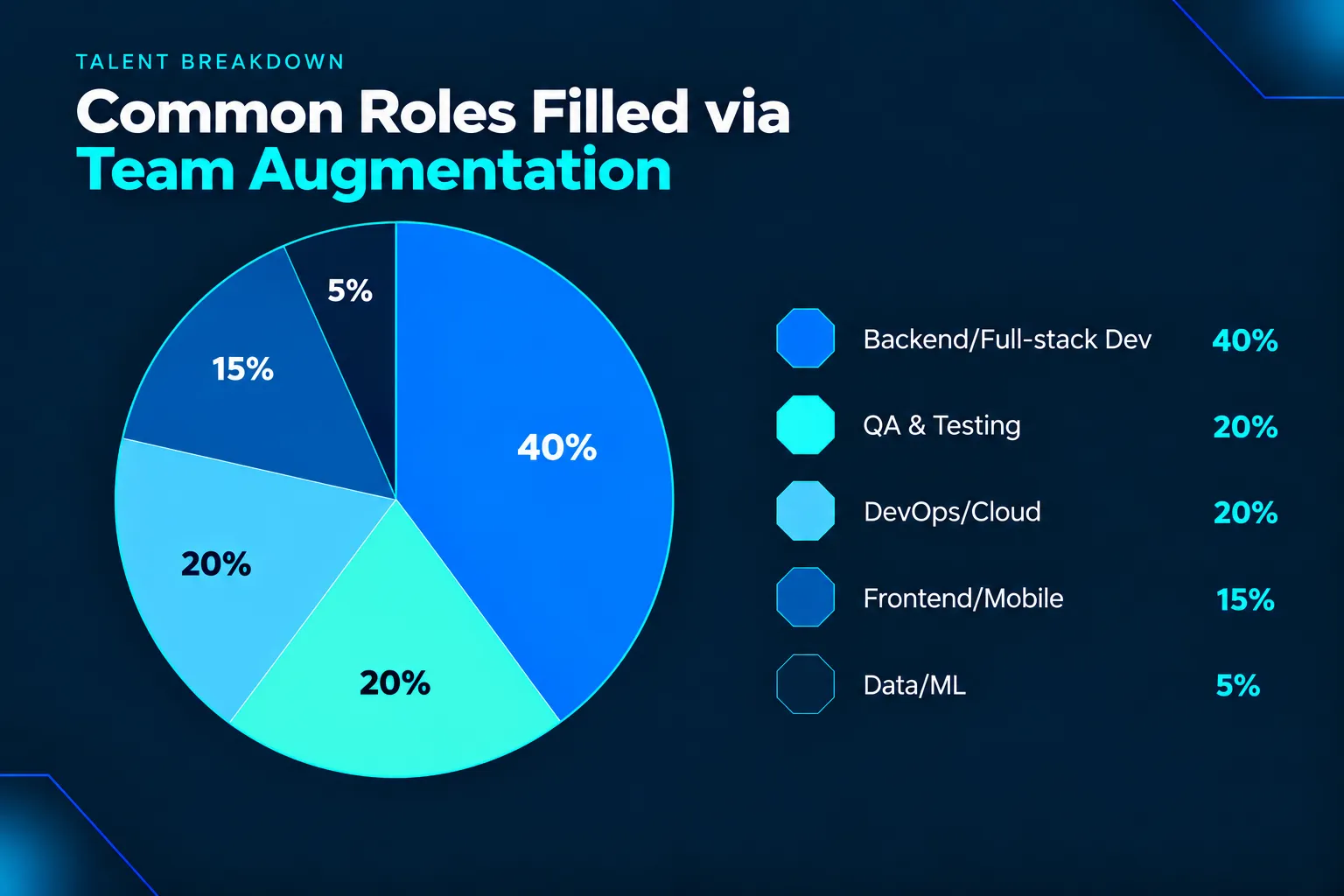
Not every role gets augmented equally. Backend and full-stack development tend to dominate demand, followed by QA, DevOps, and specialized front-end or mobile work.
Best Practices for a Successful Engagement
- Scope the gap precisely. Vague requests like "we need a senior dev" lead to mismatched hires.
- Overlap time zones deliberately. Even two or three overlapping hours a day keeps collaboration from becoming asynchronous guesswork.
- Document decisions, not just code. Augmented staff rotate in and out more than full-timers; documentation is what survives the transition.
- Avoid over-reliance on one contractor. If a single augmented engineer becomes the only person who understands a critical system, that's a risk, not a win.
- Revisit the arrangement quarterly. What made sense six months ago might not fit the current roadmap.
Common Pitfalls to Avoid
A few mistakes show up again and again across teams new to this model. Treating augmented staff as second-class team members kills morale and, eventually, retention on the vendor side. Skipping a real interview because "the agency already vetted them" leads to mismatched skill sets. And underestimating management overhead — assuming augmentation is "hands-off" — is probably the single biggest reason engagements fail to deliver value.
Final Thoughts
Technology team augmentation isn't a shortcut around good management — it's a tool that amplifies whatever management practices already exist, good or bad. Done right, it closes skill gaps fast, keeps the roadmap moving, and gives teams flexibility that a rigid hiring plan can't match. Done carelessly, it just adds another layer of coordination without the payoff.
The companies that get the most out of this model treat augmented engineers like real team members from day one: clear scope, real onboarding, regular feedback, and a plan for what happens when the engagement ends. Start there, and augmentation stops being a stopgap and starts being a genuine scaling strategy.
FAQ
Topics
Technology Team Augmentation Guide: Scale Fast Without the Guesswork

Quick Summary: Technology team augmentation lets companies plug experienced developers, QA engineers, or DevOps specialists directly into an existing team while keeping full control over the roadmap and process. It's faster than hiring and more flexible than outsourcing a whole project, but it only pays off when the intake, onboarding, and management steps are done right. This guide breaks down how the model works, what it costs in 2026, and the exact steps to run it well.
Every engineering leader eventually hits the same wall: the roadmap is full, the backlog is growing, and hiring takes months nobody has. That's the moment technology team augmentation starts sounding less like a buzzword and more like the only realistic option.
Unlike traditional outsourcing, where a vendor takes an entire project off someone's plate, team augmentation adds individual specialists directly into an in-house team. They join daily standups, use the same tools, and report to the same lead. The company keeps the architecture decisions, the product vision, and the say over who does what. So what changes? Mostly the org chart's payroll line, not the reporting structure.
This guide covers what the model actually looks like in practice, how it differs from outsourcing and managed services, what it costs by region in 2026, and the steps that separate a smooth engagement from a frustrating one.
What Is Technology Team Augmentation?
Technology team augmentation is a staffing approach where a company brings in external engineers, designers, or specialists to work alongside its existing staff on a temporary or ongoing basis. The augmented staff typically works under the client's management, follows the client's processes, and gets folded into existing sprints rather than running a separate workstream.
It's a middle ground between two extremes. On one end, there's full in-house hiring — slow, expensive, but total control. On the other, there's project outsourcing — fast, hands-off, but limited visibility. Team augmentation borrows speed from outsourcing and control from hiring.
Who Actually Uses This Model?
Startups use it to add senior expertise without diluting equity through a full-time hire. Mid-size companies use it to smooth out hiring cycles during a product push. Enterprises use it constantly — often as a permanent part of workforce planning, blending contractors and full-time staff on nearly every large initiative.
Team Augmentation vs. Outsourcing vs. Managed Services
These three terms get used interchangeably far too often, and that's where a lot of buying mistakes start. Here's how they actually differ.
Notice the pattern: as control shifts from client to vendor, speed of delegation goes up but day-to-day visibility goes down. Team augmentation sits at the end of the spectrum that favors control — which is exactly why product-focused companies tend to prefer it over full outsourcing.
Scale Technology Teams with NeoWork
Technology team augmentation helps companies add technical capacity across software, data, cloud, IT, and related functions. NeoWork provides remote professionals who can work as part of existing technology teams or within dedicated team structures. NeoWork handles recruitment, benefits, training, and ongoing engagement, while teammates integrate into the client’s systems and workflows. Its 91% annualized teammate retention rate and 3.2% candidate selectivity rate reflect a focus on selective hiring and longer-term team stability.
NeoWork's technology team augmentation model offers:
- technical professionals across multiple functions
- integration with the client’s tools and processes
- recruitment and ongoing teammate support
Contact NeoWork to expand your technology team around current delivery and operational needs.
When Team Augmentation Makes Sense (and When It Doesn't)
It's not always the right call. A few scenarios where it genuinely helps:
- A specific skill (say, a Kubernetes specialist or a mobile developer) is needed for months, not years.
- Hiring is frozen or slow, but the roadmap isn't.
- A short-term spike in workload needs extra hands without a long-term headcount commitment.
- Internal teams need mentorship from a senior engineer without a full-time salary.
And a few where it usually backfires:
- The internal team has no capacity to manage or onboard anyone new — augmentation adds coordination overhead, it doesn't remove it.
- The work is a single, isolated deliverable with a clear finish line — outsourcing is probably simpler.
- Core product knowledge needs to stay entirely in-house for IP or compliance reasons.
Costs by Region in 2026
Rates vary widely depending on where the talent is based and how senior the role is. As a general guide (actual figures shift with demand, so check current vendor quotes before budgeting):
For exact numbers tied to a specific role and region, it's worth getting quotes from two or three vendors rather than trusting a single published rate card — pricing moves faster than most guides get updated.
How to Find and Vet Augmented Talent
Sourcing is where most of the risk in this model actually lives. A resume looks fine; the real test is whether the person can plug into an existing codebase and existing team dynamics without months of ramp-up.
Screening Beyond the Resume
Technical screens matter, but so does communication style, timezone overlap, and how someone handles ambiguity. A strong technical test paired with a live pairing session tends to surface more red flags than either alone.
Vendor vs. Freelance Marketplace vs. Direct Contract
Staffing vendors handle vetting, replacement guarantees, and payroll compliance — useful when hiring at volume or across borders. Freelance marketplaces work for short, well-scoped tasks. Direct contracts make sense when a specific individual is already known and trusted.
Onboarding and Managing Augmented Engineers
This is the part competitors gloss over, and it's usually the difference between augmentation that works and augmentation that quietly drains a team's velocity.
Step 1: Set Expectations Before Day One
Access to repos, documentation, and communication channels should be ready before the engineer's first standup — not requested on it.
Step 2: Assign a Real Onboarding Buddy
Not a Slack channel. An actual person responsible for answering questions in the first two weeks.
Step 3: Integrate Into Existing Rituals
Standups, retros, sprint planning — augmented staff should be in all of it. Treating them as outsiders defeats the purpose of the model.
Step 4: Review Performance Like Any Other Team Member
Regular 1:1s and code review feedback apply just as much to contractors as to full-time staff. Skipping this is how underperformance goes unnoticed for months.
Step 5: Plan the Transition Out
Whether the engagement ends in a month or two years, knowledge transfer shouldn't be an afterthought scrambled together in the final week.
Where Companies Typically Allocate Augmented Roles
Not every role gets augmented equally. Backend and full-stack development tend to dominate demand, followed by QA, DevOps, and specialized front-end or mobile work.
Best Practices for a Successful Engagement
- Scope the gap precisely. Vague requests like "we need a senior dev" lead to mismatched hires.
- Overlap time zones deliberately. Even two or three overlapping hours a day keeps collaboration from becoming asynchronous guesswork.
- Document decisions, not just code. Augmented staff rotate in and out more than full-timers; documentation is what survives the transition.
- Avoid over-reliance on one contractor. If a single augmented engineer becomes the only person who understands a critical system, that's a risk, not a win.
- Revisit the arrangement quarterly. What made sense six months ago might not fit the current roadmap.
Common Pitfalls to Avoid
A few mistakes show up again and again across teams new to this model. Treating augmented staff as second-class team members kills morale and, eventually, retention on the vendor side. Skipping a real interview because "the agency already vetted them" leads to mismatched skill sets. And underestimating management overhead — assuming augmentation is "hands-off" — is probably the single biggest reason engagements fail to deliver value.
Final Thoughts
Technology team augmentation isn't a shortcut around good management — it's a tool that amplifies whatever management practices already exist, good or bad. Done right, it closes skill gaps fast, keeps the roadmap moving, and gives teams flexibility that a rigid hiring plan can't match. Done carelessly, it just adds another layer of coordination without the payoff.
The companies that get the most out of this model treat augmented engineers like real team members from day one: clear scope, real onboarding, regular feedback, and a plan for what happens when the engagement ends. Start there, and augmentation stops being a stopgap and starts being a genuine scaling strategy.
FAQ
Topics
Related Blogs
Related Podcasts


.webp)

.webp)
.webp)



