

.avif)
.avif)

Virtual Team Augmentation Guide: Scale Smarter in 2026


.svg)

Quick Summary: Virtual team augmentation lets companies plug remote specialists directly into their existing teams to close skill gaps, speed up delivery, and control costs without the overhead of full-time hiring. This guide walks through when it makes sense, how to source and onboard talent, what it costs, and the practices that separate successful engagements from messy ones.
Hiring freezes hit. Deadlines don't. That mismatch is exactly why virtual team augmentation has quietly become one of the most practical ways to keep projects moving without waiting months for a recruiter to fill a role.
Unlike outsourcing an entire project to a third-party vendor, virtual team augmentation embeds outside specialists directly into an in-house team. They join standups, use the same tools, and report to the same managers as everyone else — they just happen to work from somewhere else, on a flexible contract. Done right, it feels less like "outsourced help" and more like an extension of the existing crew.
This guide covers what virtual team augmentation actually looks like in practice, how it differs from staff augmentation and outsourcing, what it costs by region, how to structure a successful engagement, and the mistakes that quietly sink these arrangements.
What Is Virtual Team Augmentation, Exactly?
Virtual team augmentation is a staffing model where a business adds remote professionals — developers, designers, QA engineers, project managers, whoever's missing — to its existing team on a temporary or ongoing basis. These augmented team members work under the client's direction, follow the client's processes, and typically use the client's communication and project management tools.
It's a cousin of staff augmentation, but with an explicit remote-first lens: sourcing, onboarding, and management are all designed around distributed collaboration from day one, rather than treating remote work as an afterthought.
The core idea is simple: instead of building a brand-new team from scratch or handing a whole project to an external agency, a company borrows specific skills for a specific stretch of time. A startup needing a senior React developer for a six-month sprint doesn't need to hire permanently — it needs the skill, not necessarily the headcount.
How It Differs From Staff Augmentation and Outsourcing
These terms get thrown around loosely, and that causes real confusion during vendor conversations. Here's the distinction that actually matters:
With outsourcing, a vendor owns the deliverable and manages its own people. With team augmentation, the client keeps full control over how the work gets done — the augmented staff just fill the gaps in headcount and expertise.
When Virtual Team Augmentation Actually Makes Sense
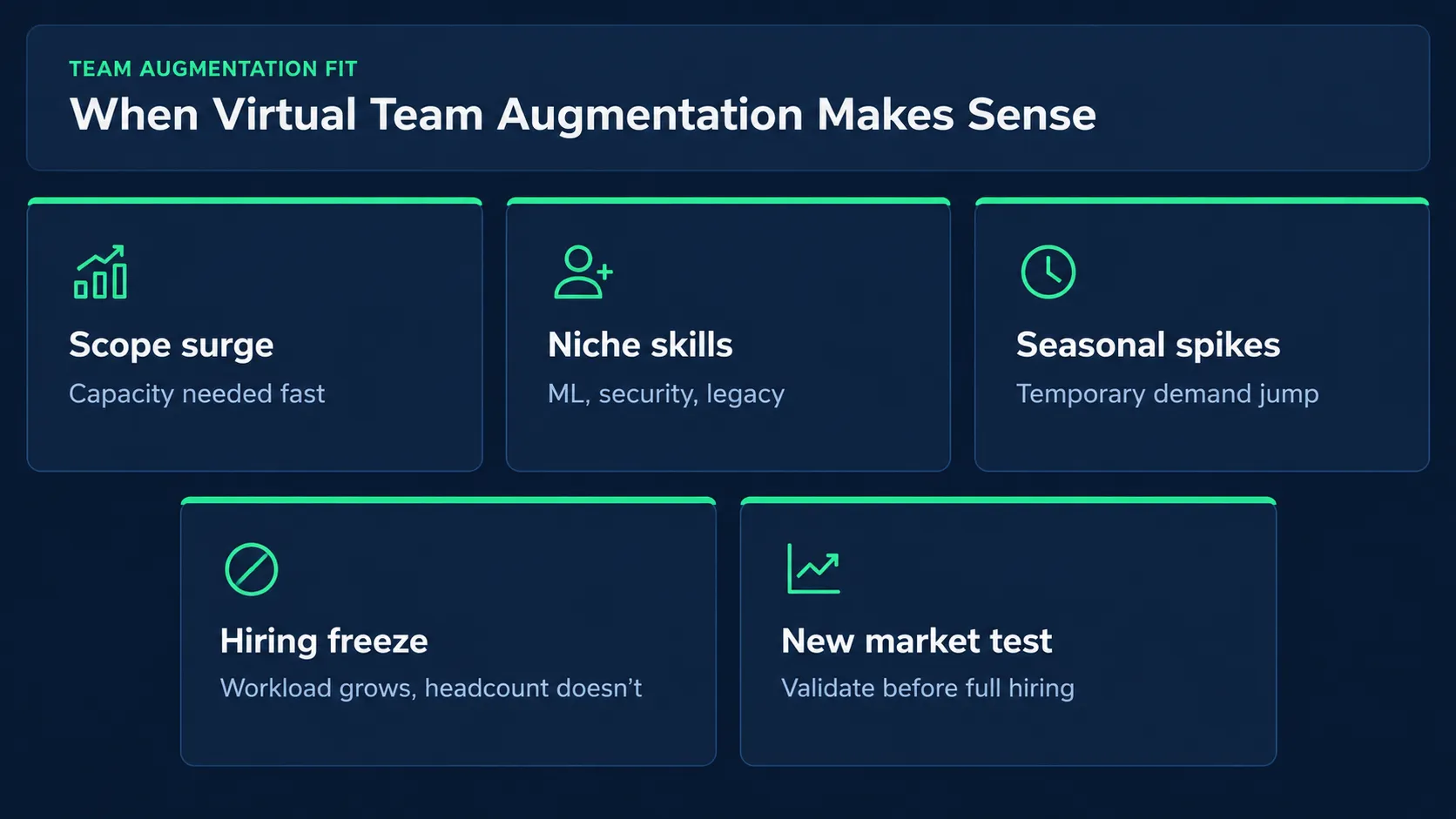
Not every gap calls for augmentation. It tends to work best in a handful of recurring scenarios:
- Sudden scope expansion. A client signs a big contract and the delivery team needs to double capacity in weeks, not quarters.
- Niche or scarce skills. Specialized roles — machine learning engineers, security specialists, certain legacy-stack developers — are hard to hire locally and slow to train internally.
- Seasonal or project-based spikes. Retail platforms scaling before a holiday season, or a fintech pushing a compliance deadline, need extra hands temporarily, not permanently.
- Budget constraints on full-time hiring. Hiring freezes don't always mean workload freezes. Augmentation offers a way around headcount limits without breaking policy.
- Testing new markets or product lines. Before committing to a full local team, augmentation lets a company validate demand with lower fixed costs.
It makes less sense when the work is deeply tied to institutional knowledge that takes months to transfer, or when the engagement is so short that onboarding costs outweigh the benefit.

Build Virtual Team Capacity with NeoWork
Virtual team augmentation helps companies add remote professionals for recurring work without expanding every function internally. NeoWork provides teammates across virtual assistance, customer support, technical services, AI, and operational functions. NeoWork handles recruitment, benefits, training, and ongoing engagement, while teammates work within the client’s existing tools, processes, and management structure. Its 91% annualized teammate retention rate and 3.2% candidate selectivity rate reflect a focus on selective hiring and longer-term team stability.
NeoWork's virtual team augmentation model offers:
- remote professionals for recurring workflows
- integration with the client’s tools and processes
- recruitment and ongoing teammate support
Contact NeoWork to build a virtual team that fits your existing operations.
How Much Does Virtual Team Augmentation Cost?
Costs vary widely by region, seniority, and specialization, and any number quoted today will shift with market conditions — always confirm current rates with a vendor's official pricing page before budgeting. That said, general patterns hold reasonably steady:
- Talent in Eastern Europe and Latin America generally comes in below North American or Western European rates for comparable seniority, while still operating in convenient time zones for many US and EU clients.
- South and Southeast Asian markets often offer the lowest hourly rates but may require more overlap planning due to time zone gaps.
- Senior and highly specialized roles (security, AI/ML, DevOps at scale) command a premium regardless of region.
- Engagement length affects pricing too — month-to-month contracts typically cost more per hour than six-month-plus commitments.
Rather than anchoring to a specific dollar figure that will age poorly, budget by comparing the fully-loaded cost of a full-time local hire (salary, benefits, taxes, office overhead, recruiting fees) against an augmented contractor's rate over the same period. In many cases, augmentation wins on flexibility even when the hourly rate looks higher on paper, because there's no long-term severance or benefits liability.
Hidden Costs Worth Planning For
Line-item rates aren't the whole picture. Management overhead, tooling licenses for extra seats, time zone coordination, and knowledge-transfer time at the end of a contract all add up. Building these into the budget upfront avoids surprises later.
Sourcing and Vetting Talent
Finding the right augmented team members comes down to three sourcing paths, each with tradeoffs.
Whichever route gets chosen, the screening process should mirror how a full-time hire would be evaluated: technical assessments, a live coding or work-sample exercise where relevant, and at least one conversation focused on communication style and collaboration habits — not just credentials. Remote work amplifies small communication gaps into big project delays, so this step matters more than it might for an onsite hire.
Onboarding: The Step Everyone Rushes and Regrets
Here's the thing though — augmented talent is only as productive as the onboarding they receive. Companies that treat onboarding as an afterthought consistently see slower ramp-up times and higher early turnover.
A solid onboarding process for augmented team members usually includes:
- Access provisioning completed before day one — tools, repos, credentials, documentation.
- A structured first-week plan with a named point of contact, not just a Slack channel invite.
- Clear documentation of coding standards, workflows, and communication norms.
- An early, low-stakes task to build familiarity with the codebase or process before high-pressure work begins.
- A 30-day check-in to catch friction early, rather than waiting for a quarterly review.
Best Practices for Managing an Augmented Virtual Team
Once the team is in place, the real work starts. A few practices consistently separate smooth engagements from painful ones:
- Overlap on communication tools, not just tasks. Standardize on one chat platform, one project tracker, one video tool. Fragmented tooling creates friction fast.
- Set explicit overlap hours. Even fully asynchronous teams benefit from a two-to-four hour daily window where everyone is reachable.
- Give augmented staff real context, not just tickets. Sharing the "why" behind a task produces better decisions than handing over isolated instructions.
- Include them in team rituals. Standups, retros, and even informal social check-ins reduce the "outsider" feeling that hurts retention and morale.
- Document everything. Distributed teams rely on written records more than in-person teams do — decisions, rationale, and status all need a paper trail.
Managing Time Zones Without Losing Momentum
Time zone gaps aren't automatically a dealbreaker. Teams that split work into clearly-owned async chunks — with a documented handoff at the end of each day — often move faster than fully co-located teams stuck in meetings. The trick is designing workflows around asynchronous handoffs rather than forcing synchronous habits onto a distributed group.
Common Pitfalls to Avoid
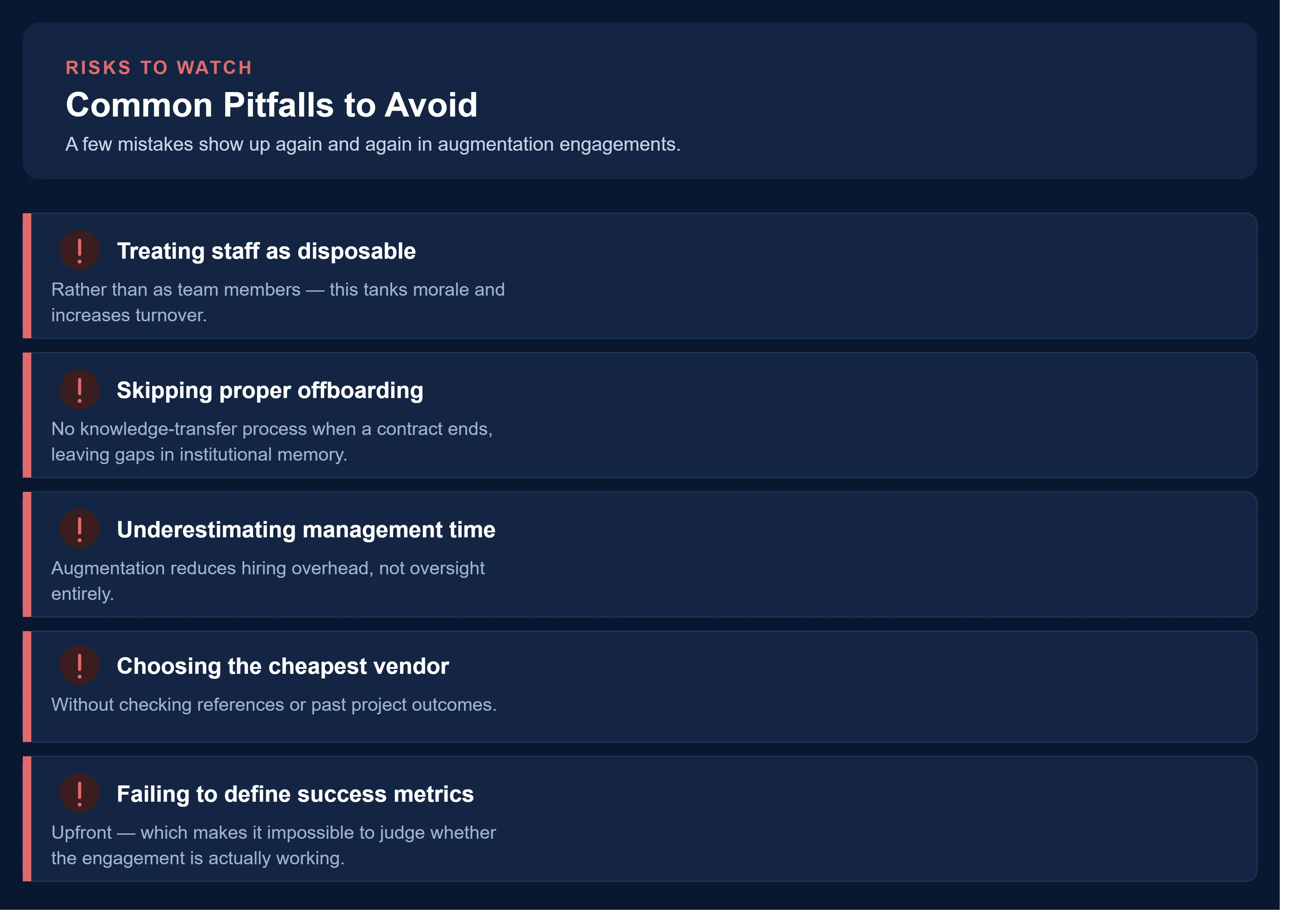
A few mistakes show up again and again in augmentation engagements:
- Treating augmented staff as disposable rather than as team members, which tanks morale and increases turnover.
- Skipping a proper offboarding and knowledge-transfer process when a contract ends, leaving gaps in institutional memory.
- Underestimating management time — augmentation reduces hiring overhead, not oversight entirely.
- Choosing the cheapest vendor without checking references or past project outcomes.
- Failing to define success metrics upfront, which makes it impossible to judge whether the engagement is actually working.
Virtual Team Augmentation vs. Building a Full Remote Team
Sometimes the better question isn't "augment or outsource" — it's "augment or hire remote full-time." Augmentation wins when the need is temporary, specialized, or uncertain in duration. Hiring wins when the role is core to the business long-term and the company wants to build institutional depth rather than rent it. Many companies land somewhere in between: augment first to validate the need, then convert high performers to full-time roles once the workload proves durable.
Getting Started
Virtual team augmentation isn't a silver bullet, but for the right situation — a specific skill gap, a time-bound spike in workload, a role that's hard to fill locally — it's one of the most efficient ways to keep projects on track without overcommitting headcount. The companies that get the most out of it treat augmented staff as real team members, invest properly in onboarding, and define what success looks like before the contract starts.
Start small if the model is new: bring in one augmented specialist for a defined project, measure the outcome against clear metrics, and scale from there. That approach limits risk while building the internal muscle to manage distributed talent well — a skill that only gets more valuable as remote work keeps expanding.
FAQ: Virtual Team Augmentation
Topics
Virtual Team Augmentation Guide: Scale Smarter in 2026

Quick Summary: Virtual team augmentation lets companies plug remote specialists directly into their existing teams to close skill gaps, speed up delivery, and control costs without the overhead of full-time hiring. This guide walks through when it makes sense, how to source and onboard talent, what it costs, and the practices that separate successful engagements from messy ones.
Hiring freezes hit. Deadlines don't. That mismatch is exactly why virtual team augmentation has quietly become one of the most practical ways to keep projects moving without waiting months for a recruiter to fill a role.
Unlike outsourcing an entire project to a third-party vendor, virtual team augmentation embeds outside specialists directly into an in-house team. They join standups, use the same tools, and report to the same managers as everyone else — they just happen to work from somewhere else, on a flexible contract. Done right, it feels less like "outsourced help" and more like an extension of the existing crew.
This guide covers what virtual team augmentation actually looks like in practice, how it differs from staff augmentation and outsourcing, what it costs by region, how to structure a successful engagement, and the mistakes that quietly sink these arrangements.
What Is Virtual Team Augmentation, Exactly?
Virtual team augmentation is a staffing model where a business adds remote professionals — developers, designers, QA engineers, project managers, whoever's missing — to its existing team on a temporary or ongoing basis. These augmented team members work under the client's direction, follow the client's processes, and typically use the client's communication and project management tools.
It's a cousin of staff augmentation, but with an explicit remote-first lens: sourcing, onboarding, and management are all designed around distributed collaboration from day one, rather than treating remote work as an afterthought.
The core idea is simple: instead of building a brand-new team from scratch or handing a whole project to an external agency, a company borrows specific skills for a specific stretch of time. A startup needing a senior React developer for a six-month sprint doesn't need to hire permanently — it needs the skill, not necessarily the headcount.
How It Differs From Staff Augmentation and Outsourcing
These terms get thrown around loosely, and that causes real confusion during vendor conversations. Here's the distinction that actually matters:
With outsourcing, a vendor owns the deliverable and manages its own people. With team augmentation, the client keeps full control over how the work gets done — the augmented staff just fill the gaps in headcount and expertise.
When Virtual Team Augmentation Actually Makes Sense
Not every gap calls for augmentation. It tends to work best in a handful of recurring scenarios:
- Sudden scope expansion. A client signs a big contract and the delivery team needs to double capacity in weeks, not quarters.
- Niche or scarce skills. Specialized roles — machine learning engineers, security specialists, certain legacy-stack developers — are hard to hire locally and slow to train internally.
- Seasonal or project-based spikes. Retail platforms scaling before a holiday season, or a fintech pushing a compliance deadline, need extra hands temporarily, not permanently.
- Budget constraints on full-time hiring. Hiring freezes don't always mean workload freezes. Augmentation offers a way around headcount limits without breaking policy.
- Testing new markets or product lines. Before committing to a full local team, augmentation lets a company validate demand with lower fixed costs.
It makes less sense when the work is deeply tied to institutional knowledge that takes months to transfer, or when the engagement is so short that onboarding costs outweigh the benefit.
Build Virtual Team Capacity with NeoWork
Virtual team augmentation helps companies add remote professionals for recurring work without expanding every function internally. NeoWork provides teammates across virtual assistance, customer support, technical services, AI, and operational functions. NeoWork handles recruitment, benefits, training, and ongoing engagement, while teammates work within the client’s existing tools, processes, and management structure. Its 91% annualized teammate retention rate and 3.2% candidate selectivity rate reflect a focus on selective hiring and longer-term team stability.
NeoWork's virtual team augmentation model offers:
- remote professionals for recurring workflows
- integration with the client’s tools and processes
- recruitment and ongoing teammate support
Contact NeoWork to build a virtual team that fits your existing operations.
How Much Does Virtual Team Augmentation Cost?
Costs vary widely by region, seniority, and specialization, and any number quoted today will shift with market conditions — always confirm current rates with a vendor's official pricing page before budgeting. That said, general patterns hold reasonably steady:
- Talent in Eastern Europe and Latin America generally comes in below North American or Western European rates for comparable seniority, while still operating in convenient time zones for many US and EU clients.
- South and Southeast Asian markets often offer the lowest hourly rates but may require more overlap planning due to time zone gaps.
- Senior and highly specialized roles (security, AI/ML, DevOps at scale) command a premium regardless of region.
- Engagement length affects pricing too — month-to-month contracts typically cost more per hour than six-month-plus commitments.
Rather than anchoring to a specific dollar figure that will age poorly, budget by comparing the fully-loaded cost of a full-time local hire (salary, benefits, taxes, office overhead, recruiting fees) against an augmented contractor's rate over the same period. In many cases, augmentation wins on flexibility even when the hourly rate looks higher on paper, because there's no long-term severance or benefits liability.
Hidden Costs Worth Planning For
Line-item rates aren't the whole picture. Management overhead, tooling licenses for extra seats, time zone coordination, and knowledge-transfer time at the end of a contract all add up. Building these into the budget upfront avoids surprises later.
Sourcing and Vetting Talent
Finding the right augmented team members comes down to three sourcing paths, each with tradeoffs.
Whichever route gets chosen, the screening process should mirror how a full-time hire would be evaluated: technical assessments, a live coding or work-sample exercise where relevant, and at least one conversation focused on communication style and collaboration habits — not just credentials. Remote work amplifies small communication gaps into big project delays, so this step matters more than it might for an onsite hire.
Onboarding: The Step Everyone Rushes and Regrets
Here's the thing though — augmented talent is only as productive as the onboarding they receive. Companies that treat onboarding as an afterthought consistently see slower ramp-up times and higher early turnover.
A solid onboarding process for augmented team members usually includes:
- Access provisioning completed before day one — tools, repos, credentials, documentation.
- A structured first-week plan with a named point of contact, not just a Slack channel invite.
- Clear documentation of coding standards, workflows, and communication norms.
- An early, low-stakes task to build familiarity with the codebase or process before high-pressure work begins.
- A 30-day check-in to catch friction early, rather than waiting for a quarterly review.
Best Practices for Managing an Augmented Virtual Team
Once the team is in place, the real work starts. A few practices consistently separate smooth engagements from painful ones:
- Overlap on communication tools, not just tasks. Standardize on one chat platform, one project tracker, one video tool. Fragmented tooling creates friction fast.
- Set explicit overlap hours. Even fully asynchronous teams benefit from a two-to-four hour daily window where everyone is reachable.
- Give augmented staff real context, not just tickets. Sharing the "why" behind a task produces better decisions than handing over isolated instructions.
- Include them in team rituals. Standups, retros, and even informal social check-ins reduce the "outsider" feeling that hurts retention and morale.
- Document everything. Distributed teams rely on written records more than in-person teams do — decisions, rationale, and status all need a paper trail.
Managing Time Zones Without Losing Momentum
Time zone gaps aren't automatically a dealbreaker. Teams that split work into clearly-owned async chunks — with a documented handoff at the end of each day — often move faster than fully co-located teams stuck in meetings. The trick is designing workflows around asynchronous handoffs rather than forcing synchronous habits onto a distributed group.
Common Pitfalls to Avoid
A few mistakes show up again and again in augmentation engagements:
- Treating augmented staff as disposable rather than as team members, which tanks morale and increases turnover.
- Skipping a proper offboarding and knowledge-transfer process when a contract ends, leaving gaps in institutional memory.
- Underestimating management time — augmentation reduces hiring overhead, not oversight entirely.
- Choosing the cheapest vendor without checking references or past project outcomes.
- Failing to define success metrics upfront, which makes it impossible to judge whether the engagement is actually working.
Virtual Team Augmentation vs. Building a Full Remote Team
Sometimes the better question isn't "augment or outsource" — it's "augment or hire remote full-time." Augmentation wins when the need is temporary, specialized, or uncertain in duration. Hiring wins when the role is core to the business long-term and the company wants to build institutional depth rather than rent it. Many companies land somewhere in between: augment first to validate the need, then convert high performers to full-time roles once the workload proves durable.
Getting Started
Virtual team augmentation isn't a silver bullet, but for the right situation — a specific skill gap, a time-bound spike in workload, a role that's hard to fill locally — it's one of the most efficient ways to keep projects on track without overcommitting headcount. The companies that get the most out of it treat augmented staff as real team members, invest properly in onboarding, and define what success looks like before the contract starts.
Start small if the model is new: bring in one augmented specialist for a defined project, measure the outcome against clear metrics, and scale from there. That approach limits risk while building the internal muscle to manage distributed talent well — a skill that only gets more valuable as remote work keeps expanding.
FAQ: Virtual Team Augmentation
Topics
Related Blogs
Related Podcasts


.webp)

.webp)
.webp)



