

.avif)
.avif)

SEO Services Outsourcing Guide: Save 60% & Get Results


.svg)

Outsourcing SEO services can reduce costs by up to 60% compared to in-house teams while providing access to specialized expertise and advanced tools. This guide covers how to choose the right outsourcing partner, avoid common pitfalls, and implement best practices for managing outsourced SEO work. The key is balancing cost efficiency with quality control through clear communication, measurable KPIs, and strategic vendor selection.
Managing search engine optimization in-house can drain budgets faster than most businesses anticipate. An in-house SEO specialist costs around $75,000 annually, but outsourcing can slash that figure to $30,000—a 60% reduction in overhead. Beyond the raw numbers, there's the hidden expense of hiring, training, and retaining talent in a field where algorithms shift quarterly.
But cost savings alone don't justify the move. Outsourcing provides access to specialized skills, established workflows, and tools that cost thousands per month individually. The challenge? Not all outsourcing arrangements deliver. Some businesses hand off their SEO to agencies only to see minimal results and opaque reporting.
This guide breaks down how to outsource SEO services correctly. It covers what to look for in a provider, which services are worth outsourcing, and how to avoid the most common mistakes that waste budgets.
What Is SEO Outsourcing?
SEO outsourcing means hiring external specialists, agencies, or consultants to handle search optimization tasks instead of building an internal team. These tasks range from technical audits and keyword research to content creation and link building.
The arrangement can take several forms. Some businesses hire full-service agencies that manage every aspect of SEO. Others bring in freelancers for specific tasks like guest blogging or local optimization. White label providers allow agencies to resell SEO services under their own brand without doing the work themselves.
Before engaging any external provider, mark out 30 minutes on your calendar for slowly reading through the Guidelines for representing your business on Google, as recommended by Moz. These guidelines are as fundamental to SEO as looking at a trail map would be before heading off into unfamiliar territory.
Types of Outsourced SEO Services
Not every service makes sense to outsource. Strategic work often stays in-house, while execution-heavy tasks benefit from external specialists.
Link building stands out as the most commonly outsourced function. Research shows that approximately 60% of SEO agencies outsource at least some part of their link building or content work. The reason? Managing outreach campaigns requires expensive tools like Ahrefs, Semrush, Hunter.io, and Pitchbox—costs that easily exceed $500 monthly or $6,000 annually.
Why Businesses Outsource SEO Services
The decision to outsource comes down to three core factors: cost, expertise, and scalability. Each plays out differently depending on business size and goals.
Cost Efficiency and Budget Predictability
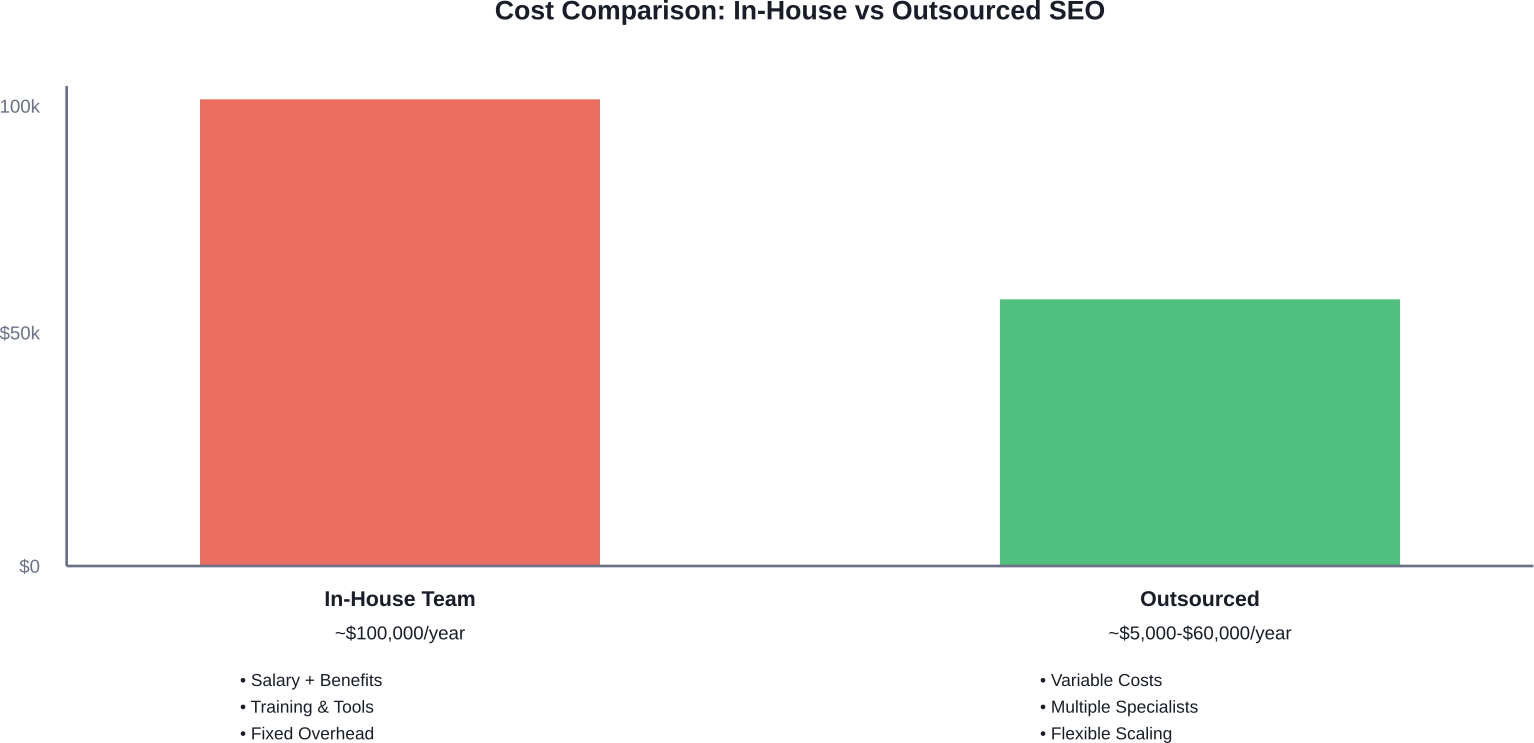
Building an in-house team means salaries, benefits, training, and tool subscriptions. A single SEO specialist earning $75,000 represents just the base cost. Add benefits (typically 30% of salary), training courses, and software subscriptions, and the total approaches $100,000 annually.
Outsourcing converts these fixed costs into variable expenses. Monthly retainers for outsourced SEO range from $500 for small-scale local work to $5,000+ for comprehensive campaigns. The flexibility helps businesses scale up during growth phases and scale down during slower periods.
That said, budget predictability cuts both ways. According to Search Engine Land, budget increases should typically stay within 10-20% to allow bidding algorithms to stabilize. The same principle applies to outsourced SEO—sudden budget changes can disrupt campaign momentum.
Access to Specialized Expertise
Search algorithms evolve constantly. Google releases multiple updates yearly, each potentially reshuffling rankings. Keeping pace demands continuous learning and adaptation—something difficult for small in-house teams.
According to HubSpot research, improving SEO and growing organic presence is identified as a top priority by a significant portion of marketers. Yet most lack the specialized skills to execute effectively across technical SEO, content optimization, and link acquisition.
Outsourcing agencies maintain teams with diverse specializations. One person handles technical audits, another manages content, a third focuses on link building. This depth of expertise rarely exists within single in-house hires.
Scalability and Flexibility
Seasonal businesses face a particular challenge. Demand spikes require more content and optimization work, but hiring full-time staff for temporary needs makes little sense.
Outsourced providers scale resources up or down based on project requirements. A business launching in new markets can temporarily increase content production without permanent hiring commitments. When the launch stabilizes, services can scale back to maintenance levels.
Access to tools represents another scalability advantage. Enterprise SEO platforms cost thousands monthly—expenses justified for agencies serving multiple clients but often prohibitive for individual businesses.
Potential Drawbacks of Outsourcing SEO
Outsourcing isn't universally beneficial. Certain challenges emerge regardless of provider quality.
Communication Gaps and Misaligned Expectations
Remote collaboration creates natural friction. Time zones complicate real-time communication. Cultural differences affect interpretation of feedback. Technical jargon gets lost in translation between business stakeholders and SEO specialists.
The problem intensifies when businesses lack internal SEO knowledge. Without baseline understanding, evaluating provider recommendations becomes difficult. An agency might suggest technical changes that sound reasonable but don't align with business priorities.
Quality Control Concerns
Outsourced work quality varies dramatically. According to Moz, there are at least 50 companies that have over $1 million in annual gross revenue that outsource almost all of their services, and many of them don't really have a true expert on staff. The person working on an account often isn't the experienced professional who closed the deal.
Content quality presents particular challenges. Generic blog posts produced at scale rarely match the depth and authenticity of material created by subject matter experts. Link building campaigns can cross into spammy territory if not properly supervised.
Loss of Institutional Knowledge
When external providers handle all optimization work, internal teams don't develop SEO competency. This creates dependency. If the relationship ends, the business lacks the knowledge to maintain momentum or evaluate new providers effectively.
Strategic insights also remain siloed. External providers don't absorb the deep business context that emerges from daily operations. They might optimize for keywords that drive traffic but miss opportunities more aligned with actual business goals.
How to Choose the Right SEO Outsourcing Partner
Provider selection determines whether outsourcing delivers value or becomes a budget drain. Several evaluation criteria separate effective partners from mediocre ones.
Verify Expertise and Track Record
Portfolio reviews reveal more than sales pitches. Ask for case studies with specific metrics: organic traffic growth, ranking improvements for competitive keywords, conversion rate changes. Vague claims about "improved visibility" don't count.
According to Moz's guidance on hiring local SEO agencies, the best partners are there when things go right AND when they go wrong. Request references specifically about problem resolution—how the agency handled algorithm updates, ranking drops, or technical issues.
Check whether the provider stays current with industry changes. Do team members speak at conferences? Publish research? Contribute to industry publications? Active participation signals genuine expertise versus surface-level knowledge.
Evaluate Communication Practices
Strong communication frameworks prevent most outsourcing failures. During evaluation, assess:
- Response time to initial inquiries (slow responses during sales suggest worse service after signing)
- Clarity of explanations when discussing technical topics
- Willingness to educate rather than simply execute
- Reporting format and frequency
- Availability for strategic discussions beyond routine updates
The Federal Trade Commission's Consumer Reviews and Testimonials Rule, which went into effect on October 21, 2024, also matters here. Legitimate providers don't suggest reviews must be positive to receive promised services. Ask how the agency handles client feedback and complaints.
Understand Service Scope and Limitations
Comprehensive doesn't mean better. Some agencies claim to handle everything from SEO to social media to paid advertising. Specialization often produces better results than generalized services.
Clarify exactly which tasks the provider will handle versus what remains internal. Will they only execute or also provide strategic guidance? Who owns the content created? What happens to built links if the relationship ends?
Assess Pricing Structure and Value
The lowest bid usually signals problems. Quality link building requires relationship capital that cheap providers don't possess. Content written for pennies per word lacks the research depth that drives results.
Monthly retainers offer more stability than project-based pricing for ongoing work. Retainers incentivize long-term thinking rather than quick wins that might damage site health.
Performance-based pricing sounds appealing but creates perverse incentives. Providers might chase easy rankings for low-value keywords rather than competitive terms that drive business impact. Check official websites for current pricing since subscription tiers change frequently.
Best Practices for Managing Outsourced SEO Work
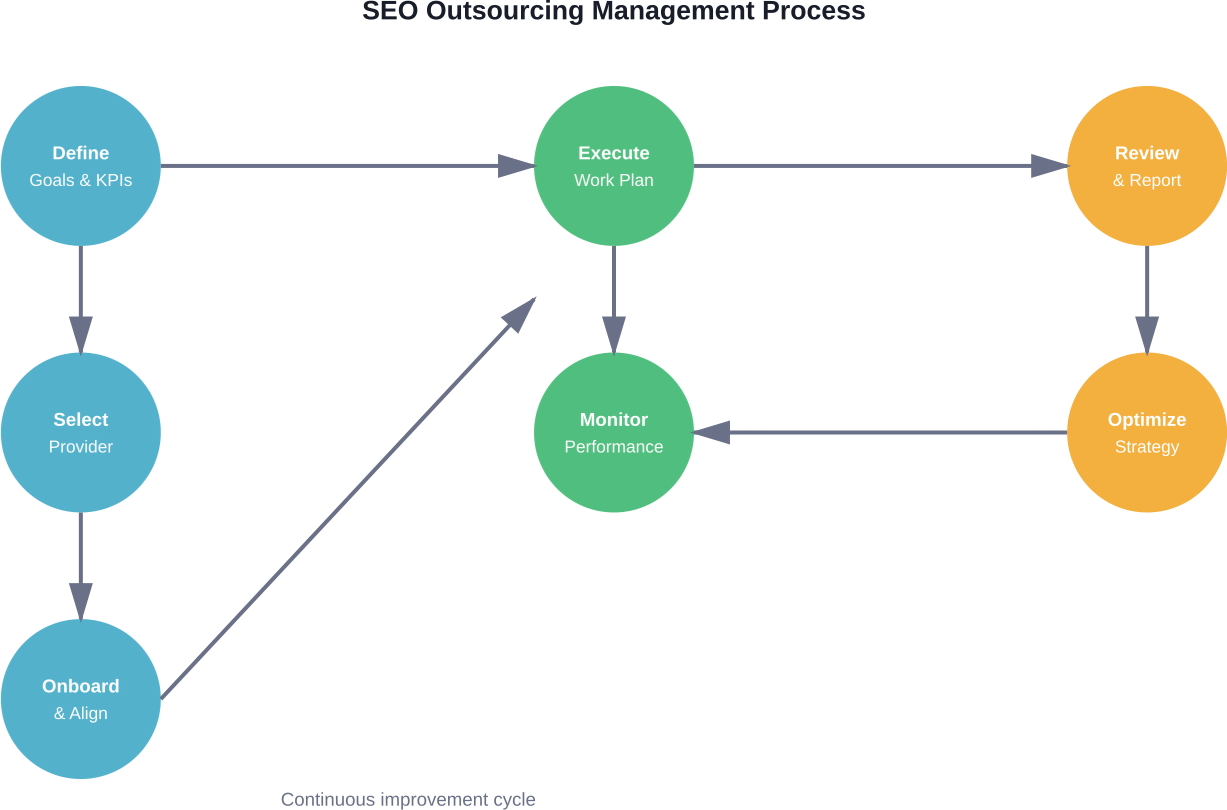
Hiring the right provider is half the equation. Effective management determines whether the relationship produces results.
Establish Clear KPIs and Reporting Cadence
Vague goals produce vague results. Define specific, measurable objectives before work begins. According to industry data, top-tier providers establish clear benchmarks, regularly monitor metrics, and present data in understandable formats. For example, tracking a 30% increase in organic traffic over six months following specific on-page optimization efforts.
Common KPIs for outsourced SEO include:
- Organic traffic growth (monthly and quarterly)
- Ranking positions for target keywords
- Domain authority and backlink profile growth
- Conversion rate from organic traffic
- Page load speed and Core Web Vitals scores
- Index coverage and crawl error resolution
Monthly reporting works for most arrangements. More frequent updates create noise; less frequent reporting loses momentum. Reports should compare current performance to baseline metrics and explain significant changes.
Maintain Strategic Oversight
Outsourcing execution doesn't mean abdicating strategy. Internal teams should retain ownership of overall direction while providers handle implementation.
As Moz notes in their discussion of SEO's three bosses, successful optimization requires answering to business needs, searcher intent, and search engine requirements simultaneously. External providers excel at the technical aspects but need guidance on business priorities.
Regular strategy sessions—quarterly at minimum—ensure alignment. These discussions should cover upcoming product launches, seasonal promotions, competitive moves, and other business factors that affect optimization priorities.
Foster Knowledge Transfer
The best outsourcing relationships build internal competency rather than creating dependency. Request explanations for major recommendations. Ask providers to document processes and train internal team members on basic maintenance tasks.
This approach protects against provider transitions while improving collaboration quality. Internal team members who understand SEO fundamentals provide better briefings and catch potential issues earlier.
Address Issues Promptly
Problems compound when left unaddressed. If reporting becomes inconsistent, rankings drop unexpectedly, or communication slows, raise concerns immediately rather than waiting for scheduled reviews.
Document issues clearly with specific examples. "Results aren't good enough" provides no actionable direction. "Organic traffic declined 15% last month despite the content publication schedule remaining consistent" focuses the conversation productively.
Most legitimate providers respond constructively to specific feedback. Defensiveness or dismissal of concerns signals relationship problems that likely won't improve.

Reduce SEO Costs Without Losing Control of Execution
Lowering SEO costs usually sounds simple until delivery starts slipping. Deadlines move, context gets lost between handoffs, and small gaps begin to affect results more than expected.
NeoWork is set up to avoid that kind of drift. Instead of splitting work across multiple vendors, they build a dedicated team that stays with your SEO over time. The same people handle tasks, keep track of what’s been done, and adjust without needing constant re-briefing. With a 3.2% selection rate, the emphasis is on people who can take ownership of ongoing work, while a 91% retention rate keeps that continuity in place.
If you want to reduce costs without dealing with scattered execution, reach out to NeoWork and talk through how they can support your SEO setup.
Common Outsourcing Mistakes to Avoid
Several failure patterns repeat across unsuccessful outsourcing arrangements. Recognizing these patterns early prevents wasted time and budget.
Choosing Based Solely on Price
The cheapest option rarely delivers value. Rock-bottom pricing indicates corners cut somewhere—inexperienced staff, automated tools instead of strategic thinking, or black-hat techniques that risk penalties.
As industry analysis notes, companies should focus on value rather than cost alone. A provider charging $2,000 monthly that drives measurable revenue growth outperforms a $500 provider that produces no business impact.
Neglecting to Define Success Metrics
"Improve our SEO" isn't a success metric. Without specific targets, providers optimize for whatever metrics make their reports look good—often vanity metrics disconnected from business outcomes.
Before engaging any provider, define what success looks like. Is it 50% more organic traffic? First-page rankings for three specific keywords? 20% reduction in cost per acquisition from organic channels? Clear targets enable evaluation.
Expecting Immediate Results
SEO produces results over months, not weeks. New content needs time to be crawled and indexed. Links accumulate gradually. Authority builds through sustained effort.
According to Search Engine Land's guidance on scaling campaigns, budget increases should stay within 10-20% to allow algorithms to stabilize. The same patience applies to SEO work—expecting immediate spikes leads to disappointment and premature provider changes that restart the timeline.
Realistic expectations for SEO timelines:
- Initial audit and strategy: 2-4 weeks
- Technical fixes and on-page optimization: 1-3 months
- Content production and publication: Ongoing, 2-4 weeks per piece
- Link building momentum: 3-6 months for meaningful results
- Measurable organic traffic growth: 4-8 months minimum
- Competitive keyword rankings: 6-12 months
Providing Insufficient Business Context
External providers can't read minds. They need detailed briefings on business models, target audiences, competitive landscape, and strategic priorities.
The more context provided upfront, the better the alignment between optimization work and business goals. Share product roadmaps, seasonal patterns, customer research, and anything else that helps providers understand what drives actual business value.
Failing to Maintain Ownership of Assets
Who owns content created during the engagement? What happens to built links if the relationship ends? Can the business access all tools and accounts directly?
Establish ownership terms explicitly in contracts. Content should be business property. Link relationships should be transparent. Access to analytics, Search Console, and other tools should never be exclusive to the provider.
In-House vs Outsourced vs Hybrid Approach
The binary choice between full in-house or complete outsourcing misses a middle option that often works best.
When to Keep SEO In-House
Certain situations favor internal teams despite higher costs. Complex businesses with unique products or services benefit from in-house specialists who develop deep domain expertise. Companies with sensitive data or strict compliance requirements might find outsourcing too risky.
Large enterprises with substantial organic traffic often justify in-house teams economically. When SEO impacts millions in revenue, having dedicated internal resources makes sense.
When to Fully Outsource
Small businesses and startups rarely justify full-time SEO staff. Outsourcing provides access to expertise that would be financially impossible to hire directly.
Businesses with straightforward products in established markets also benefit from outsourcing. Local service businesses, e-commerce stores with clear product categories, and companies in less competitive niches can achieve strong results through external providers.
The Hybrid Model Advantage
Many successful businesses blend approaches. They maintain strategic oversight and content creation internally while outsourcing technical audits, link building, and specialized tasks.
This model preserves strategic control and institutional knowledge while accessing specialized capabilities cost-effectively. A single internal coordinator manages relationships and integrates outsourced work into broader marketing efforts.
White Label SEO: A Special Case for Agencies
Marketing agencies face unique outsourcing considerations. Many offer SEO services to clients without maintaining full in-house capabilities.
White label providers handle SEO work that agencies resell under their own brand. The client relationship stays with the agency while execution happens behind the scenes.
This arrangement allows small agencies to compete with larger firms offering comprehensive services. Rather than turning away SEO clients, they deliver through partnerships while maintaining client relationships.
The risks? Quality control becomes more difficult. The agency depends on the white label provider but lacks direct oversight of work. If the provider delivers poor results, the agency's reputation suffers even though they didn't do the work.
Successful white label arrangements require:
- Thorough vetting of the white label provider's capabilities and processes
- Clear communication protocols between agency, provider, and client
- Transparent reporting that the agency can customize for client presentation
- Realistic expectation-setting with clients about timelines and outcomes
- Contractual protections around quality standards and deliverables
Outsourcing SEO for Different Business Types
Optimal outsourcing approaches vary by business model and industry.
E-commerce Businesses
Online retailers benefit from outsourcing technical SEO and link building while maintaining product descriptions and category pages internally. Product expertise matters for conversion-focused content.
Seasonal fluctuations make outsourcing particularly valuable. Agencies can scale content production before high-demand periods without permanent hiring commitments.
Local Service Businesses
According to Moz's guidance on local SEO agencies, businesses with physical locations need providers who understand local search factors—Google Business Profile optimization, local citations, review management, and geo-targeted content.
Local businesses should prioritize agencies with geographic expertise in their markets. Understanding regional search patterns and local link opportunities produces better results than generic approaches.
B2B Companies
Business-to-business companies face longer sales cycles and more complex buyer journeys. Content needs to address multiple stakeholder concerns and demonstrate deep industry knowledge.
Hybrid approaches work well here. Internal subject matter experts provide content foundation while external providers handle optimization, distribution, and link building.
SaaS and Technology Companies
Software companies need technical content that explains complex products clearly. This specialized writing often stays in-house or requires freelancers with industry background.
Technical SEO audits and link building campaigns outsource well. The technical nature of these tasks aligns with external specialist capabilities.
Vetting Outsourced Work Quality
How do businesses without deep SEO knowledge evaluate whether outsourced work meets standards?
Content Quality Checks
Published content should demonstrate research depth, not just keyword stuffing. Look for:
- Specific examples and data points
- Proper sourcing and citations
- Natural keyword integration without awkward phrasing
- Logical structure with clear subtopics
- Actionable information readers can apply
Run content through plagiarism checkers. Original content is non-negotiable. Also verify that content aligns with brand voice and positioning.
Link Quality Assessment
Not all backlinks provide value. Spammy links from low-quality sites can trigger penalties. Evaluate built links by:
- Domain authority of linking sites (use Moz or Ahrefs metrics)
- Relevance of linking content to business niche
- Anchor text diversity (over-optimization with exact-match anchors signals manipulation)
- Link placement (editorial links in main content vs. sidebar/footer)
- Site traffic and engagement of linking domains
Request complete link reports monthly. Transparency about link sources indicates legitimate practices.
Technical Implementation Review
Technical recommendations should include clear explanations of why changes matter and expected impact. Vague advice like "improve site speed" without specific guidance suggests surface-level analysis.
Legitimate technical audits identify specific issues: uncompressed images, render-blocking JavaScript, missing schema markup, crawl errors, broken links. Each finding should include implementation guidance.
The Future of SEO Outsourcing
Several trends are reshaping how businesses approach outsourced optimization work.
AI-Assisted SEO Services
Artificial intelligence tools increasingly handle routine optimization tasks. Keyword research, content outlining, and technical audits benefit from AI acceleration.
According to research on link building OKRs, implementing ChatGPT into outreach and list building can streamline repetitive tasks, saving at least 10 hours of manual work weekly and reallocating time toward strategic initiatives.
Smart outsourcing providers leverage AI for efficiency while maintaining human oversight for strategy and quality control. This combination delivers faster results at lower costs without sacrificing effectiveness.
Specialization Over Generalization
The days of generalist SEO agencies are fading. Businesses increasingly seek specialists: local SEO experts, e-commerce optimization specialists, technical SEO consultants, link building agencies.
This specialization produces better results but requires businesses to potentially work with multiple providers for comprehensive coverage. Coordination complexity increases, making strong internal project management more valuable.
Performance-Based and Hybrid Pricing
Traditional monthly retainers are evolving. Some providers offer hybrid models: base retainer plus performance bonuses tied to specific outcomes. Others charge per successful link placement or content piece that ranks.
These models align incentives better but require careful contract structuring to prevent gaming of metrics. Clear definitions of what constitutes success prevent disputes.
Conclusion: Making Outsourcing Work for Your Business
SEO outsourcing offers legitimate advantages—cost savings averaging 60%, access to specialized expertise, and operational flexibility that in-house teams can't match. But success requires more than writing a check to an agency.
The businesses that benefit most from outsourcing maintain strategic oversight while delegating execution. They establish clear success metrics before engaging providers. They communicate openly and frequently. And they recognize that SEO produces results over months through sustained effort, not overnight through shortcuts.
Start by honestly assessing internal capabilities. What SEO functions could the team realistically handle versus where external help would add most value? Use that analysis to determine whether full outsourcing, a hybrid approach, or primarily in-house work makes sense.
When ready to engage a provider, prioritize expertise and communication over cost savings. The cheapest option rarely delivers value. Invest time in thorough vetting—check portfolios, verify references, and ensure alignment on goals and methods before committing.
Then manage the relationship actively. Review reports critically, ask questions about strategies and results, and provide the business context external providers need to optimize effectively. The best outcomes emerge from partnerships, not vendor relationships.
Done correctly, outsourcing SEO services provides capabilities that would be financially impossible to build internally while preserving the strategic control that drives business-aligned results. The key is approaching it as a strategic partnership requiring ongoing management rather than a hands-off solution to be set and forgotten.
Frequently Asked Questions
Topics
SEO Services Outsourcing Guide: Save 60% & Get Results

Outsourcing SEO services can reduce costs by up to 60% compared to in-house teams while providing access to specialized expertise and advanced tools. This guide covers how to choose the right outsourcing partner, avoid common pitfalls, and implement best practices for managing outsourced SEO work. The key is balancing cost efficiency with quality control through clear communication, measurable KPIs, and strategic vendor selection.
Managing search engine optimization in-house can drain budgets faster than most businesses anticipate. An in-house SEO specialist costs around $75,000 annually, but outsourcing can slash that figure to $30,000—a 60% reduction in overhead. Beyond the raw numbers, there's the hidden expense of hiring, training, and retaining talent in a field where algorithms shift quarterly.
But cost savings alone don't justify the move. Outsourcing provides access to specialized skills, established workflows, and tools that cost thousands per month individually. The challenge? Not all outsourcing arrangements deliver. Some businesses hand off their SEO to agencies only to see minimal results and opaque reporting.
This guide breaks down how to outsource SEO services correctly. It covers what to look for in a provider, which services are worth outsourcing, and how to avoid the most common mistakes that waste budgets.
What Is SEO Outsourcing?
SEO outsourcing means hiring external specialists, agencies, or consultants to handle search optimization tasks instead of building an internal team. These tasks range from technical audits and keyword research to content creation and link building.
The arrangement can take several forms. Some businesses hire full-service agencies that manage every aspect of SEO. Others bring in freelancers for specific tasks like guest blogging or local optimization. White label providers allow agencies to resell SEO services under their own brand without doing the work themselves.
Before engaging any external provider, mark out 30 minutes on your calendar for slowly reading through the Guidelines for representing your business on Google, as recommended by Moz. These guidelines are as fundamental to SEO as looking at a trail map would be before heading off into unfamiliar territory.
Types of Outsourced SEO Services
Not every service makes sense to outsource. Strategic work often stays in-house, while execution-heavy tasks benefit from external specialists.
Link building stands out as the most commonly outsourced function. Research shows that approximately 60% of SEO agencies outsource at least some part of their link building or content work. The reason? Managing outreach campaigns requires expensive tools like Ahrefs, Semrush, Hunter.io, and Pitchbox—costs that easily exceed $500 monthly or $6,000 annually.
Why Businesses Outsource SEO Services
The decision to outsource comes down to three core factors: cost, expertise, and scalability. Each plays out differently depending on business size and goals.
Cost Efficiency and Budget Predictability
Building an in-house team means salaries, benefits, training, and tool subscriptions. A single SEO specialist earning $75,000 represents just the base cost. Add benefits (typically 30% of salary), training courses, and software subscriptions, and the total approaches $100,000 annually.
Outsourcing converts these fixed costs into variable expenses. Monthly retainers for outsourced SEO range from $500 for small-scale local work to $5,000+ for comprehensive campaigns. The flexibility helps businesses scale up during growth phases and scale down during slower periods.
That said, budget predictability cuts both ways. According to Search Engine Land, budget increases should typically stay within 10-20% to allow bidding algorithms to stabilize. The same principle applies to outsourced SEO—sudden budget changes can disrupt campaign momentum.
Access to Specialized Expertise
Search algorithms evolve constantly. Google releases multiple updates yearly, each potentially reshuffling rankings. Keeping pace demands continuous learning and adaptation—something difficult for small in-house teams.
According to HubSpot research, improving SEO and growing organic presence is identified as a top priority by a significant portion of marketers. Yet most lack the specialized skills to execute effectively across technical SEO, content optimization, and link acquisition.
Outsourcing agencies maintain teams with diverse specializations. One person handles technical audits, another manages content, a third focuses on link building. This depth of expertise rarely exists within single in-house hires.
Scalability and Flexibility
Seasonal businesses face a particular challenge. Demand spikes require more content and optimization work, but hiring full-time staff for temporary needs makes little sense.
Outsourced providers scale resources up or down based on project requirements. A business launching in new markets can temporarily increase content production without permanent hiring commitments. When the launch stabilizes, services can scale back to maintenance levels.
Access to tools represents another scalability advantage. Enterprise SEO platforms cost thousands monthly—expenses justified for agencies serving multiple clients but often prohibitive for individual businesses.
Potential Drawbacks of Outsourcing SEO
Outsourcing isn't universally beneficial. Certain challenges emerge regardless of provider quality.
Communication Gaps and Misaligned Expectations
Remote collaboration creates natural friction. Time zones complicate real-time communication. Cultural differences affect interpretation of feedback. Technical jargon gets lost in translation between business stakeholders and SEO specialists.
The problem intensifies when businesses lack internal SEO knowledge. Without baseline understanding, evaluating provider recommendations becomes difficult. An agency might suggest technical changes that sound reasonable but don't align with business priorities.
Quality Control Concerns
Outsourced work quality varies dramatically. According to Moz, there are at least 50 companies that have over $1 million in annual gross revenue that outsource almost all of their services, and many of them don't really have a true expert on staff. The person working on an account often isn't the experienced professional who closed the deal.
Content quality presents particular challenges. Generic blog posts produced at scale rarely match the depth and authenticity of material created by subject matter experts. Link building campaigns can cross into spammy territory if not properly supervised.
Loss of Institutional Knowledge
When external providers handle all optimization work, internal teams don't develop SEO competency. This creates dependency. If the relationship ends, the business lacks the knowledge to maintain momentum or evaluate new providers effectively.
Strategic insights also remain siloed. External providers don't absorb the deep business context that emerges from daily operations. They might optimize for keywords that drive traffic but miss opportunities more aligned with actual business goals.
How to Choose the Right SEO Outsourcing Partner
Provider selection determines whether outsourcing delivers value or becomes a budget drain. Several evaluation criteria separate effective partners from mediocre ones.
Verify Expertise and Track Record
Portfolio reviews reveal more than sales pitches. Ask for case studies with specific metrics: organic traffic growth, ranking improvements for competitive keywords, conversion rate changes. Vague claims about "improved visibility" don't count.
According to Moz's guidance on hiring local SEO agencies, the best partners are there when things go right AND when they go wrong. Request references specifically about problem resolution—how the agency handled algorithm updates, ranking drops, or technical issues.
Check whether the provider stays current with industry changes. Do team members speak at conferences? Publish research? Contribute to industry publications? Active participation signals genuine expertise versus surface-level knowledge.
Evaluate Communication Practices
Strong communication frameworks prevent most outsourcing failures. During evaluation, assess:
- Response time to initial inquiries (slow responses during sales suggest worse service after signing)
- Clarity of explanations when discussing technical topics
- Willingness to educate rather than simply execute
- Reporting format and frequency
- Availability for strategic discussions beyond routine updates
The Federal Trade Commission's Consumer Reviews and Testimonials Rule, which went into effect on October 21, 2024, also matters here. Legitimate providers don't suggest reviews must be positive to receive promised services. Ask how the agency handles client feedback and complaints.
Understand Service Scope and Limitations
Comprehensive doesn't mean better. Some agencies claim to handle everything from SEO to social media to paid advertising. Specialization often produces better results than generalized services.
Clarify exactly which tasks the provider will handle versus what remains internal. Will they only execute or also provide strategic guidance? Who owns the content created? What happens to built links if the relationship ends?
Assess Pricing Structure and Value
The lowest bid usually signals problems. Quality link building requires relationship capital that cheap providers don't possess. Content written for pennies per word lacks the research depth that drives results.
Monthly retainers offer more stability than project-based pricing for ongoing work. Retainers incentivize long-term thinking rather than quick wins that might damage site health.
Performance-based pricing sounds appealing but creates perverse incentives. Providers might chase easy rankings for low-value keywords rather than competitive terms that drive business impact. Check official websites for current pricing since subscription tiers change frequently.
Best Practices for Managing Outsourced SEO Work
Hiring the right provider is half the equation. Effective management determines whether the relationship produces results.
Establish Clear KPIs and Reporting Cadence
Vague goals produce vague results. Define specific, measurable objectives before work begins. According to industry data, top-tier providers establish clear benchmarks, regularly monitor metrics, and present data in understandable formats. For example, tracking a 30% increase in organic traffic over six months following specific on-page optimization efforts.
Common KPIs for outsourced SEO include:
- Organic traffic growth (monthly and quarterly)
- Ranking positions for target keywords
- Domain authority and backlink profile growth
- Conversion rate from organic traffic
- Page load speed and Core Web Vitals scores
- Index coverage and crawl error resolution
Monthly reporting works for most arrangements. More frequent updates create noise; less frequent reporting loses momentum. Reports should compare current performance to baseline metrics and explain significant changes.
Maintain Strategic Oversight
Outsourcing execution doesn't mean abdicating strategy. Internal teams should retain ownership of overall direction while providers handle implementation.
As Moz notes in their discussion of SEO's three bosses, successful optimization requires answering to business needs, searcher intent, and search engine requirements simultaneously. External providers excel at the technical aspects but need guidance on business priorities.
Regular strategy sessions—quarterly at minimum—ensure alignment. These discussions should cover upcoming product launches, seasonal promotions, competitive moves, and other business factors that affect optimization priorities.
Foster Knowledge Transfer
The best outsourcing relationships build internal competency rather than creating dependency. Request explanations for major recommendations. Ask providers to document processes and train internal team members on basic maintenance tasks.
This approach protects against provider transitions while improving collaboration quality. Internal team members who understand SEO fundamentals provide better briefings and catch potential issues earlier.
Address Issues Promptly
Problems compound when left unaddressed. If reporting becomes inconsistent, rankings drop unexpectedly, or communication slows, raise concerns immediately rather than waiting for scheduled reviews.
Document issues clearly with specific examples. "Results aren't good enough" provides no actionable direction. "Organic traffic declined 15% last month despite the content publication schedule remaining consistent" focuses the conversation productively.
Most legitimate providers respond constructively to specific feedback. Defensiveness or dismissal of concerns signals relationship problems that likely won't improve.
Reduce SEO Costs Without Losing Control of Execution
Lowering SEO costs usually sounds simple until delivery starts slipping. Deadlines move, context gets lost between handoffs, and small gaps begin to affect results more than expected.
NeoWork is set up to avoid that kind of drift. Instead of splitting work across multiple vendors, they build a dedicated team that stays with your SEO over time. The same people handle tasks, keep track of what’s been done, and adjust without needing constant re-briefing. With a 3.2% selection rate, the emphasis is on people who can take ownership of ongoing work, while a 91% retention rate keeps that continuity in place.
If you want to reduce costs without dealing with scattered execution, reach out to NeoWork and talk through how they can support your SEO setup.
Common Outsourcing Mistakes to Avoid
Several failure patterns repeat across unsuccessful outsourcing arrangements. Recognizing these patterns early prevents wasted time and budget.
Choosing Based Solely on Price
The cheapest option rarely delivers value. Rock-bottom pricing indicates corners cut somewhere—inexperienced staff, automated tools instead of strategic thinking, or black-hat techniques that risk penalties.
As industry analysis notes, companies should focus on value rather than cost alone. A provider charging $2,000 monthly that drives measurable revenue growth outperforms a $500 provider that produces no business impact.
Neglecting to Define Success Metrics
"Improve our SEO" isn't a success metric. Without specific targets, providers optimize for whatever metrics make their reports look good—often vanity metrics disconnected from business outcomes.
Before engaging any provider, define what success looks like. Is it 50% more organic traffic? First-page rankings for three specific keywords? 20% reduction in cost per acquisition from organic channels? Clear targets enable evaluation.
Expecting Immediate Results
SEO produces results over months, not weeks. New content needs time to be crawled and indexed. Links accumulate gradually. Authority builds through sustained effort.
According to Search Engine Land's guidance on scaling campaigns, budget increases should stay within 10-20% to allow algorithms to stabilize. The same patience applies to SEO work—expecting immediate spikes leads to disappointment and premature provider changes that restart the timeline.
Realistic expectations for SEO timelines:
- Initial audit and strategy: 2-4 weeks
- Technical fixes and on-page optimization: 1-3 months
- Content production and publication: Ongoing, 2-4 weeks per piece
- Link building momentum: 3-6 months for meaningful results
- Measurable organic traffic growth: 4-8 months minimum
- Competitive keyword rankings: 6-12 months
Providing Insufficient Business Context
External providers can't read minds. They need detailed briefings on business models, target audiences, competitive landscape, and strategic priorities.
The more context provided upfront, the better the alignment between optimization work and business goals. Share product roadmaps, seasonal patterns, customer research, and anything else that helps providers understand what drives actual business value.
Failing to Maintain Ownership of Assets
Who owns content created during the engagement? What happens to built links if the relationship ends? Can the business access all tools and accounts directly?
Establish ownership terms explicitly in contracts. Content should be business property. Link relationships should be transparent. Access to analytics, Search Console, and other tools should never be exclusive to the provider.
In-House vs Outsourced vs Hybrid Approach
The binary choice between full in-house or complete outsourcing misses a middle option that often works best.
When to Keep SEO In-House
Certain situations favor internal teams despite higher costs. Complex businesses with unique products or services benefit from in-house specialists who develop deep domain expertise. Companies with sensitive data or strict compliance requirements might find outsourcing too risky.
Large enterprises with substantial organic traffic often justify in-house teams economically. When SEO impacts millions in revenue, having dedicated internal resources makes sense.
When to Fully Outsource
Small businesses and startups rarely justify full-time SEO staff. Outsourcing provides access to expertise that would be financially impossible to hire directly.
Businesses with straightforward products in established markets also benefit from outsourcing. Local service businesses, e-commerce stores with clear product categories, and companies in less competitive niches can achieve strong results through external providers.
The Hybrid Model Advantage
Many successful businesses blend approaches. They maintain strategic oversight and content creation internally while outsourcing technical audits, link building, and specialized tasks.
This model preserves strategic control and institutional knowledge while accessing specialized capabilities cost-effectively. A single internal coordinator manages relationships and integrates outsourced work into broader marketing efforts.
White Label SEO: A Special Case for Agencies
Marketing agencies face unique outsourcing considerations. Many offer SEO services to clients without maintaining full in-house capabilities.
White label providers handle SEO work that agencies resell under their own brand. The client relationship stays with the agency while execution happens behind the scenes.
This arrangement allows small agencies to compete with larger firms offering comprehensive services. Rather than turning away SEO clients, they deliver through partnerships while maintaining client relationships.
The risks? Quality control becomes more difficult. The agency depends on the white label provider but lacks direct oversight of work. If the provider delivers poor results, the agency's reputation suffers even though they didn't do the work.
Successful white label arrangements require:
- Thorough vetting of the white label provider's capabilities and processes
- Clear communication protocols between agency, provider, and client
- Transparent reporting that the agency can customize for client presentation
- Realistic expectation-setting with clients about timelines and outcomes
- Contractual protections around quality standards and deliverables
Outsourcing SEO for Different Business Types
Optimal outsourcing approaches vary by business model and industry.
E-commerce Businesses
Online retailers benefit from outsourcing technical SEO and link building while maintaining product descriptions and category pages internally. Product expertise matters for conversion-focused content.
Seasonal fluctuations make outsourcing particularly valuable. Agencies can scale content production before high-demand periods without permanent hiring commitments.
Local Service Businesses
According to Moz's guidance on local SEO agencies, businesses with physical locations need providers who understand local search factors—Google Business Profile optimization, local citations, review management, and geo-targeted content.
Local businesses should prioritize agencies with geographic expertise in their markets. Understanding regional search patterns and local link opportunities produces better results than generic approaches.
B2B Companies
Business-to-business companies face longer sales cycles and more complex buyer journeys. Content needs to address multiple stakeholder concerns and demonstrate deep industry knowledge.
Hybrid approaches work well here. Internal subject matter experts provide content foundation while external providers handle optimization, distribution, and link building.
SaaS and Technology Companies
Software companies need technical content that explains complex products clearly. This specialized writing often stays in-house or requires freelancers with industry background.
Technical SEO audits and link building campaigns outsource well. The technical nature of these tasks aligns with external specialist capabilities.
Vetting Outsourced Work Quality
How do businesses without deep SEO knowledge evaluate whether outsourced work meets standards?
Content Quality Checks
Published content should demonstrate research depth, not just keyword stuffing. Look for:
- Specific examples and data points
- Proper sourcing and citations
- Natural keyword integration without awkward phrasing
- Logical structure with clear subtopics
- Actionable information readers can apply
Run content through plagiarism checkers. Original content is non-negotiable. Also verify that content aligns with brand voice and positioning.
Link Quality Assessment
Not all backlinks provide value. Spammy links from low-quality sites can trigger penalties. Evaluate built links by:
- Domain authority of linking sites (use Moz or Ahrefs metrics)
- Relevance of linking content to business niche
- Anchor text diversity (over-optimization with exact-match anchors signals manipulation)
- Link placement (editorial links in main content vs. sidebar/footer)
- Site traffic and engagement of linking domains
Request complete link reports monthly. Transparency about link sources indicates legitimate practices.
Technical Implementation Review
Technical recommendations should include clear explanations of why changes matter and expected impact. Vague advice like "improve site speed" without specific guidance suggests surface-level analysis.
Legitimate technical audits identify specific issues: uncompressed images, render-blocking JavaScript, missing schema markup, crawl errors, broken links. Each finding should include implementation guidance.
The Future of SEO Outsourcing
Several trends are reshaping how businesses approach outsourced optimization work.
AI-Assisted SEO Services
Artificial intelligence tools increasingly handle routine optimization tasks. Keyword research, content outlining, and technical audits benefit from AI acceleration.
According to research on link building OKRs, implementing ChatGPT into outreach and list building can streamline repetitive tasks, saving at least 10 hours of manual work weekly and reallocating time toward strategic initiatives.
Smart outsourcing providers leverage AI for efficiency while maintaining human oversight for strategy and quality control. This combination delivers faster results at lower costs without sacrificing effectiveness.
Specialization Over Generalization
The days of generalist SEO agencies are fading. Businesses increasingly seek specialists: local SEO experts, e-commerce optimization specialists, technical SEO consultants, link building agencies.
This specialization produces better results but requires businesses to potentially work with multiple providers for comprehensive coverage. Coordination complexity increases, making strong internal project management more valuable.
Performance-Based and Hybrid Pricing
Traditional monthly retainers are evolving. Some providers offer hybrid models: base retainer plus performance bonuses tied to specific outcomes. Others charge per successful link placement or content piece that ranks.
These models align incentives better but require careful contract structuring to prevent gaming of metrics. Clear definitions of what constitutes success prevent disputes.
Conclusion: Making Outsourcing Work for Your Business
SEO outsourcing offers legitimate advantages—cost savings averaging 60%, access to specialized expertise, and operational flexibility that in-house teams can't match. But success requires more than writing a check to an agency.
The businesses that benefit most from outsourcing maintain strategic oversight while delegating execution. They establish clear success metrics before engaging providers. They communicate openly and frequently. And they recognize that SEO produces results over months through sustained effort, not overnight through shortcuts.
Start by honestly assessing internal capabilities. What SEO functions could the team realistically handle versus where external help would add most value? Use that analysis to determine whether full outsourcing, a hybrid approach, or primarily in-house work makes sense.
When ready to engage a provider, prioritize expertise and communication over cost savings. The cheapest option rarely delivers value. Invest time in thorough vetting—check portfolios, verify references, and ensure alignment on goals and methods before committing.
Then manage the relationship actively. Review reports critically, ask questions about strategies and results, and provide the business context external providers need to optimize effectively. The best outcomes emerge from partnerships, not vendor relationships.
Done correctly, outsourcing SEO services provides capabilities that would be financially impossible to build internally while preserving the strategic control that drives business-aligned results. The key is approaching it as a strategic partnership requiring ongoing management rather than a hands-off solution to be set and forgotten.
Frequently Asked Questions
Topics
Related Blogs
Related Podcasts


.webp)
.webp)



