

.avif)
.avif)

Software Development Team Augmentation Guide for 2026


.svg)

Quick Summary: Software development team augmentation lets companies plug external engineers directly into an existing team to close skill gaps, speed up delivery, and scale headcount without the overhead of full-time hiring. It works best when the in-house team keeps control of architecture and product decisions while augmented specialists handle execution. Done right, it cuts time-to-hire from months to weeks and keeps projects moving without ballooning payroll.
Hiring a senior backend engineer in 2026 can take anywhere from six to twelve weeks, and that's if the role gets filled at all. Meanwhile the backlog keeps growing, the roadmap slips, and leadership wants answers. This is exactly the gap software development team augmentation was built to close.
Unlike full outsourcing, where an external vendor owns an entire project, team augmentation adds individual engineers or small pods directly into an existing team. They join daily standups, use the same tools, and answer to the same product owner. The company keeps control; the augmented talent just adds capacity.
This guide breaks down what team augmentation actually is, how it differs from staff augmentation and outsourcing, when it makes sense, the real challenges teams run into, and how to manage the whole thing without losing quality or momentum.
What Is Software Development Team Augmentation?
Software development team augmentation is a staffing model where a company brings in external developers, designers, QA engineers, or DevOps specialists to work alongside its internal team under its own management and processes. The augmented staff aren't a separate vendor team running a parallel project — they're embedded into the existing workflow.
Think of it less like hiring a contractor to build a house and more like borrowing a few skilled tradespeople who show up on-site, follow the existing blueprint, and report to the same foreman. That's the core distinction that trips people up when comparing this model to traditional outsourcing.
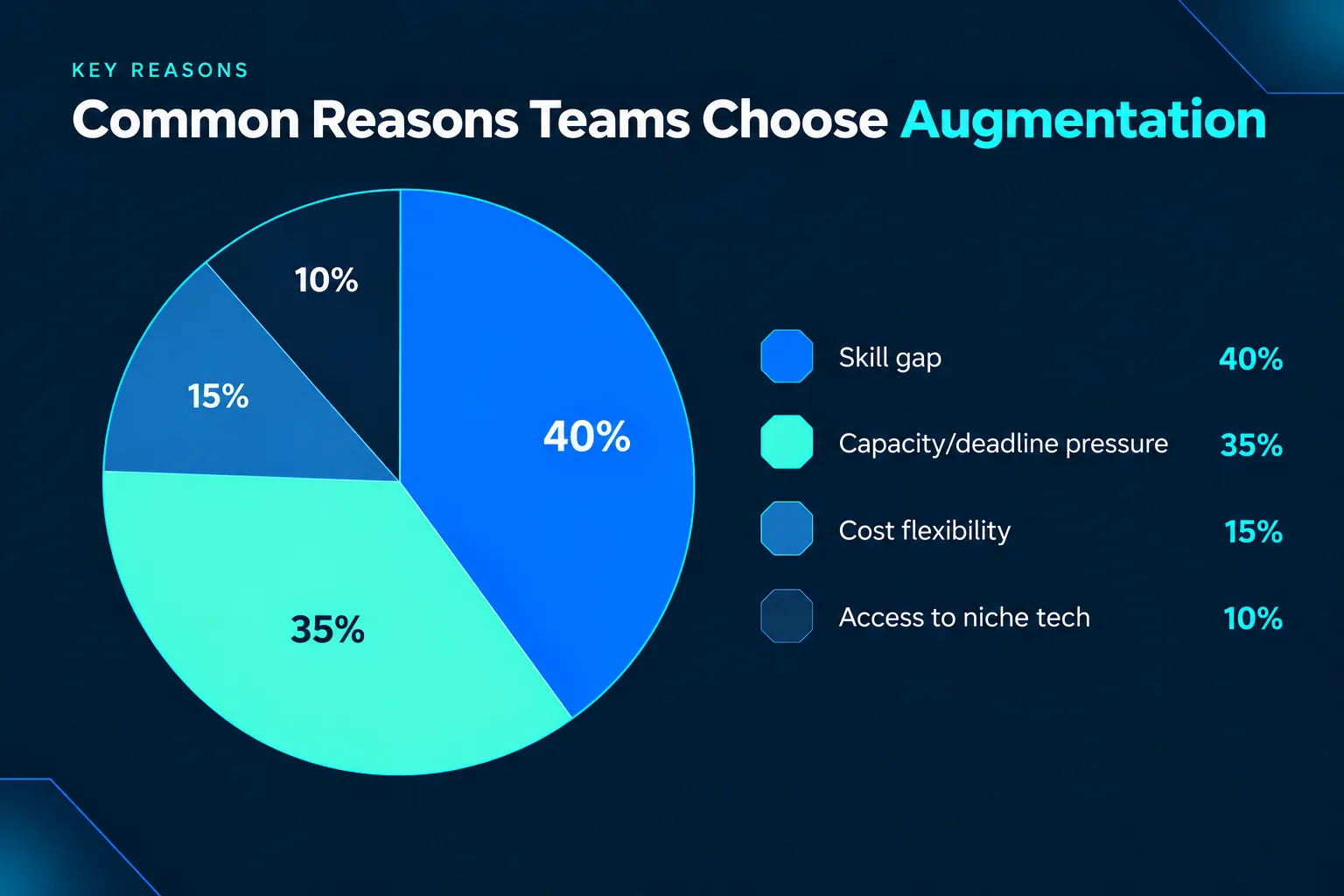
Most companies turn to augmentation for one of three reasons: a skills gap (nobody in-house knows Kubernetes well enough), a capacity gap (the roadmap has more work than hands), or a timing gap (a launch date can't move but hiring takes too long). So which one fits a given situation? That question alone usually determines whether augmentation, project outsourcing, or straight-up hiring is the right call.
Team Augmentation vs. Staff Augmentation vs. Outsourcing
These terms get used almost interchangeably, but there are real differences worth knowing before signing a contract.
Staff augmentation and team augmentation are, in practice, the same idea. Some vendors use "staff" for individual placements and "team" when a whole pod — say, two developers, a QA engineer, and a scrum master — joins together. The distinction matters less than understanding that control stays internal either way.

Expand Software Development Teams with NeoWork
Software development team augmentation helps companies add technical capacity without hiring every role internally. NeoWork provides remote professionals across software engineering, data science, cloud architecture, and related technical functions. NeoWork handles recruitment, benefits, training, and ongoing engagement, while teammates integrate into the client’s systems, tools, and development workflows. Its 91% annualized teammate retention rate and 3.2% candidate selectivity rate reflect a focus on selective hiring and longer-term team stability.
NeoWork's software development team model offers:
- software engineering and technical talent
- integration with the client’s tools and processes
- recruitment and ongoing teammate support
Contact NeoWork to expand your software development team around current product and delivery needs.
Benefits of Team Augmentation
The appeal isn't just speed, though that's the headline benefit most companies notice first.
- Faster time-to-productivity. Augmented engineers are typically pre-vetted, so onboarding takes days, not months.
- Access to niche skills. Specialized expertise in areas like machine learning ops or legacy system migration doesn't need to be a permanent headcount line.
- Cost flexibility. Teams scale up during crunch periods and scale down after launch, without severance costs or idle payroll.
- Knowledge stays in-house. Because augmented staff work inside existing processes, institutional knowledge and architecture decisions remain with the core team.
- Lower hiring risk. A bad fit can be swapped out far more easily than a full-time employee can be let go.
Cost is usually the number leadership fixates on, but it's rarely the deciding factor once teams have actually tried the model. Speed and flexibility tend to matter more once the first project ships.
How Software Development Team Augmentation Actually Works
The mechanics are fairly consistent across vendors, even if the marketing language varies.
- Define the gap. Get specific about the skill, seniority level, and time commitment needed — vague requests lead to vague matches.
- Shortlist and interview. Most reputable providers offer a pool of pre-vetted candidates within days; the hiring team still interviews and approves each person.
- Onboard into existing systems. Access to repos, project management tools, and communication channels gets set up before day one, not after.
- Integrate into the workflow. Augmented staff join standups, sprint planning, and code review just like internal engineers.
- Manage and measure. Ongoing 1:1s, sprint velocity tracking, and code quality reviews keep the arrangement accountable.
Common Challenges — and How to Get Ahead of Them
Augmentation isn't automatically smooth. A few problems show up again and again.
Communication and time zone friction
Overlapping working hours matter more than most contracts account for. Even a two-hour daily overlap window can prevent the kind of async-only communication that slows decisions down.
Weak onboarding
Dropping a new engineer into a codebase with no documentation and no context wastes the first few weeks. A short onboarding checklist — repo access, architecture overview, coding standards, a buddy system — pays for itself quickly.
Culture and process mismatch
Augmented staff who don't understand how decisions get made or who owns what will either overstep or under-deliver. Clear ownership boundaries from day one avoid both.
Turnover on the vendor side
Some providers rotate engineers between clients more than others. It's worth asking directly about average tenure and replacement policies before signing.
Security and IP concerns
External engineers touching production code need the same access controls, NDAs, and code review discipline as internal staff — no exceptions just because they're "temporary."
Pricing Models Explained
Pricing varies by region, seniority, and engagement length, so exact figures are best confirmed directly with a vendor rather than trusted to a blog post. That said, most engagements fall into one of these structures.
Region matters too — rates for comparable seniority can differ significantly between, say, North America, Eastern Europe, and South Asia. Check the vendor's current published rates directly since these figures shift with market demand.
Best Practices for Managing an Augmented Team
Getting augmentation right is less about the contract and more about day-to-day management discipline.
- Assign a clear internal point of contact for every augmented hire — someone who owns their onboarding and performance.
- Set explicit expectations for code review, documentation, and testing standards before work starts, not after a bug ships.
- Include augmented staff in retrospectives and planning, not just execution — they'll catch issues the core team might miss.
- Track outcomes, not just hours. Velocity, code quality metrics, and delivery accuracy tell a better story than a timesheet.
- Revisit the arrangement every quarter. Needs change, and a skill gap from six months ago might not be the gap today.
Choosing the Right Augmentation Partner
Not all providers operate the same way, and the wrong fit can undo most of the benefits listed above. A few things worth checking before committing:
- How candidates are vetted — technical tests, live coding, portfolio review?
- What happens if a placed engineer isn't a good fit — replacement terms and timelines.
- Average tenure of engineers on the bench, as a proxy for stability.
- Whether they specialize in the tech stack in question, or staff generalists across everything.
- References from companies with a similar team size and industry.
A quick reference call with an existing client is worth more than any sales deck. Ask specifically about communication quality and what happened when something went wrong — every vendor has had something go wrong eventually.
Final Thoughts
Software development team augmentation works best as a precision tool, not a blanket solution. Used to close a specific skill or capacity gap, with clear ownership and solid onboarding, it can shave months off a roadmap without the long-term cost of over-hiring. Used carelessly — no clear scope, no internal ownership, no follow-through — it just adds headcount without adding output.
Start small: identify one real gap, bring in one or two engineers, and measure the actual outcome before scaling the arrangement further. That's a far safer bet than augmenting an entire team at once and hoping it works out.
FAQ: Software Development Team Augmentation
Topics
Software Development Team Augmentation Guide for 2026

Quick Summary: Software development team augmentation lets companies plug external engineers directly into an existing team to close skill gaps, speed up delivery, and scale headcount without the overhead of full-time hiring. It works best when the in-house team keeps control of architecture and product decisions while augmented specialists handle execution. Done right, it cuts time-to-hire from months to weeks and keeps projects moving without ballooning payroll.
Hiring a senior backend engineer in 2026 can take anywhere from six to twelve weeks, and that's if the role gets filled at all. Meanwhile the backlog keeps growing, the roadmap slips, and leadership wants answers. This is exactly the gap software development team augmentation was built to close.
Unlike full outsourcing, where an external vendor owns an entire project, team augmentation adds individual engineers or small pods directly into an existing team. They join daily standups, use the same tools, and answer to the same product owner. The company keeps control; the augmented talent just adds capacity.
This guide breaks down what team augmentation actually is, how it differs from staff augmentation and outsourcing, when it makes sense, the real challenges teams run into, and how to manage the whole thing without losing quality or momentum.
What Is Software Development Team Augmentation?
Software development team augmentation is a staffing model where a company brings in external developers, designers, QA engineers, or DevOps specialists to work alongside its internal team under its own management and processes. The augmented staff aren't a separate vendor team running a parallel project — they're embedded into the existing workflow.
Think of it less like hiring a contractor to build a house and more like borrowing a few skilled tradespeople who show up on-site, follow the existing blueprint, and report to the same foreman. That's the core distinction that trips people up when comparing this model to traditional outsourcing.
Most companies turn to augmentation for one of three reasons: a skills gap (nobody in-house knows Kubernetes well enough), a capacity gap (the roadmap has more work than hands), or a timing gap (a launch date can't move but hiring takes too long). So which one fits a given situation? That question alone usually determines whether augmentation, project outsourcing, or straight-up hiring is the right call.
Team Augmentation vs. Staff Augmentation vs. Outsourcing
These terms get used almost interchangeably, but there are real differences worth knowing before signing a contract.
Staff augmentation and team augmentation are, in practice, the same idea. Some vendors use "staff" for individual placements and "team" when a whole pod — say, two developers, a QA engineer, and a scrum master — joins together. The distinction matters less than understanding that control stays internal either way.
Expand Software Development Teams with NeoWork
Software development team augmentation helps companies add technical capacity without hiring every role internally. NeoWork provides remote professionals across software engineering, data science, cloud architecture, and related technical functions. NeoWork handles recruitment, benefits, training, and ongoing engagement, while teammates integrate into the client’s systems, tools, and development workflows. Its 91% annualized teammate retention rate and 3.2% candidate selectivity rate reflect a focus on selective hiring and longer-term team stability.
NeoWork's software development team model offers:
- software engineering and technical talent
- integration with the client’s tools and processes
- recruitment and ongoing teammate support
Contact NeoWork to expand your software development team around current product and delivery needs.
Benefits of Team Augmentation
The appeal isn't just speed, though that's the headline benefit most companies notice first.
- Faster time-to-productivity. Augmented engineers are typically pre-vetted, so onboarding takes days, not months.
- Access to niche skills. Specialized expertise in areas like machine learning ops or legacy system migration doesn't need to be a permanent headcount line.
- Cost flexibility. Teams scale up during crunch periods and scale down after launch, without severance costs or idle payroll.
- Knowledge stays in-house. Because augmented staff work inside existing processes, institutional knowledge and architecture decisions remain with the core team.
- Lower hiring risk. A bad fit can be swapped out far more easily than a full-time employee can be let go.
Cost is usually the number leadership fixates on, but it's rarely the deciding factor once teams have actually tried the model. Speed and flexibility tend to matter more once the first project ships.
How Software Development Team Augmentation Actually Works
The mechanics are fairly consistent across vendors, even if the marketing language varies.
- Define the gap. Get specific about the skill, seniority level, and time commitment needed — vague requests lead to vague matches.
- Shortlist and interview. Most reputable providers offer a pool of pre-vetted candidates within days; the hiring team still interviews and approves each person.
- Onboard into existing systems. Access to repos, project management tools, and communication channels gets set up before day one, not after.
- Integrate into the workflow. Augmented staff join standups, sprint planning, and code review just like internal engineers.
- Manage and measure. Ongoing 1:1s, sprint velocity tracking, and code quality reviews keep the arrangement accountable.
Common Challenges — and How to Get Ahead of Them
Augmentation isn't automatically smooth. A few problems show up again and again.
Communication and time zone friction
Overlapping working hours matter more than most contracts account for. Even a two-hour daily overlap window can prevent the kind of async-only communication that slows decisions down.
Weak onboarding
Dropping a new engineer into a codebase with no documentation and no context wastes the first few weeks. A short onboarding checklist — repo access, architecture overview, coding standards, a buddy system — pays for itself quickly.
Culture and process mismatch
Augmented staff who don't understand how decisions get made or who owns what will either overstep or under-deliver. Clear ownership boundaries from day one avoid both.
Turnover on the vendor side
Some providers rotate engineers between clients more than others. It's worth asking directly about average tenure and replacement policies before signing.
Security and IP concerns
External engineers touching production code need the same access controls, NDAs, and code review discipline as internal staff — no exceptions just because they're "temporary."
Pricing Models Explained
Pricing varies by region, seniority, and engagement length, so exact figures are best confirmed directly with a vendor rather than trusted to a blog post. That said, most engagements fall into one of these structures.
Region matters too — rates for comparable seniority can differ significantly between, say, North America, Eastern Europe, and South Asia. Check the vendor's current published rates directly since these figures shift with market demand.
Best Practices for Managing an Augmented Team
Getting augmentation right is less about the contract and more about day-to-day management discipline.
- Assign a clear internal point of contact for every augmented hire — someone who owns their onboarding and performance.
- Set explicit expectations for code review, documentation, and testing standards before work starts, not after a bug ships.
- Include augmented staff in retrospectives and planning, not just execution — they'll catch issues the core team might miss.
- Track outcomes, not just hours. Velocity, code quality metrics, and delivery accuracy tell a better story than a timesheet.
- Revisit the arrangement every quarter. Needs change, and a skill gap from six months ago might not be the gap today.
Choosing the Right Augmentation Partner
Not all providers operate the same way, and the wrong fit can undo most of the benefits listed above. A few things worth checking before committing:
- How candidates are vetted — technical tests, live coding, portfolio review?
- What happens if a placed engineer isn't a good fit — replacement terms and timelines.
- Average tenure of engineers on the bench, as a proxy for stability.
- Whether they specialize in the tech stack in question, or staff generalists across everything.
- References from companies with a similar team size and industry.
A quick reference call with an existing client is worth more than any sales deck. Ask specifically about communication quality and what happened when something went wrong — every vendor has had something go wrong eventually.
Final Thoughts
Software development team augmentation works best as a precision tool, not a blanket solution. Used to close a specific skill or capacity gap, with clear ownership and solid onboarding, it can shave months off a roadmap without the long-term cost of over-hiring. Used carelessly — no clear scope, no internal ownership, no follow-through — it just adds headcount without adding output.
Start small: identify one real gap, bring in one or two engineers, and measure the actual outcome before scaling the arrangement further. That's a far safer bet than augmenting an entire team at once and hoping it works out.
FAQ: Software Development Team Augmentation
Topics
Related Blogs
Related Podcasts


.webp)

.webp)
.webp)



