


Updated:
Oct 30
2026





Quick Summary: Transportation outsourcing is when a shipper, carrier, broker, or logistics company hands part of its transportation work to an outside partner. That can mean outsourcing the physical movement of freight to a third-party logistics provider (3PL), outsourcing transportation management to a 4PL or managed transportation provider, or outsourcing the operational back office (dispatch, load booking, track and trace, carrier onboarding, freight billing, and customer updates) to a remote operations team. Fortune Business Insights values the global third-party logistics market at about 1.36 trillion US dollars in 2026. This guide explains the three layers of transportation outsourcing, which tasks fit each one, what it costs, which KPIs to track, and how to transition without disrupting shipments.
Transportation runs on thin margins and constant exceptions. A truck is late, a carrier falls off a load at the last minute, a customer wants an updated ETA, an invoice does not match the rate confirmation. Each problem is small, but together they eat up the time of dispatchers, brokers, and operations managers who should be planning capacity and growing accounts.
That is why more transportation businesses outsource. Some outsource the trucks. Many more outsource the work around the trucks: the calls, emails, data entry, tracking, and paperwork that keep freight moving. This guide helps you decide what to outsource and how to do it without losing control of service quality.
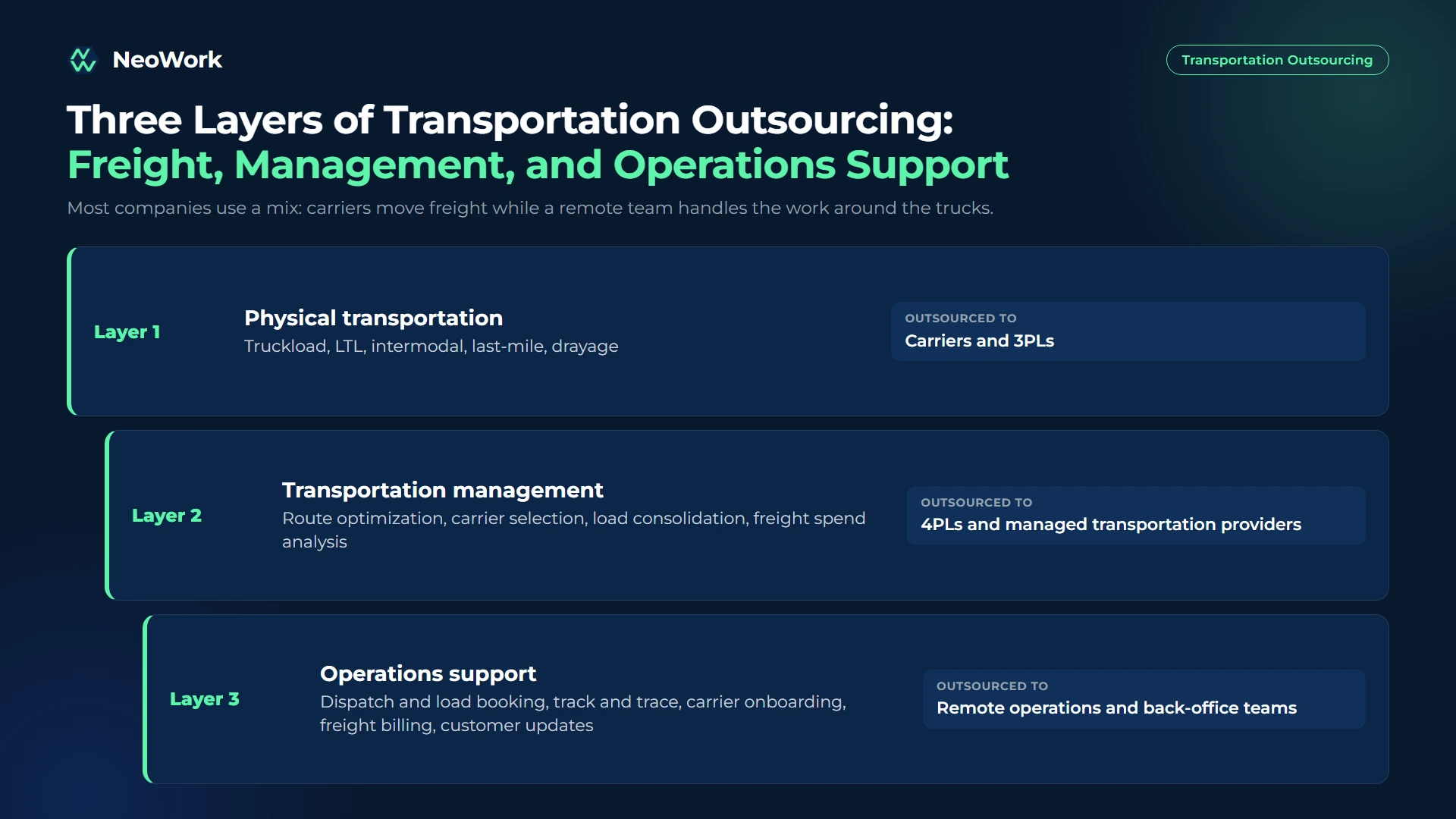
Transportation outsourcing is the practice of contracting external partners to perform transportation-related activities that a company would otherwise handle in-house. It works at three levels:
Most companies use a mix. A shipper might outsource freight movement to carriers and a 3PL, while a freight brokerage might keep sales and carrier relationships in-house and outsource track and trace, carrier onboarding, and billing to a dedicated support team.

At NeoWork, we build dedicated operations teams for logistics and transportation companies. Our teammates handle the daily work that keeps freight moving: load booking support, check calls and track and trace, carrier onboarding, document management, freight billing, and shipment updates for your customers. They work inside your TMS, load boards, and communication tools as part of your team.
We take care of recruiting, onboarding, benefits, and ongoing teammate support, so your dispatchers and brokers can focus on carriers, customers, and margin.
What we bring:
Contact us to tell us which parts of your transportation operation are stretched. We will map out the roles that can take that work over.
The most common reason is cost structure. Transportation volumes rise and fall with seasons, contracts, and the broader freight cycle, and a fixed in-house team sized for peak weeks sits underused in slow ones. Outsourced freight capacity and outsourced support teams both turn a large share of those fixed costs into variable ones that follow volume more closely.
The second reason is reach. A 3PL or broker brings a carrier network that an individual shipper could not build alone, and a remote operations team in another time zone can run check calls and handle exceptions overnight. For brokerages and carriers whose customers expect updates at any hour, that around-the-clock visibility is often worth more than the labor savings.
The third reason is focus. When back-office tasks are covered by a reliable team, brokers and account managers spend more of their day on revenue work: quoting, building relationships, and winning new lanes. Billing and audit specialists, meanwhile, tend to catch mismatched invoices, missed accessorials, and duplicate charges that busy generalists overlook, which improves both margin and cash flow.
For many brokerages and carriers, a dedicated team is the best fit because the work stays in their own TMS and under their own processes. For simpler admin and coordination tasks, virtual assistants can also cover scheduling, document collection, and data entry.
Compare total cost per load handled, including the cost of errors, missed updates, and staff overtime you avoid, not just the rate card. Our pricing page shows how we structure dedicated teams.
The most common mistake is outsourcing without documentation. When customer-specific rules live only in someone's head, the new team will miss them, and customers will feel the difference within days. Closely related is the loss of visibility that happens when freight is handed to a 3PL without clear tracking requirements, which leaves you unable to answer customers who ask where their shipment is.
Another frequent problem is choosing a partner on price alone. The cheapest option often means slow responses, high turnover, and errors in billing or tracking that cost more than the savings. Compliance also tends to be underestimated: carrier vetting, insurance checks, and document control must be built into the outsourced process from the start, not added after an incident.
Finally, many companies try to move everything at once. Transportation operations are interconnected, and changing several functions simultaneously makes it hard to see what is working. Starting with one function and expanding once quality is proven is slower on paper but almost always faster in reality.
Transportation outsourcing works best when you are clear about which layer you are outsourcing: the freight, the planning, or the operational work around it. Many companies get the biggest return from outsourcing the high-volume back-office and tracking tasks while keeping carrier and customer relationships in-house.
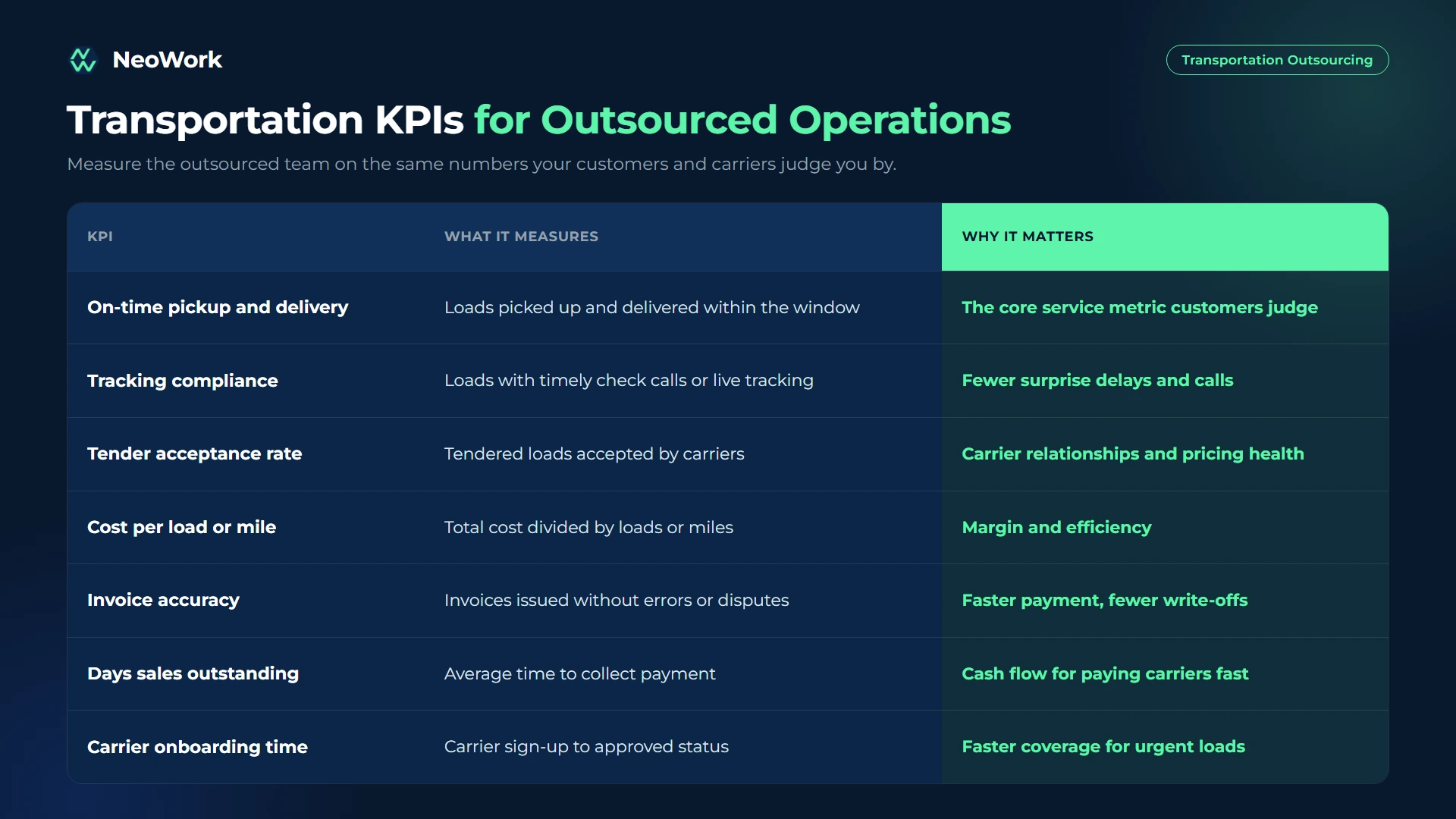
Start with a clear workflow map, document your rules, and measure on-time performance, tracking, and billing accuracy from day one. If you want a dedicated operations team that works inside your systems, see how we build teams at NeoWork.

Quick Summary: Transportation outsourcing is when a shipper, carrier, broker, or logistics company hands part of its transportation work to an outside partner. That can mean outsourcing the physical movement of freight to a third-party logistics provider (3PL), outsourcing transportation management to a 4PL or managed transportation provider, or outsourcing the operational back office (dispatch, load booking, track and trace, carrier onboarding, freight billing, and customer updates) to a remote operations team. Fortune Business Insights values the global third-party logistics market at about 1.36 trillion US dollars in 2026. This guide explains the three layers of transportation outsourcing, which tasks fit each one, what it costs, which KPIs to track, and how to transition without disrupting shipments.
Transportation runs on thin margins and constant exceptions. A truck is late, a carrier falls off a load at the last minute, a customer wants an updated ETA, an invoice does not match the rate confirmation. Each problem is small, but together they eat up the time of dispatchers, brokers, and operations managers who should be planning capacity and growing accounts.
That is why more transportation businesses outsource. Some outsource the trucks. Many more outsource the work around the trucks: the calls, emails, data entry, tracking, and paperwork that keep freight moving. This guide helps you decide what to outsource and how to do it without losing control of service quality.
Transportation outsourcing is the practice of contracting external partners to perform transportation-related activities that a company would otherwise handle in-house. It works at three levels:
Most companies use a mix. A shipper might outsource freight movement to carriers and a 3PL, while a freight brokerage might keep sales and carrier relationships in-house and outsource track and trace, carrier onboarding, and billing to a dedicated support team.
At NeoWork, we build dedicated operations teams for logistics and transportation companies. Our teammates handle the daily work that keeps freight moving: load booking support, check calls and track and trace, carrier onboarding, document management, freight billing, and shipment updates for your customers. They work inside your TMS, load boards, and communication tools as part of your team.
We take care of recruiting, onboarding, benefits, and ongoing teammate support, so your dispatchers and brokers can focus on carriers, customers, and margin.
What we bring:
Contact us to tell us which parts of your transportation operation are stretched. We will map out the roles that can take that work over.
The most common reason is cost structure. Transportation volumes rise and fall with seasons, contracts, and the broader freight cycle, and a fixed in-house team sized for peak weeks sits underused in slow ones. Outsourced freight capacity and outsourced support teams both turn a large share of those fixed costs into variable ones that follow volume more closely.
The second reason is reach. A 3PL or broker brings a carrier network that an individual shipper could not build alone, and a remote operations team in another time zone can run check calls and handle exceptions overnight. For brokerages and carriers whose customers expect updates at any hour, that around-the-clock visibility is often worth more than the labor savings.
The third reason is focus. When back-office tasks are covered by a reliable team, brokers and account managers spend more of their day on revenue work: quoting, building relationships, and winning new lanes. Billing and audit specialists, meanwhile, tend to catch mismatched invoices, missed accessorials, and duplicate charges that busy generalists overlook, which improves both margin and cash flow.
For many brokerages and carriers, a dedicated team is the best fit because the work stays in their own TMS and under their own processes. For simpler admin and coordination tasks, virtual assistants can also cover scheduling, document collection, and data entry.
Compare total cost per load handled, including the cost of errors, missed updates, and staff overtime you avoid, not just the rate card. Our pricing page shows how we structure dedicated teams.
The most common mistake is outsourcing without documentation. When customer-specific rules live only in someone's head, the new team will miss them, and customers will feel the difference within days. Closely related is the loss of visibility that happens when freight is handed to a 3PL without clear tracking requirements, which leaves you unable to answer customers who ask where their shipment is.
Another frequent problem is choosing a partner on price alone. The cheapest option often means slow responses, high turnover, and errors in billing or tracking that cost more than the savings. Compliance also tends to be underestimated: carrier vetting, insurance checks, and document control must be built into the outsourced process from the start, not added after an incident.
Finally, many companies try to move everything at once. Transportation operations are interconnected, and changing several functions simultaneously makes it hard to see what is working. Starting with one function and expanding once quality is proven is slower on paper but almost always faster in reality.
Transportation outsourcing works best when you are clear about which layer you are outsourcing: the freight, the planning, or the operational work around it. Many companies get the biggest return from outsourcing the high-volume back-office and tracking tasks while keeping carrier and customer relationships in-house.
Start with a clear workflow map, document your rules, and measure on-time performance, tracking, and billing accuracy from day one. If you want a dedicated operations team that works inside your systems, see how we build teams at NeoWork.





