

.avif)
.avif)

UI Design Outsourcing Guide: 2026 Complete Playbook


.svg)

UI design outsourcing connects businesses with external specialists to create digital interfaces without building in-house teams. This guide covers when to outsource, how to choose partners, typical pricing models, and the complete process from briefing to delivery—helping companies access specialized talent while controlling costs.
The interface speaks before your product does. Users make snap judgments about credibility, usability, and value within seconds of landing on your app or website. According to Capgemini research cited by UI/UX design outsourcing firms, 80% of users are willing to pay more for a better experience—making UI design quality a direct revenue driver.
But here's the thing: building and maintaining an in-house design team carries significant costs. According to SHRM, the average cost-per-hire is nearly $4,700, but for specialized roles like senior UI/UX designers, this figure can be 3-4 times higher, often exceeding $15,000–$20,000 per hire. For many businesses, particularly startups and mid-sized companies, that's capital better spent on product development or market expansion.
UI design outsourcing offers a different path. Instead of hiring full-time staff, companies tap specialized agencies or freelancers who deliver interface design as a service. The model provides access to diverse expertise, faster turnaround times, and cost structures that scale with project needs rather than headcount.
What UI Design Outsourcing Actually Includes
When businesses outsource UI design, they're not just buying mockups. The service typically encompasses a range of deliverables that transform rough concepts into polished, ready-to-develop interfaces.
Most UI design outsourcing packages include visual design systems—comprehensive libraries of colors, typography, spacing rules, and component styles that maintain consistency across the product. Designers create high-fidelity mockups showing exactly how each screen should look, from login flows to complex dashboards.
Interactive prototypes come standard in quality engagements. These clickable models let stakeholders test navigation patterns and user flows before a single line of code gets written. The prototypes catch usability issues early, when changes cost hours instead of sprints.
Responsive design work ensures interfaces adapt properly across devices. Mobile, tablet, and desktop layouts each need careful consideration—responsive design isn't just shrinking elements but reimagining layouts for different contexts.
Many outsourcing partners also handle icon design, illustration work, and micro-interactions. These details elevate interfaces from functional to memorable. The best partners think beyond static screens, considering loading states, error messages, empty states, and all the edge cases that separate amateur work from professional design.
The Outsourcing Process: How It Actually Works
Understanding the typical workflow helps set realistic expectations and ensures smoother collaboration with external design teams.
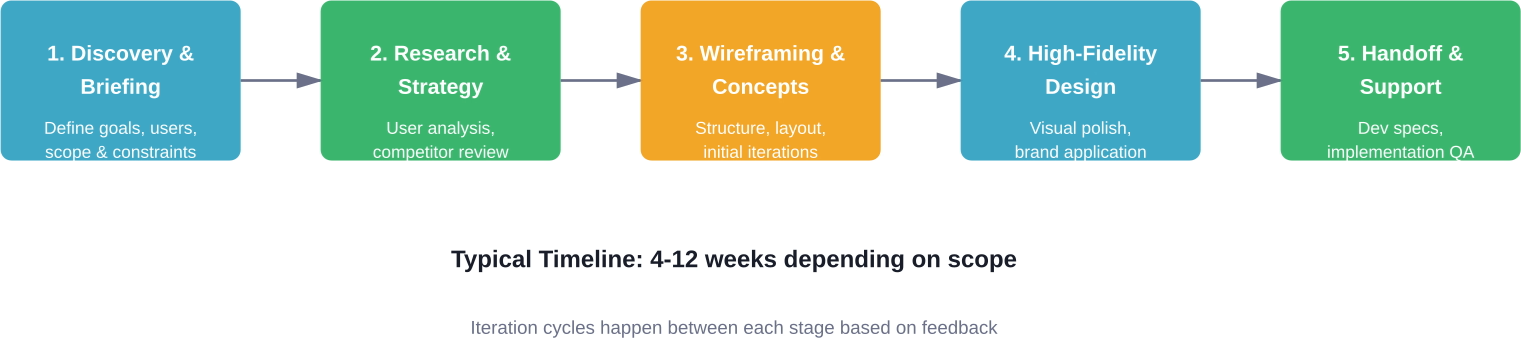
The discovery phase sets the foundation. Both parties align on project goals, target users, technical constraints, and success metrics. Good agencies ask probing questions about business objectives, not just aesthetic preferences. They want to understand what success looks like in measurable terms.
Research follows briefing. Designers analyze the competitive landscape, study user behavior patterns, and identify design opportunities. External partners bring valuable perspective here—they don't share the internal biases that can blind in-house teams to obvious problems.
Wireframing establishes structure before visual polish. Low-fidelity mockups focus on layout, hierarchy, and user flow logic. This stage moves fast because changes are cheap. Stakeholders review and iterate until the underlying structure feels solid.
High-fidelity design applies brand identity, color, typography, and detailed visual treatment. This is where interfaces go from functional blueprints to polished products. Designers create comprehensive screens showing various states and scenarios.
The handoff phase delivers assets and specifications to development teams. Quality partners provide detailed documentation, including spacing measurements, color codes, font specifications, and interaction notes. Many also offer implementation support, reviewing built interfaces against designs to ensure accuracy.
When Outsourcing Makes Strategic Sense
Not every situation calls for outsourced design. The model shines brightest under specific circumstances.
Startups launching minimum viable products benefit enormously from outsourcing. Speed matters more than building internal capabilities when racing to validate product-market fit. An external team can deliver launch-ready interfaces in weeks while the startup focuses on core technology and customer acquisition.
Companies scaling rapidly often can't hire in-house designers fast enough to match product roadmap demands. Outsourcing provides immediate capacity without months of recruiting, onboarding, and ramp-up time. The approach works particularly well for defined projects with clear scopes and timelines.
Businesses entering new markets or product categories gain fresh perspective from external specialists. A finance app expanding into healthcare benefits from designers who understand healthcare-specific patterns, compliance requirements, and user expectations. That specialized expertise would take years to develop internally.
Budget constraints make outsourcing attractive for smaller companies. Maintaining a three-person in-house UI design team in the US or Western Europe typically costs between $25,000 and $45,000 monthly in salaries alone. Outsourced design services cost approximately $5,385 monthly for comparable output, with zero recruitment overhead.
But wait. Outsourcing isn't always the answer. Companies building long-term product culture, where design deeply integrates with engineering and product management, eventually need in-house capabilities. Strategic design decisions—those that define product direction rather than execute defined requirements—benefit from embedded team members who breathe the company mission daily.
In-House vs Outsourced: The Real Tradeoffs
The choice between internal and external design resources involves more than just cost calculations. Each model carries distinct advantages and limitations.
In-house teams excel at ongoing product evolution. They understand user feedback loops, maintain design system consistency, and make incremental improvements without extensive briefing. The knowledge they accumulate about users, technical constraints, and business priorities compounds over time.
Outsourced partners bring objectivity and specialized skills. They've solved similar problems across multiple products and industries, bringing battle-tested patterns and fresh approaches. The cost flexibility helps companies scale design capacity up or down without hiring or layoff complications.
Many successful companies use hybrid approaches. Core product work stays in-house while specialized projects, redesigns, or capacity overflow go to external partners. This balances institutional knowledge with specialized expertise and cost flexibility.
Choosing the Right Design Partner
Selecting a UI design outsourcing partner determines project success more than any other factor. The wrong choice wastes time and money while potentially damaging product reputation.
Portfolio quality matters most. Review actual shipped work, not just Dribbble shots or concept designs. Look for projects similar in complexity and industry to yours. According to Smashing Magazine's guidance on evaluating UX/UI designers, strong case studies should include the problem context, research approach, design iterations, and measurable outcomes—not just visual appeal.
Process maturity reveals professionalism. Ask candidates to walk through their typical workflow. Quality partners articulate clear discovery, research, iteration, and delivery processes. They explain how they handle feedback, manage revisions, and ensure alignment. Vague answers or resistance to process questions signals trouble ahead.
Communication standards separate good partners from problematic ones. Evaluate responsiveness during the sales process—it won't improve after signing. Discuss meeting cadence, feedback mechanisms, and timezone overlap. Remote collaboration demands crystal-clear communication; mediocre communication always creates friction.
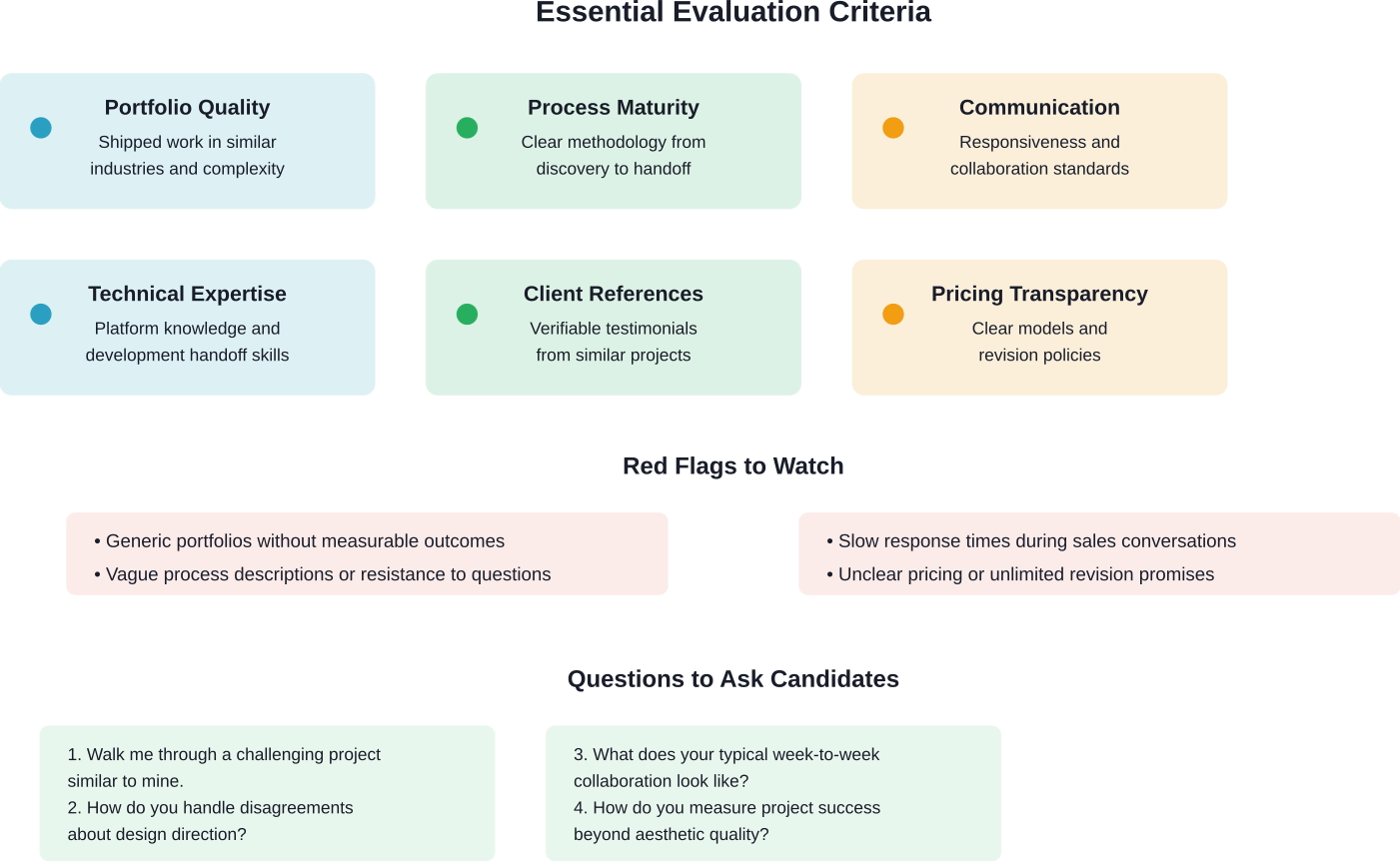
Technical expertise in relevant platforms matters. A partner designing mobile apps should understand iOS and Android design guidelines, platform-specific patterns, and technical constraints. Web product designers need solid grasp of responsive design principles and front-end development realities.
Client references provide validation beyond marketing claims. Request contacts from 2-3 recent clients with similar project types. Ask those references about communication quality, adherence to timelines, handling of feedback, and overall satisfaction. People share surprisingly honest assessments when approached directly.
Pricing transparency eliminates unpleasant surprises. Understand not just base costs but how revisions, scope changes, and additional deliverables are handled. Partners offering unlimited revisions often have catch-22 definitions of what constitutes a revision versus new work.

Scale UI Design Through Outsourcing
UI design outsourcing requires designers who understand usability, platform guidelines, and your game mechanics. NeoWork helps studios scale with dedicated remote UI designers who work inside your development process. Their 91% annualized teammate retention rate and 3.2% candidate selectivity rate support long-term collaboration rather than short-term staffing fixes. This reduces handoff friction and keeps your UI system consistent from prototype to release.
Ready to Strengthen Your UI Design Team Through Outsourcing?
Talk with NeoWork to:
- build a remote UI team aligned with your UX standards
- support iterative testing and updates
- maintain consistency across platforms and releases
👉 Contact NeoWork to plan your UI design outsourcing strategy.
Understanding Pricing Models
UI design outsourcing costs vary wildly based on partner experience, location, and engagement structure. Three primary pricing models dominate the market.
- Fixed-price projects suit well-defined scopes. Both parties agree upfront on deliverables, timeline, and total cost. This model provides budget certainty but requires detailed specifications before starting. Changes mid-project typically trigger additional charges. Fixed pricing works well for redesigns, landing pages, or other clearly bounded work.
- Hourly billing offers maximum flexibility. Clients pay for actual time spent, allowing scope to evolve as understanding deepens. Hourly rates range from $50-$200+ depending on designer experience and location. This model suits exploratory projects where requirements emerge through iteration, but costs can balloon without careful management.
- Monthly retainers provide ongoing design capacity. Companies pay a set monthly fee for a defined number of hours or deliverables. Retainers suit businesses with continuous design needs—maintaining products, launching features, running experiments. The predictable cost and dedicated capacity balance flexibility with budget control.
Geography significantly impacts pricing. Designers in North America and Western Europe typically charge $100-$200 per hour. Eastern European designers offer strong quality at $50-$100 hourly. Asian markets span $30-$80 per hour, though quality varies more widely at lower price points.
Real talk: cheapest rarely means best value. Rock-bottom pricing usually signals inexperience, communication challenges, or quality issues that cost more to fix than the initial savings. Mid-range pricing from established partners in cost-effective regions often delivers optimal value—professional quality without premium-market rates.
Common Challenges and How to Navigate Them
Even with careful partner selection, UI design outsourcing presents recurring challenges. Anticipating them enables better mitigation strategies.
- Communication gaps top the list. Misunderstood requirements, unclear feedback, and different interpretations of design direction cause friction and wasted iterations. Combat this by documenting requirements thoroughly, providing visual examples alongside written descriptions, and establishing regular check-in rhythms. Video calls beat email for nuanced discussions.
- Timezone differences complicate real-time collaboration. A 12-hour offset between teams means questions take a full day to answer, slowing momentum. Solutions include overlapping work hours for daily standups, asynchronous communication tools like Loom for detailed feedback, and clear decision-making authority to minimize approval bottlenecks.
- Quality inconsistency emerges when partners juggle multiple clients. Attention wavers and delivery quality fluctuates. Mitigate this by establishing clear quality benchmarks upfront, requesting regular progress updates rather than single final deliveries, and building review checkpoints into the timeline.
- Knowledge transfer challenges arise when external teams lack product context. They miss subtle requirements or design for generic users instead of actual target audiences. Counter this by providing comprehensive background documentation, user research data, and competitor analysis. Invest time in thorough briefings—it pays dividends in relevant output.
- Legal and ethical guidelines emphasize clear agreements about design ownership, usage rights, and confidentiality terms before work begins, as covered in freelance business best practices. Standard NDAs protect proprietary information while clear IP clauses ensure you own delivered work.
Making Outsourcing Work Long-Term
Successful UI design outsourcing relationships extend beyond single projects. The real value emerges when external partners become extensions of internal teams.
- Building relationship depth requires consistent communication and mutual understanding. Share business updates, strategic shifts, and user feedback regularly—not just project briefs. Partners who understand business context deliver more strategic design recommendations rather than merely executing specifications.
- Establishing design systems early prevents fragmentation across projects. A well-documented component library ensures consistency whether work happens internally or externally. It also accelerates future projects since designers work from established foundations rather than starting from scratch.
- Feedback quality determines iteration efficiency. Vague comments like "make it pop" or "this doesn't feel right" waste everyone's time. Effective feedback identifies specific issues ("the call-to-action gets lost against the busy background"), explains why it matters ("we need clear conversion paths"), and sometimes suggests directions ("can we try a solid color section to create separation?").
- Regular retrospectives improve collaboration. After completing projects, discuss what worked well and what caused friction. Both parties learn and refine processes. This continuous improvement mindset separates transactional vendor relationships from true partnerships.
According to the Interaction Design Foundation, companies with higher UX maturity gain competitive advantages through superior user experiences by understanding and implementing user-centered design principles across the organization. Strategic use of external design expertise can amplify these capabilities.
The Role of AI in Modern UI Design Outsourcing
Artificial intelligence tools are reshaping how design work happens, both internally and through outsourcing partnerships. But the changes aren't what many expect.
AI excels at accelerating routine tasks—generating layout variations, creating icon sets, or proposing color palettes. Quality design partners now incorporate AI tools to deliver faster first drafts and explore more options in the same timeframe. This means clients get more iteration cycles for the same budget.
However, research from Nielsen Norman Group's '7 Deadly AI Sins for UX Professionals' warns against over-reliance on AI tools. The framework highlights how blindly trusting AI output weakens design quality. Strategic design decisions—those requiring business context, user empathy, and creative problem-solving—still demand human judgment.
Smart outsourcing partners use AI as an accelerant, not a replacement. They employ tools to handle repetitive work while focusing human creativity on strategic challenges. When evaluating partners, ask how they incorporate AI tools and where they maintain human oversight. Partners who claim AI does most of the work probably deliver generic, context-blind designs.
Final Thoughts: Making Your Outsourcing Decision
UI design outsourcing offers clear advantages for companies needing design expertise without building large internal teams. The model provides cost flexibility, access to specialized skills, and faster project completion than traditional hiring.
Success requires more than finding a designer and sending a brief. It demands careful partner selection based on portfolio quality, process maturity, and communication standards. It needs clear requirements documentation, regular feedback loops, and relationship investment that extends beyond transactional project execution.
The companies getting the most value from design outsourcing treat external partners as extended team members rather than vendors. They share context generously, provide constructive feedback efficiently, and build lasting relationships that deepen over time. According to PwC research cited in UX maturity studies, 32% of customers will abandon a brand they love after just one bad experience—underscoring the critical role of positive user experience in maintaining customer loyalty.
Ready to improve your product's interface without the overhead of full-time hires? Start by documenting your requirements, researching partners with relevant portfolio work, and conducting thorough evaluations before committing. The right outsourcing relationship accelerates product development, elevates user experience, and delivers professional design quality at sustainable costs.
Frequently Asked Questions
Topics
UI Design Outsourcing Guide: 2026 Complete Playbook

UI design outsourcing connects businesses with external specialists to create digital interfaces without building in-house teams. This guide covers when to outsource, how to choose partners, typical pricing models, and the complete process from briefing to delivery—helping companies access specialized talent while controlling costs.
The interface speaks before your product does. Users make snap judgments about credibility, usability, and value within seconds of landing on your app or website. According to Capgemini research cited by UI/UX design outsourcing firms, 80% of users are willing to pay more for a better experience—making UI design quality a direct revenue driver.
But here's the thing: building and maintaining an in-house design team carries significant costs. According to SHRM, the average cost-per-hire is nearly $4,700, but for specialized roles like senior UI/UX designers, this figure can be 3-4 times higher, often exceeding $15,000–$20,000 per hire. For many businesses, particularly startups and mid-sized companies, that's capital better spent on product development or market expansion.
UI design outsourcing offers a different path. Instead of hiring full-time staff, companies tap specialized agencies or freelancers who deliver interface design as a service. The model provides access to diverse expertise, faster turnaround times, and cost structures that scale with project needs rather than headcount.
What UI Design Outsourcing Actually Includes
When businesses outsource UI design, they're not just buying mockups. The service typically encompasses a range of deliverables that transform rough concepts into polished, ready-to-develop interfaces.
Most UI design outsourcing packages include visual design systems—comprehensive libraries of colors, typography, spacing rules, and component styles that maintain consistency across the product. Designers create high-fidelity mockups showing exactly how each screen should look, from login flows to complex dashboards.
Interactive prototypes come standard in quality engagements. These clickable models let stakeholders test navigation patterns and user flows before a single line of code gets written. The prototypes catch usability issues early, when changes cost hours instead of sprints.
Responsive design work ensures interfaces adapt properly across devices. Mobile, tablet, and desktop layouts each need careful consideration—responsive design isn't just shrinking elements but reimagining layouts for different contexts.
Many outsourcing partners also handle icon design, illustration work, and micro-interactions. These details elevate interfaces from functional to memorable. The best partners think beyond static screens, considering loading states, error messages, empty states, and all the edge cases that separate amateur work from professional design.
The Outsourcing Process: How It Actually Works
Understanding the typical workflow helps set realistic expectations and ensures smoother collaboration with external design teams.
The discovery phase sets the foundation. Both parties align on project goals, target users, technical constraints, and success metrics. Good agencies ask probing questions about business objectives, not just aesthetic preferences. They want to understand what success looks like in measurable terms.
Research follows briefing. Designers analyze the competitive landscape, study user behavior patterns, and identify design opportunities. External partners bring valuable perspective here—they don't share the internal biases that can blind in-house teams to obvious problems.
Wireframing establishes structure before visual polish. Low-fidelity mockups focus on layout, hierarchy, and user flow logic. This stage moves fast because changes are cheap. Stakeholders review and iterate until the underlying structure feels solid.
High-fidelity design applies brand identity, color, typography, and detailed visual treatment. This is where interfaces go from functional blueprints to polished products. Designers create comprehensive screens showing various states and scenarios.
The handoff phase delivers assets and specifications to development teams. Quality partners provide detailed documentation, including spacing measurements, color codes, font specifications, and interaction notes. Many also offer implementation support, reviewing built interfaces against designs to ensure accuracy.
When Outsourcing Makes Strategic Sense
Not every situation calls for outsourced design. The model shines brightest under specific circumstances.
Startups launching minimum viable products benefit enormously from outsourcing. Speed matters more than building internal capabilities when racing to validate product-market fit. An external team can deliver launch-ready interfaces in weeks while the startup focuses on core technology and customer acquisition.
Companies scaling rapidly often can't hire in-house designers fast enough to match product roadmap demands. Outsourcing provides immediate capacity without months of recruiting, onboarding, and ramp-up time. The approach works particularly well for defined projects with clear scopes and timelines.
Businesses entering new markets or product categories gain fresh perspective from external specialists. A finance app expanding into healthcare benefits from designers who understand healthcare-specific patterns, compliance requirements, and user expectations. That specialized expertise would take years to develop internally.
Budget constraints make outsourcing attractive for smaller companies. Maintaining a three-person in-house UI design team in the US or Western Europe typically costs between $25,000 and $45,000 monthly in salaries alone. Outsourced design services cost approximately $5,385 monthly for comparable output, with zero recruitment overhead.
But wait. Outsourcing isn't always the answer. Companies building long-term product culture, where design deeply integrates with engineering and product management, eventually need in-house capabilities. Strategic design decisions—those that define product direction rather than execute defined requirements—benefit from embedded team members who breathe the company mission daily.
In-House vs Outsourced: The Real Tradeoffs
The choice between internal and external design resources involves more than just cost calculations. Each model carries distinct advantages and limitations.
In-house teams excel at ongoing product evolution. They understand user feedback loops, maintain design system consistency, and make incremental improvements without extensive briefing. The knowledge they accumulate about users, technical constraints, and business priorities compounds over time.
Outsourced partners bring objectivity and specialized skills. They've solved similar problems across multiple products and industries, bringing battle-tested patterns and fresh approaches. The cost flexibility helps companies scale design capacity up or down without hiring or layoff complications.
Many successful companies use hybrid approaches. Core product work stays in-house while specialized projects, redesigns, or capacity overflow go to external partners. This balances institutional knowledge with specialized expertise and cost flexibility.
Choosing the Right Design Partner
Selecting a UI design outsourcing partner determines project success more than any other factor. The wrong choice wastes time and money while potentially damaging product reputation.
Portfolio quality matters most. Review actual shipped work, not just Dribbble shots or concept designs. Look for projects similar in complexity and industry to yours. According to Smashing Magazine's guidance on evaluating UX/UI designers, strong case studies should include the problem context, research approach, design iterations, and measurable outcomes—not just visual appeal.
Process maturity reveals professionalism. Ask candidates to walk through their typical workflow. Quality partners articulate clear discovery, research, iteration, and delivery processes. They explain how they handle feedback, manage revisions, and ensure alignment. Vague answers or resistance to process questions signals trouble ahead.
Communication standards separate good partners from problematic ones. Evaluate responsiveness during the sales process—it won't improve after signing. Discuss meeting cadence, feedback mechanisms, and timezone overlap. Remote collaboration demands crystal-clear communication; mediocre communication always creates friction.
Technical expertise in relevant platforms matters. A partner designing mobile apps should understand iOS and Android design guidelines, platform-specific patterns, and technical constraints. Web product designers need solid grasp of responsive design principles and front-end development realities.
Client references provide validation beyond marketing claims. Request contacts from 2-3 recent clients with similar project types. Ask those references about communication quality, adherence to timelines, handling of feedback, and overall satisfaction. People share surprisingly honest assessments when approached directly.
Pricing transparency eliminates unpleasant surprises. Understand not just base costs but how revisions, scope changes, and additional deliverables are handled. Partners offering unlimited revisions often have catch-22 definitions of what constitutes a revision versus new work.
Scale UI Design Through Outsourcing
UI design outsourcing requires designers who understand usability, platform guidelines, and your game mechanics. NeoWork helps studios scale with dedicated remote UI designers who work inside your development process. Their 91% annualized teammate retention rate and 3.2% candidate selectivity rate support long-term collaboration rather than short-term staffing fixes. This reduces handoff friction and keeps your UI system consistent from prototype to release.
Ready to Strengthen Your UI Design Team Through Outsourcing?
Talk with NeoWork to:
- build a remote UI team aligned with your UX standards
- support iterative testing and updates
- maintain consistency across platforms and releases
👉 Contact NeoWork to plan your UI design outsourcing strategy.
Understanding Pricing Models
UI design outsourcing costs vary wildly based on partner experience, location, and engagement structure. Three primary pricing models dominate the market.
- Fixed-price projects suit well-defined scopes. Both parties agree upfront on deliverables, timeline, and total cost. This model provides budget certainty but requires detailed specifications before starting. Changes mid-project typically trigger additional charges. Fixed pricing works well for redesigns, landing pages, or other clearly bounded work.
- Hourly billing offers maximum flexibility. Clients pay for actual time spent, allowing scope to evolve as understanding deepens. Hourly rates range from $50-$200+ depending on designer experience and location. This model suits exploratory projects where requirements emerge through iteration, but costs can balloon without careful management.
- Monthly retainers provide ongoing design capacity. Companies pay a set monthly fee for a defined number of hours or deliverables. Retainers suit businesses with continuous design needs—maintaining products, launching features, running experiments. The predictable cost and dedicated capacity balance flexibility with budget control.
Geography significantly impacts pricing. Designers in North America and Western Europe typically charge $100-$200 per hour. Eastern European designers offer strong quality at $50-$100 hourly. Asian markets span $30-$80 per hour, though quality varies more widely at lower price points.
Real talk: cheapest rarely means best value. Rock-bottom pricing usually signals inexperience, communication challenges, or quality issues that cost more to fix than the initial savings. Mid-range pricing from established partners in cost-effective regions often delivers optimal value—professional quality without premium-market rates.
Common Challenges and How to Navigate Them
Even with careful partner selection, UI design outsourcing presents recurring challenges. Anticipating them enables better mitigation strategies.
- Communication gaps top the list. Misunderstood requirements, unclear feedback, and different interpretations of design direction cause friction and wasted iterations. Combat this by documenting requirements thoroughly, providing visual examples alongside written descriptions, and establishing regular check-in rhythms. Video calls beat email for nuanced discussions.
- Timezone differences complicate real-time collaboration. A 12-hour offset between teams means questions take a full day to answer, slowing momentum. Solutions include overlapping work hours for daily standups, asynchronous communication tools like Loom for detailed feedback, and clear decision-making authority to minimize approval bottlenecks.
- Quality inconsistency emerges when partners juggle multiple clients. Attention wavers and delivery quality fluctuates. Mitigate this by establishing clear quality benchmarks upfront, requesting regular progress updates rather than single final deliveries, and building review checkpoints into the timeline.
- Knowledge transfer challenges arise when external teams lack product context. They miss subtle requirements or design for generic users instead of actual target audiences. Counter this by providing comprehensive background documentation, user research data, and competitor analysis. Invest time in thorough briefings—it pays dividends in relevant output.
- Legal and ethical guidelines emphasize clear agreements about design ownership, usage rights, and confidentiality terms before work begins, as covered in freelance business best practices. Standard NDAs protect proprietary information while clear IP clauses ensure you own delivered work.
Making Outsourcing Work Long-Term
Successful UI design outsourcing relationships extend beyond single projects. The real value emerges when external partners become extensions of internal teams.
- Building relationship depth requires consistent communication and mutual understanding. Share business updates, strategic shifts, and user feedback regularly—not just project briefs. Partners who understand business context deliver more strategic design recommendations rather than merely executing specifications.
- Establishing design systems early prevents fragmentation across projects. A well-documented component library ensures consistency whether work happens internally or externally. It also accelerates future projects since designers work from established foundations rather than starting from scratch.
- Feedback quality determines iteration efficiency. Vague comments like "make it pop" or "this doesn't feel right" waste everyone's time. Effective feedback identifies specific issues ("the call-to-action gets lost against the busy background"), explains why it matters ("we need clear conversion paths"), and sometimes suggests directions ("can we try a solid color section to create separation?").
- Regular retrospectives improve collaboration. After completing projects, discuss what worked well and what caused friction. Both parties learn and refine processes. This continuous improvement mindset separates transactional vendor relationships from true partnerships.
According to the Interaction Design Foundation, companies with higher UX maturity gain competitive advantages through superior user experiences by understanding and implementing user-centered design principles across the organization. Strategic use of external design expertise can amplify these capabilities.
The Role of AI in Modern UI Design Outsourcing
Artificial intelligence tools are reshaping how design work happens, both internally and through outsourcing partnerships. But the changes aren't what many expect.
AI excels at accelerating routine tasks—generating layout variations, creating icon sets, or proposing color palettes. Quality design partners now incorporate AI tools to deliver faster first drafts and explore more options in the same timeframe. This means clients get more iteration cycles for the same budget.
However, research from Nielsen Norman Group's '7 Deadly AI Sins for UX Professionals' warns against over-reliance on AI tools. The framework highlights how blindly trusting AI output weakens design quality. Strategic design decisions—those requiring business context, user empathy, and creative problem-solving—still demand human judgment.
Smart outsourcing partners use AI as an accelerant, not a replacement. They employ tools to handle repetitive work while focusing human creativity on strategic challenges. When evaluating partners, ask how they incorporate AI tools and where they maintain human oversight. Partners who claim AI does most of the work probably deliver generic, context-blind designs.
Final Thoughts: Making Your Outsourcing Decision
UI design outsourcing offers clear advantages for companies needing design expertise without building large internal teams. The model provides cost flexibility, access to specialized skills, and faster project completion than traditional hiring.
Success requires more than finding a designer and sending a brief. It demands careful partner selection based on portfolio quality, process maturity, and communication standards. It needs clear requirements documentation, regular feedback loops, and relationship investment that extends beyond transactional project execution.
The companies getting the most value from design outsourcing treat external partners as extended team members rather than vendors. They share context generously, provide constructive feedback efficiently, and build lasting relationships that deepen over time. According to PwC research cited in UX maturity studies, 32% of customers will abandon a brand they love after just one bad experience—underscoring the critical role of positive user experience in maintaining customer loyalty.
Ready to improve your product's interface without the overhead of full-time hires? Start by documenting your requirements, researching partners with relevant portfolio work, and conducting thorough evaluations before committing. The right outsourcing relationship accelerates product development, elevates user experience, and delivers professional design quality at sustainable costs.
Frequently Asked Questions
Topics
Related Blogs
Related Podcasts


.webp)

.webp)
.webp)



