
.avif)
.avif)

Recruitment Outsourcing Guide 2026: How RPO Works


.svg)

Quick Summary: Recruitment outsourcing, or RPO, is when a company hands part or all of its hiring process to an external provider who sources, screens, and sometimes onboards candidates under the company's own brand. It differs from a staffing agency because it's a long-term, embedded partnership rather than a per-hire transaction, and it typically delivers lower cost-per-hire, faster time-to-fill, and more consistent hiring quality at scale. It makes the most sense for companies with high-volume, recurring, or unpredictable hiring needs rather than one-off vacancies.
Hiring has quietly become one of the hardest operational problems a growing company faces. Job boards are noisy, candidates ghost interviews, and internal recruiters burn out trying to fill forty roles while also fielding resumes for the one executive search that actually needs white-glove attention.
That's roughly why recruitment process outsourcing exists. It's not a new idea — RPO has been around for decades — but it's having a moment again as companies try to do more hiring with leaner internal teams. This guide breaks down what RPO actually is, how it works day to day, what it costs, and how to tell if it's the right move before signing a contract.
What Is Recruitment Outsourcing (RPO)?
Recruitment process outsourcing is an arrangement where a business transfers all or part of its hiring function to an external provider, who then acts as an extension of that company's internal team. The provider typically owns sourcing, screening, interview coordination, and offer management, usually operating under the client's employer brand rather than its own.
That last part matters. Candidates going through an RPO-run hiring process generally don't realize a third party is involved at all — the careers page, the emails, the interview invites all look like they're coming straight from the hiring company.
How RPO Differs From a Recruitment Agency
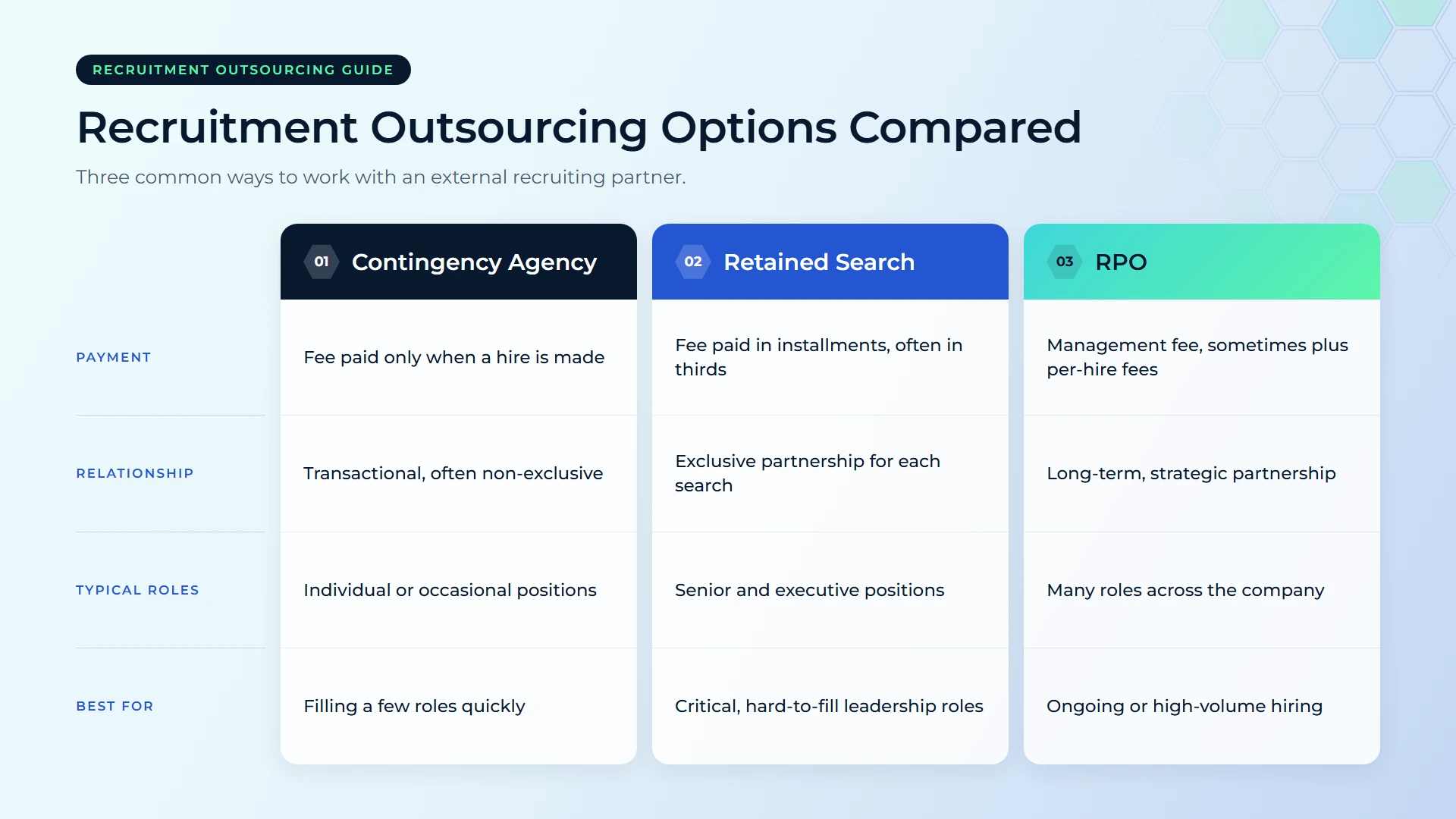
This is the single most common point of confusion, and it shows up in nearly every search result on the topic. An agency fills individual roles for a fee, usually a percentage of first-year salary, and the relationship resets with every new req. RPO is structural: the provider embeds into the hiring process itself, often for months or years, and is measured on outcomes like time-to-fill, quality of hire, and cost-per-hire across the whole pipeline rather than one placement at a time.
Here are the main features to keep in mind:
- Agencies are transactional; RPO is a long-term operating partnership.
- Agencies compete against each other for the same req; an RPO provider usually has exclusivity over the roles it manages.
- Agencies are paid per placement; RPO is usually billed as a retainer, per-hire fee, or management fee tied to volume.
How Recruitment Process Outsourcing Works
In practice, an RPO engagement moves through a fairly predictable sequence, even though the scope of what's outsourced can vary a lot between providers.
Some providers stop at the shortlist stage and hand interviewing back to internal teams. Others run the entire funnel through to the signed offer letter and first day. The scope is negotiated up front and usually written into a service-level agreement with specific metrics attached — time-to-fill targets, diversity benchmarks, candidate satisfaction scores, and so on.

Outsource Recruitment Without Losing Control of Your Team
At NeoWork, we take on the recruiting work needed to build reliable offshore teams. We source and screen candidates based on the role, required skills, and the way your company operates. Once a hire is made, we continue supporting the teammate rather than ending our involvement at placement.
With us, you can:
- Hire pre-screened talent without adding more work to your internal recruiting team
- Build individual roles or dedicated teams around your operational needs
- Keep onboarding, benefits, and ongoing teammate support in one place
- Support long-term team stability with a 91% annualized teammate retention rate
Contact us to discuss the roles you need to fill and the kind of team you want to build.
Types of RPO Models
Not every company needs the same flavor of outsourcing. Providers generally offer a handful of models, and picking the wrong one is probably the most common reason RPO engagements disappoint.
Hybrid is increasingly the default choice for mid-size companies — internal recruiters keep ownership of leadership and highly specialized hires, while the RPO partner absorbs the repetitive, high-volume requisitions that eat the most time.
Benefits of Recruitment Outsourcing
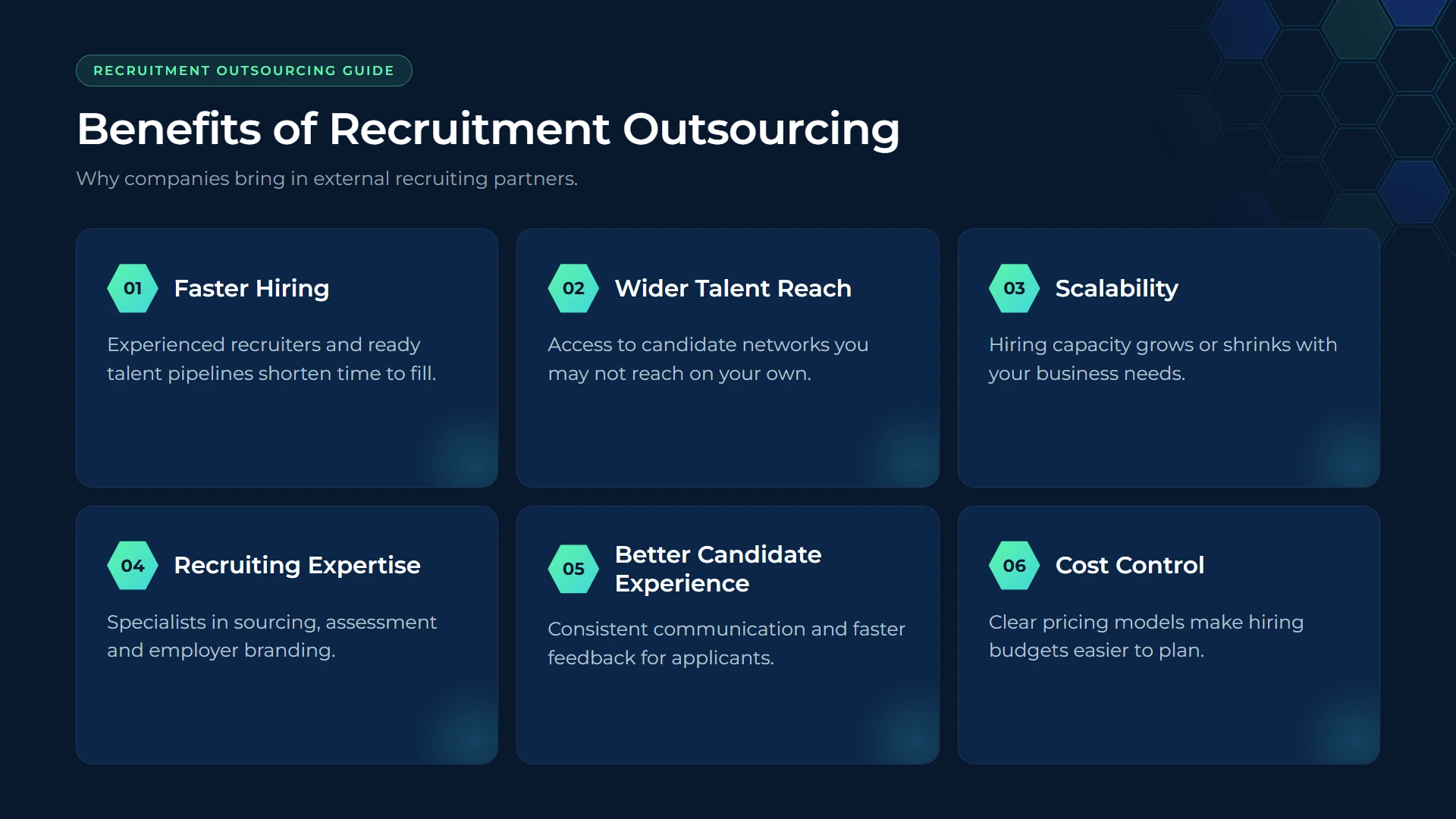
The appeal isn't just cost. Most companies that adopt RPO cite a mix of reasons, and the weighting tends to shift depending on company size and growth stage:
- Speed: Dedicated sourcing teams with mature pipelines tend to fill roles faster than internal recruiters juggling dozens of other responsibilities.
- Cost control: Trading variable agency fees for a predictable RPO structure often lowers overall cost-per-hire, especially at volume.
- Scalability: Hiring fifty people in a quarter and then five the next is hard to staff internally; RPO providers flex capacity up and down.
- Specialized expertise: Many providers bring sourcing technology, market data, and screening frameworks that smaller internal teams simply don't have budget for.
- Consistency: A standardized process across regions or departments reduces the wild variance that often shows up when every hiring manager runs interviews their own way.
Costs of RPO: What to Expect
Pricing varies by provider, region, and scope, so anyone shopping for a partner should request a detailed proposal rather than relying on industry averages. That said, most contracts fall into one of a few common structures.
As a rule of thumb, RPO tends to come in below traditional agency fees once volume climbs past a certain threshold, since agencies typically charge 15–25% of first-year salary per placement. For exact current pricing benchmarks, it's worth checking proposals directly from a shortlist of providers, since published averages shift year to year.
When RPO Makes Sense (and When It Doesn't)
RPO isn't a universal fix. It tends to work best where hiring volume or unpredictability is the core problem, and it tends to underdeliver where the issue is actually about culture fit, brand, or leadership-level hiring.
Good candidates for RPO usually include fast-growing companies opening new offices, retailers or logistics firms with seasonal surges, and organizations consolidating hiring across multiple regions. Poor candidates include companies hiring only a handful of highly specialized executives a year, or ones that haven't yet defined their employer brand well enough for a third party to represent it convincingly.
How to Choose an RPO Provider
Once the decision to outsource is made, the provider selection process deserves real scrutiny — a mismatched partner can do more damage than no outsourcing at all:
- Check the technology stack: Does the provider's applicant tracking system integrate cleanly with existing HR tools?
- Clarify reporting cadence: Weekly dashboards versus monthly summaries make a real difference when something's going wrong.
- Negotiate exit terms early: Transition plans for bringing hiring back in-house should be defined before the contract is signed, not after.
- Pilot before committing fully: A short project-based engagement is a low-risk way to test fit before an end-to-end contract.
Final Thoughts
Recruitment outsourcing isn't about replacing a hiring team — it's about giving that team room to focus on the roles that need the most judgment, while a specialized partner handles the volume work that's easiest to standardize. The companies that get the most out of RPO are the ones that treat the provider as an extension of their own team, not a vendor to be managed at arm's length.
Anyone weighing the decision should start small: pilot a project-based engagement on one department or one hiring surge, measure the results against current benchmarks, and expand from there. That's a far lower-risk path than signing a multi-year, end-to-end contract on a provider's first pitch.
Topics
Recruitment Outsourcing Guide 2026: How RPO Works

Quick Summary: Recruitment outsourcing, or RPO, is when a company hands part or all of its hiring process to an external provider who sources, screens, and sometimes onboards candidates under the company's own brand. It differs from a staffing agency because it's a long-term, embedded partnership rather than a per-hire transaction, and it typically delivers lower cost-per-hire, faster time-to-fill, and more consistent hiring quality at scale. It makes the most sense for companies with high-volume, recurring, or unpredictable hiring needs rather than one-off vacancies.
Hiring has quietly become one of the hardest operational problems a growing company faces. Job boards are noisy, candidates ghost interviews, and internal recruiters burn out trying to fill forty roles while also fielding resumes for the one executive search that actually needs white-glove attention.
That's roughly why recruitment process outsourcing exists. It's not a new idea — RPO has been around for decades — but it's having a moment again as companies try to do more hiring with leaner internal teams. This guide breaks down what RPO actually is, how it works day to day, what it costs, and how to tell if it's the right move before signing a contract.
What Is Recruitment Outsourcing (RPO)?
Recruitment process outsourcing is an arrangement where a business transfers all or part of its hiring function to an external provider, who then acts as an extension of that company's internal team. The provider typically owns sourcing, screening, interview coordination, and offer management, usually operating under the client's employer brand rather than its own.
That last part matters. Candidates going through an RPO-run hiring process generally don't realize a third party is involved at all — the careers page, the emails, the interview invites all look like they're coming straight from the hiring company.
How RPO Differs From a Recruitment Agency
This is the single most common point of confusion, and it shows up in nearly every search result on the topic. An agency fills individual roles for a fee, usually a percentage of first-year salary, and the relationship resets with every new req. RPO is structural: the provider embeds into the hiring process itself, often for months or years, and is measured on outcomes like time-to-fill, quality of hire, and cost-per-hire across the whole pipeline rather than one placement at a time.
Here are the main features to keep in mind:
- Agencies are transactional; RPO is a long-term operating partnership.
- Agencies compete against each other for the same req; an RPO provider usually has exclusivity over the roles it manages.
- Agencies are paid per placement; RPO is usually billed as a retainer, per-hire fee, or management fee tied to volume.
How Recruitment Process Outsourcing Works
In practice, an RPO engagement moves through a fairly predictable sequence, even though the scope of what's outsourced can vary a lot between providers.
Some providers stop at the shortlist stage and hand interviewing back to internal teams. Others run the entire funnel through to the signed offer letter and first day. The scope is negotiated up front and usually written into a service-level agreement with specific metrics attached — time-to-fill targets, diversity benchmarks, candidate satisfaction scores, and so on.
Outsource Recruitment Without Losing Control of Your Team
At NeoWork, we take on the recruiting work needed to build reliable offshore teams. We source and screen candidates based on the role, required skills, and the way your company operates. Once a hire is made, we continue supporting the teammate rather than ending our involvement at placement.
With us, you can:
- Hire pre-screened talent without adding more work to your internal recruiting team
- Build individual roles or dedicated teams around your operational needs
- Keep onboarding, benefits, and ongoing teammate support in one place
- Support long-term team stability with a 91% annualized teammate retention rate
Contact us to discuss the roles you need to fill and the kind of team you want to build.
Types of RPO Models
Not every company needs the same flavor of outsourcing. Providers generally offer a handful of models, and picking the wrong one is probably the most common reason RPO engagements disappoint.
Hybrid is increasingly the default choice for mid-size companies — internal recruiters keep ownership of leadership and highly specialized hires, while the RPO partner absorbs the repetitive, high-volume requisitions that eat the most time.
Benefits of Recruitment Outsourcing
The appeal isn't just cost. Most companies that adopt RPO cite a mix of reasons, and the weighting tends to shift depending on company size and growth stage:
- Speed: Dedicated sourcing teams with mature pipelines tend to fill roles faster than internal recruiters juggling dozens of other responsibilities.
- Cost control: Trading variable agency fees for a predictable RPO structure often lowers overall cost-per-hire, especially at volume.
- Scalability: Hiring fifty people in a quarter and then five the next is hard to staff internally; RPO providers flex capacity up and down.
- Specialized expertise: Many providers bring sourcing technology, market data, and screening frameworks that smaller internal teams simply don't have budget for.
- Consistency: A standardized process across regions or departments reduces the wild variance that often shows up when every hiring manager runs interviews their own way.
Costs of RPO: What to Expect
Pricing varies by provider, region, and scope, so anyone shopping for a partner should request a detailed proposal rather than relying on industry averages. That said, most contracts fall into one of a few common structures.
As a rule of thumb, RPO tends to come in below traditional agency fees once volume climbs past a certain threshold, since agencies typically charge 15–25% of first-year salary per placement. For exact current pricing benchmarks, it's worth checking proposals directly from a shortlist of providers, since published averages shift year to year.
When RPO Makes Sense (and When It Doesn't)
RPO isn't a universal fix. It tends to work best where hiring volume or unpredictability is the core problem, and it tends to underdeliver where the issue is actually about culture fit, brand, or leadership-level hiring.
Good candidates for RPO usually include fast-growing companies opening new offices, retailers or logistics firms with seasonal surges, and organizations consolidating hiring across multiple regions. Poor candidates include companies hiring only a handful of highly specialized executives a year, or ones that haven't yet defined their employer brand well enough for a third party to represent it convincingly.
How to Choose an RPO Provider
Once the decision to outsource is made, the provider selection process deserves real scrutiny — a mismatched partner can do more damage than no outsourcing at all:
- Check the technology stack: Does the provider's applicant tracking system integrate cleanly with existing HR tools?
- Clarify reporting cadence: Weekly dashboards versus monthly summaries make a real difference when something's going wrong.
- Negotiate exit terms early: Transition plans for bringing hiring back in-house should be defined before the contract is signed, not after.
- Pilot before committing fully: A short project-based engagement is a low-risk way to test fit before an end-to-end contract.
Final Thoughts
Recruitment outsourcing isn't about replacing a hiring team — it's about giving that team room to focus on the roles that need the most judgment, while a specialized partner handles the volume work that's easiest to standardize. The companies that get the most out of RPO are the ones that treat the provider as an extension of their own team, not a vendor to be managed at arm's length.
Anyone weighing the decision should start small: pilot a project-based engagement on one department or one hiring surge, measure the results against current benchmarks, and expand from there. That's a far lower-risk path than signing a multi-year, end-to-end contract on a provider's first pitch.
Topics
Related Blogs
Related Podcasts